The Flag of Czechia
Czech Republic
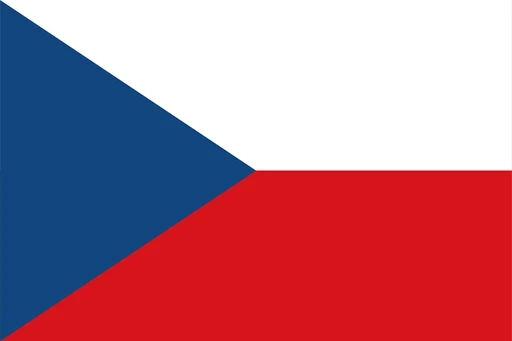
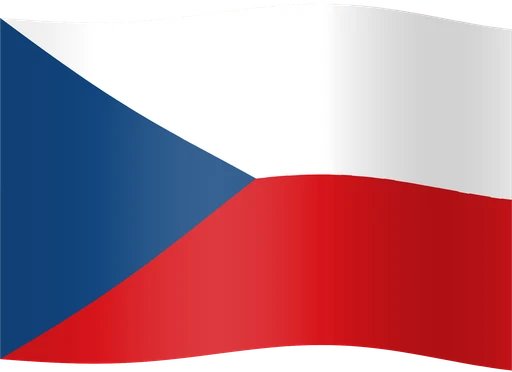
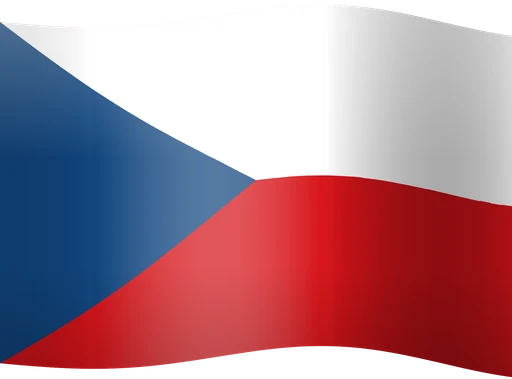
The flag of Czechia, also known as the Czech Republic, has two equal horizontal bands of white (top) and red, with a blue triangle extending from the hoist side. The triangle is what distinguishes it from the white and red bicolor used by Poland.
Czechia's flag is a study in geopolitical stubbornness. When Czechoslovakia dissolved peacefully on January 1, 1993, the two successor states had agreed that neither would keep the shared federal flag. Slovakia honored this promise and adopted a new design. Czechia did not. The Czech Republic kept the blue chevron that had been added in 1920 specifically to represent Slovakia, which makes it one of the rare cases where a country's flag commemorates a nation that walked out. The white, red, and blue looks plain enough at a glance. The wedge in it is a leftover from a state that no longer exists.
A flag built for two: the Czechoslovak origins
Before there was a Czechoslovakia, there was Bohemia, and Bohemia's flag was about as straightforward as flags get: white over red, a horizontal bicolor pulled directly from the medieval coat of arms of the Kingdom of Bohemia, which featured a silver (white) lion rampant on a red field. When the independent Czechoslovak state was proclaimed on October 28, 1918, this ancient bicolor was the obvious choice for the new nation's flag.
There was just one problem. Poland's flag was also white over red. The confusion was immediate and, for diplomats, genuinely annoying.
Enter Jaroslav Kursa, an archivist at the Ministry of the Interior, who in 1920 proposed an elegant fix: a blue chevron, or wedge-shaped triangle, extending from the hoist side into the body of the flag. The blue carried double duty. It represented Slovakia, the other half of the new state, and it nodded to broader Slavic identity, whose traditional palette is red, white, and blue. The triangle also killed the Poland resemblance dead.
On March 30, 1920, Constitutional Act No. 252/1920 made the design official. It flew over the First Republic, was banned under the Nazi occupation, came through the Communist era, and was waved by the crowds of the Velvet Revolution in 1989.
The divorce promise nobody kept
As Czechoslovakia prepared for its "Velvet Divorce," the two republics passed Act No. 542/1992, which explicitly stated that neither successor state could use the symbols of the former federation. The intention was clear: a clean break, two fresh starts.
Slovakia held up its end. Its new flag featured the traditional double cross atop three blue hills on a white-blue-red tricolor, a design rooted in distinctly Slovak heraldry. Czechia, however, had a harder conversation. Czech politicians and vexillologists debated alternatives. Some proposed returning to the old Bohemian white-and-red bicolor. Others floated entirely new concepts. None gained traction.
In the end, the Czech National Council simply kept the Czechoslovak flag, unchanged, and passed Act No. 3/1993 codifying it as the flag of the new Czech Republic. The justification was twofold. First, the practical argument: the flag was already internationally recognized, and changing it would create confusion. Second, and more creatively, Czech leaders argued that the blue triangle had evolved in meaning. It no longer represented Slovakia, they said. It now stood for Moravia and Czech Silesia, the other two historical lands of the Czech Crown alongside Bohemia.
Slovak officials protested. Many vexillologists raised eyebrows. The reinterpretation was, to put it gently, convenient. Kursa's original 1920 proposal left no ambiguity about the blue representing Slovakia. But international law had no enforcement mechanism for the dissolution agreement's flag clause, and the matter quietly faded from diplomatic discussion. The flag stayed.
The chevron, and the shifting story of the blue
Two horizontal bands sit stacked: white on top, red on the bottom. From the hoist, a blue isosceles triangle drives into the flag's body, its apex landing precisely at the midpoint of the flag's length. The ratio is 2:3. Every angle, every proportion is codified in law.
The original color symbolism was tidy. White for the Czech people, carrying associations of purity and peace. Red for courage, for the blood shed in the long pursuit of freedom. Blue for Slovakia and for pan-Slavic solidarity. After 1993, the official story shifted. Blue became the color of the sky, of truth, of loyalty, or, depending on who you ask, a stand-in for Moravia and Silesia.
Those pan-Slavic roots run deep, though. Red, white, and blue appear on the flags of Russia, Slovenia, Slovakia, Croatia, and Serbia. The shared palette traces back to the 19th-century pan-Slavic congresses that adopted Russia's tricolor as a template. Each nation shuffles the arrangement differently, but the family resemblance is unmistakable.
What sets Czechia's flag apart is the chevron. Most national flags stick to stripes, crosses, or cantons. The wedge cutting in from the hoist is genuinely unusual, and it makes the flag hard to confuse with any ordinary tricolor.
Protocol, usage, and the flag in Czech life
Act No. 3/1993 on State Symbols governs how the flag is displayed: on government buildings, during state ceremonies, and at international gatherings. Standard rules apply. It must not touch the ground, shouldn't appear in advertising, and can't be flown in damaged or faded condition. Enforcement, in practice, is more cultural expectation than legal crackdown.
The presidential standard is a separate thing entirely: a white field bearing the Czech lion from the greater coat of arms, reserved strictly for the head of state.
Czech Flag Day falls on June 30. It's not a public holiday, but since its establishment by the Senate in 2001, it's become an occasion for civic displays and educational events. The date itself commemorates the day in 1627 when Czech colors were first documented in a specific historical context.
The flag gets its biggest outings during international ice hockey tournaments. Hockey matters enormously in Czech culture, and when the national team plays, stadiums and living rooms fill with white, red, and blue. The 1998 Olympic gold in Nagano is still the reference point: millions watched, and the flag was everywhere. Nobody in those crowds was arguing about what the blue triangle originally meant.
Flags that share the design
Strip away the blue chevron, and you're left with the old Bohemian bicolor: white over red. That layout is still used as the flag of Bohemia itself, and it's virtually identical to the flags of Poland, Indonesia, and Monaco, differing only in exact proportions and shades. It's one of the most duplicated designs in world vexillology.
The chevron structure, meanwhile, has a distant cousin in the Philippine flag, which also features a triangle extending from the hoist, though the Filipino version carries a golden sun and three stars inside it and uses different proportions. These two are among the very few national flags worldwide that share this angular layout.
The pan-Slavic color connection ties Czechia into a broad visual family. Russia, Slovenia, Slovakia, Croatia, and Serbia all work from the same red-white-blue palette, each rearranging it to tell a different national story. But only Czechia uses those colors in this particular geometric configuration.
One final oddity. Czechoslovakia's flag design influenced exactly one successor flag: Czechia's. That may make it the only case in modern history where a dissolved state's flag survived entirely intact in one of the countries that emerged from it. It flies daily over Prague, and it still draws the occasional grumble from Bratislava.
References
[1] Constitutional Act No. 252/1920 of the Czechoslovak Republic. Original legislation establishing the Czechoslovak flag design with the blue chevron.
[2] Act No. 3/1993 Coll. on State Symbols of the Czech Republic. Current governing legislation for the Czech national flag and other state symbols.
[3] Act No. 542/1992 Coll. on the Dissolution of the Czech and Slovak Federative Republic. The constitutional act containing the provision that neither successor state would use former federal symbols.
[4] Flags of the World (FOTW), Czech Republic entry. https://www.crwflags.com/fotw/flags/cz.html
[5] Jaroslav Kursa's original 1920 flag proposal, archived at the National Archives of the Czech Republic, Prague.
[6] Whitney Smith, Flags Through the Ages and Across the World (1975), McGraw-Hill. Historical context of Slavic flag traditions and Czechoslovak vexillology.
[7] Aleš Brožek, Vlajky a znaky zemí světa (Flags and Emblems of the Countries of the World). Czech-language reference on national symbols.
[8] Senate of the Parliament of the Czech Republic, resolution establishing June 30 as Czech Flag Day (2001).
Common questions
- What does the blue triangle on the Czech flag symbolize?
- The blue triangle stands for vigilance and truth. It was added to set the Czech flag apart from Poland's and to highlight the unity of Czechs and Slovaks from the days of Czechoslovakia.
- Why did Czechia keep the Czechoslovak flag after the split?
- When Czechoslovakia split in 1993, both countries had actually agreed not to use the old federal flag. Slovakia went ahead and adopted a new design, but Czechia just... kept it. Czech leaders argued it was already recognized internationally, and they reframed the blue triangle as representing Moravia and Silesia instead of Slovakia. Slovakia wasn't happy about it, but the issue quietly faded over time.
Featured in these articles
Download this flag
Free in 12 styles, from 32px icons up to 2000px, as SVG, PNG, WebP and JPG.