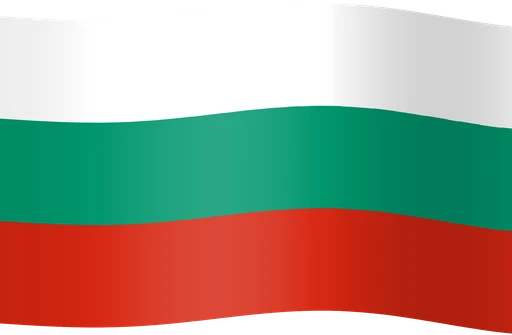
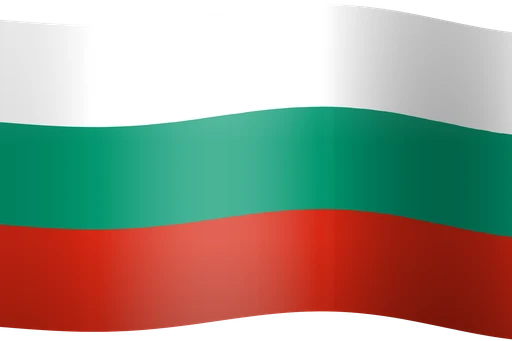
The Flag of Bulgaria
Republic of Bulgaria
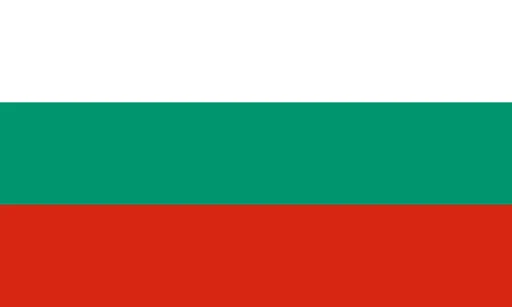
The flag of Bulgaria has three horizontal bands of equal size: white on top, then green, then red. That order has been fixed since 1879.
Bulgaria's national flag is one of the few European tricolors in white, green, and red, which sets it apart from the red-white-and-blue banners that fill the rest of the continent. Its modern form dates from 1990, after the fall of communism, but the design goes back to the 1878 liberation from Ottoman rule, making it one of the oldest national symbols still in use in the Balkans. Monarchy and then communist rule each added something to it, and each time the country came back to the plain tricolor that revolutionary fighters had carried.
Why no blue?
Walk down a lineup of European flags and you'll notice a pattern: blue, white, and red dominate. France, the Netherlands, Luxembourg, Russia, Serbia, Croatia. The tricolor template that swept the continent after the French Revolution almost always included blue. Bulgaria didn't get the memo.
The white-green-red combination traces back to the First Bulgarian Legion, organized by Georgi Sava Rakovski in Belgrade in 1862. Rakovski's volunteers carried a green-white-red banner that drew on both pan-Slavic sentiment and the Italian revolutionary tradition. That second influence matters. The Italian Risorgimento was electrifying nationalist movements across Europe at the time, and its green-white-red tricolor clearly left a mark on Bulgarian revolutionaries. Some historians argue the green was a deliberate substitution for the pan-Slavic blue, meant to evoke the fertility of the Bulgarian landscape and the forests that sheltered guerrilla fighters. Others say the Italian connection is the simpler and more likely explanation. The debate hasn't been settled.
What we do know is that the arrangement, white on top, green in the middle, red on the bottom, was fixed during the Constituent Assembly at Tarnovo in 1879, a year after liberation from the Ottoman Empire. The Tarnovo Constitution codified the flag, which made Bulgaria one of the first newly independent Balkan states to put its national banner into constitutional law.
The flag through five regimes
Before the flag was codified, it was improvised. During the April Uprising of 1876, Bulgarian rebels carried all sorts of revolutionary banners, many in green, white, and red but with no consistent design. The best known is the flag of Panagyurishte, embroidered by Rayna Knyaginya, a schoolteacher who became a national heroine. Hers had a lion and the words "Freedom or Death" on it, a long way from the bare tricolor that followed.
Once the Tarnovo Constitution established the plain tricolor in 1879, the flag remained largely unchanged through the Kingdom of Bulgaria period (1908-1946). The state coat of arms was sometimes placed on the white stripe for official and diplomatic purposes, but the civil flag stayed clean.
Then came the communists. After the People's Republic of Bulgaria was proclaimed in 1946, the new government added a state emblem to the white stripe: a lion inside a wreath of wheat ears, crowned by a red star, with the dates 681 (the founding of the First Bulgarian Empire) and 1944 (the communist-led coup). The emblem was revised in 1948, again in 1967, and once more in 1971, as political taste and the degree of Soviet influence shifted.
It came down fast after Todor Zhivkov's regime collapsed in November 1989. By 1990 the communist insignia was gone and the plain tricolor was back. The Constitution of 1991 reaffirmed it, and a 1998 law on national symbols pinned down the specifications for design, colors, and proportions.
What the colors actually mean
Ask a Bulgarian what the colors mean and you'll get a confident answer: white for peace, freedom, and the snowy peaks of the Balkan Mountains; green for the country's agricultural wealth and dense forests; red for the blood and courage of those who fought for independence. It's a neat story, and it's not wrong exactly, but it's probably backwards. The colors were almost certainly borrowed from revolutionary flags for practical and aesthetic reasons, with symbolic meaning attached after the fact. That's true of most national flags, by the way. People see the colors, then find reasons to love them.
The lion, Bulgaria's heraldic animal since the Second Bulgarian Empire (1185-1396), doesn't appear on the civil flag at all. It lives on the coat of arms and the naval ensign, where it still roars from a dark red shield. Keeping the civil flag free of emblems was a deliberate choice in the democratic era, one that lines the banner up with its earliest form, before either the monarchy or the communists.
For the detail-oriented: the official shades are Pantone 347 for the green and Pantone 485 for the red, with white left unspecified. The proportions are 3:5, height to width.
Protocol and variants
The national flag flies from all government buildings and is required on national holidays, including Liberation Day (3 March), Unification Day (6 September), and Independence Day (22 September). Of these, March 3rd draws the biggest displays. It commemorates the 1878 Treaty of San Stefano, which ended Ottoman rule, and the streets fill with tricolor ribbons, lapel pins, and full-sized flags draped from apartment balconies.
Military and naval variants build on the basic design. The naval ensign puts the coat of arms on the tricolor within a bordered layout, and military unit flags carry regiment-specific insignia. The president's standard is a different beast entirely: a white field with the national coat of arms, a golden crowned lion on a dark red shield, inside a border in the tricolor colors.
A 2011 law introduced fines for desecrating the national flag, which says something about how a country works out its relationship with national symbols after decades of imposed communist iconography.
Lookalikes
Bulgaria's flag gets confused with Hungary's (red-white-green) and Italy's (green-white-red) more often than Bulgarians would like. All three share two of three colors, but the arrangements are different enough that a quick glance at the stripe order sorts them out. Iran also uses a white-green-red scheme, though with a central emblem and a completely different design tradition rooted in Islamic calligraphy.
Genealogically, Bulgaria's flag belongs to the pan-Slavic family, alongside Russia, Serbia, and Croatia. But the swap of green for blue marks a distinct branch on the tree. It's a flag that borrowed from two revolutionary traditions at once, Slavic and Italian, and ended up looking like neither.
Vexillologists sometimes group Bulgaria with Ireland (green-white-orange) and Côte d'Ivoire (orange-white-green) as examples of tricolors that deliberately broke from the French blue-white-red template. Within Bulgaria itself, regional and historical flags, such as the banner of Bulgarian Macedonia and various medieval standards, maintain alternative traditions of Bulgarian heraldic identity that predate the modern tricolor by centuries.
References
[1] Constitution of the Republic of Bulgaria (1991), Article 166. Official constitutional definition of the national flag. Available via the Bulgarian National Assembly: https://www.parliament.bg
[2] Law on the State Seal and the National Flag of the Republic of Bulgaria (1998). Legal specifications for design, colors, and proportions.
[3] Tarnovo Constitution (1879). Original codification of the Bulgarian national flag by the Constituent Assembly.
[4] Flags of the World (FOTW), Bulgaria page. The world's largest online vexillological resource. https://www.crwflags.com/fotw/flags/bg.html
[5] Whitney Smith, Flags Through the Ages and Across the World (New York: McGraw-Hill, 1975). Comprehensive vexillological reference.
[6] R.J. Crampton, A Concise History of Bulgaria (Cambridge University Press, 2005). Authoritative English-language history covering the flag's political context.
[7] North American Vexillological Association (NAVA). Comparative resources on tricolor flag traditions. https://nava.org
Common questions
- What do the colors on the Bulgarian flag mean?
- White is for peace, freedom, and the snowy Balkan Mountains. Green represents the country's agricultural wealth and forests. Red honors the blood and courage of those who fought for independence. That said, these meanings were probably assigned after the fact. The colors were originally borrowed from revolutionary flags inspired by Italian and pan-Slavic traditions.
- Why does Bulgaria's flag have green instead of blue like most European tricolors?
- Most Slavic flags use blue, but Bulgarian revolutionaries in the 1860s went with green instead. It may have been inspired by Italy's green-white-red flag, or it could've been a nod to Bulgaria's fertile landscape and forests. Historians still aren't sure of the exact reason, honestly. Either way, it's one of the things that makes Bulgaria's flag easy to pick out.
- What's the difference between the Bulgarian and Hungarian flags?
- They both use white, green, and red, but the stripe order is different. Bulgaria's goes white-green-red from top to bottom, while Hungary's is red-white-green. People also mix up Bulgaria's flag with Italy's green-white-red tricolor. Just check the stripe order and you'll sort them out quickly.
- Did the Bulgarian flag change during communism?
- It did. After 1946, the communist government stuck a state emblem on the white stripe, featuring a lion, a wheat wreath, a red star, and the dates 681 and 1944. They revised it a few times over the years. Once communism fell in 1989, the emblem was removed by 1990, bringing the flag back to the plain tricolor it had been since 1879.
Featured in these articles
Download this flag
Free in 12 styles, from 32px icons up to 2000px, as SVG, PNG, WebP and JPG.