The Flag of The British Virgin Islands
Virgin Islands
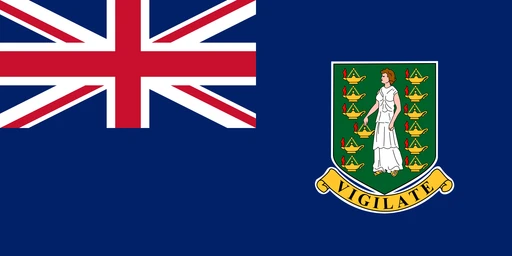
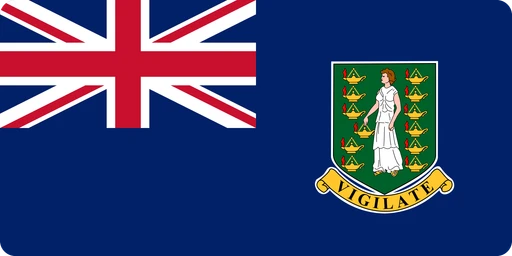
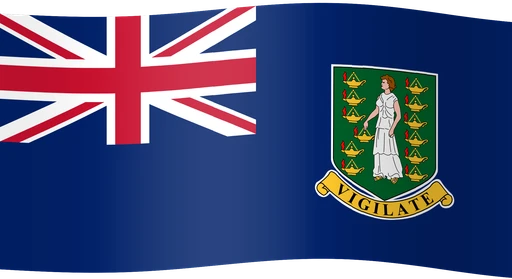
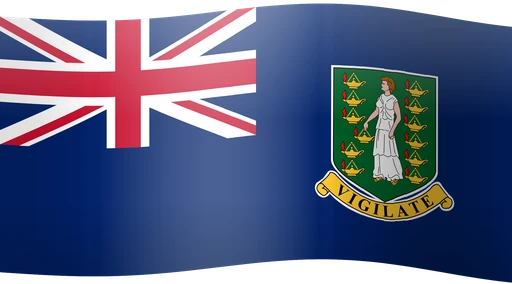
The flag of the British Virgin Islands has a deep blue field with the Union Jack in the upper hoist-side quadrant, marking the islands' ties to the United Kingdom. On the fly side is a coat of arms showing Saint Ursula on a green shield, holding a gold oil lamp and framed by eleven more, one for each thousand of the 11,000 virgins the islands are named after. A scroll beneath the shield carries the Latin motto 'Vigilate' (Be Vigilant).
The flag of the British Virgin Islands is easy to pick out among Britain's Overseas Territory ensigns: it carries Saint Ursula, a legendary Romano-British princess, holding a lamp on a green shield with eleven more lamps around her. Adopted in 1960, it preserves the reason Christopher Columbus gave the archipelago its name, an ancient story of martyrdom that stuck to the islands and never came off.
Eleven thousand virgins and the name of the islands
When Christopher Columbus sighted this cluster of islands in 1493, on his second voyage to the Americas, he skipped the usual geographic naming and called them Santa Úrsula y las Once Mil Vírgenes: Saint Ursula and the Eleven Thousand Virgins.
The legend behind that name was centuries old by then. Ursula was a Romano-British Christian princess who, before agreeing to marry a pagan prince, set out on a pilgrimage to Rome with 11,000 virgin handmaidens. On the return journey the whole company was massacred by Huns at Cologne, and Ursula was shot with an arrow after refusing to marry the Hun chieftain. The story was popular across medieval Europe, painted by Carpaccio and Memling, and evidently well known to Columbus and his crew.
The name was later shortened to the Virgin Islands, but the coat of arms kept the original reference. Saint Ursula stands at the center flanked by eleven gold oil lamps, each one traditionally standing for a thousand of her companions. Eleven thousand martyred women, compressed into eleven small flames.
Very few flags anywhere take their central image from a saint's legend rather than from landscape, politics, or war. Most reach for eagles, stars, or stripes. This one tells a story about a specific person.
From colony to territory
For most of their colonial history the British Virgin Islands were governed as part of the British Leeward Islands colony and had no flag of their own. They used a generic colonial badge, the sort of administrative emblem that said nothing about the islands or the people on them.
That changed in 1960. The Saint Ursula coat of arms was granted by Royal Warrant and the flag carrying it was adopted the same year. The timing was not accidental. It came during a round of constitutional reform that gave the BVI a new administrator and a legislative council, both steps toward internal self-government.
The design follows the standard British Blue Ensign format used across many Overseas Territories and Crown Dependencies: blue field, Union Jack in the canton, territorial badge on the fly side. The Cayman Islands and Montserrat use the same formula. What the Saint Ursula arms gave the BVI was a badge unlike any other in the British colonial world.
Saint Ursula, the lamps, and the Blue Ensign
The flag uses the standard 1:2 ratio of British ensigns. Depending on the rendering, the coat of arms sits either on a white disc or directly on the blue. At its center is a woman in white robes holding a single golden oil lamp. The green shield she stands on is there for the tropical vegetation of the islands, the one piece of the design that comes from the place rather than from Europe.
Eleven more gold lamps flank her, in two columns, five on one side and six on the other, flames pointing upward. The 1960 royal warrant blazons them exactly that way, which is why the count is eleven around her and one in her hand rather than twelve arranged evenly.
Beneath her feet is a scroll with the Latin motto VIGILATE, "Be Watchful" or "Be Vigilant." The word comes from the Parable of the Ten Virgins in the Gospel of Matthew (25:13), which ties the legendary virgins to Christian virtue. The wise virgins in the parable kept their lamps lit, and on the flag the lamps are still burning.
The blue field reads as the Caribbean Sea, though it is really just the standard Blue Ensign field rather than a choice made for the BVI. The Union Jack in the canton marks the territory's constitutional relationship with the United Kingdom.
Comparisons with other territory flags
At a distance the BVI flag can be mistaken for any number of British Overseas Territory flags, since they all share the Blue Ensign backbone. The badge settles it. No other territory puts a named saint front and center. Flags with religious imagery usually go abstract, with crosses, crescents, or the Star of David. This one is figurative and tells a story.
The neighboring U.S. Virgin Islands make the contrast plain. That flag has an American eagle on a white field between the letters V and I, from a colonial path that ran through Denmark and then the United States. Same archipelago, same original name, entirely different visual language.
Residents and commentators have occasionally floated the idea of a more distinctly Caribbean design that drops the Blue Ensign format, but no formal redesign has been attempted. The Governor of the British Virgin Islands flies a separate flag, the Union Flag defaced with the territorial coat of arms, as governors of British Overseas Territories generally do.
Where the flag turns up
The flag flies on government buildings throughout the territory, at the Olympic Games and Commonwealth Games, where the BVI competes as a separate entity, and on vessels registered in the islands. That last one counts for more than it sounds. The BVI is a major offshore financial center, and its Red Ensign variant for merchant shipping shows up on ships worldwide, which gives a territory of roughly 30,000 people a flag presence well out of proportion to its population.
It is also everywhere during the Emancipation Festival in late July and early August, the territory's biggest cultural event, which marks the abolition of slavery in 1834.
For many British Virgin Islanders the flag holds several things at once: Caribbean culture, British constitutional ties, and a European saint whose name was handed to the islands by a Genoese explorer sailing for Spain.
The coat of arms turns up on official documents, currency, stamps, and tourism material, which makes Saint Ursula and her lamps the most reproduced images in the territory. VIGILATE reads differently since September 2017, when Hurricane Irma devastated the islands and vigilance stopped being a biblical abstraction.
References
[1] Government of the Virgin Islands, Official Website: Coat of Arms and National Symbols. bvi.gov.vg
[2] Smith, Whitney. Flags Through the Ages and Across the World. McGraw-Hill, 1975.
[3] Flag Institute (UK): British Overseas Territories Flags reference pages. flaginstitute.org
[4] Dookhan, Isaac. A History of the British Virgin Islands, 1672 to 1970. Caribbean Universities Press, 1975.
[5] Royal Warrant establishing the Arms of the British Virgin Islands, 1960. College of Arms records.
[6] Proudfoot, Mary. Britain and the United States in the Caribbean. Faber and Faber, 1954.
[7] Central Intelligence Agency. The World Factbook: British Virgin Islands entry.
[8] North American Vexillological Association (NAVA) and Vexillological Association of the State of Texas (VAST): publications on Caribbean flags.
Common questions
- Why is there a woman on the British Virgin Islands flag?
- That's Saint Ursula, a legendary Romano-British princess. When Columbus sighted the islands in 1493 he named them after the medieval legend of Ursula and her 11,000 martyred virgin handmaidens. The coat of arms still carries that origin story, which puts the BVI among the very few flags anywhere built on a medieval saint's legend.
- What do the 11 lamps on the British Virgin Islands flag represent?
- Each of the eleven gold oil lamps represents one thousand of Saint Ursula's legendary 11,000 virgin companions. They're a nod to Columbus's original name for the islands: 'Saint Ursula and the Eleven Thousand Virgins.' The lamps also tie into the Parable of the Ten Virgins from the Bible, which connects to the flag's motto, 'Vigilate' (Be Watchful).
- What does 'Vigilate' mean on the British Virgin Islands flag?
- 'Vigilate' is Latin for 'Be Watchful.' It comes from the Parable of the Ten Virgins in the Gospel of Matthew, where the wise virgins kept their oil lamps burning, which is also where the lamps on the flag come from. Islanders have read the motto more literally since Hurricane Irma hit in 2017.
- Why does the British Virgin Islands flag have a Union Jack on it?
- The BVI is a British Overseas Territory, so its flag follows the British Blue Ensign format. That Union Jack in the upper left corner signals the islands' constitutional relationship with the UK. It's actually a common setup. Other territories like the Cayman Islands and Montserrat use the same layout, each with their own unique badge on the right side.
Featured in these articles
Download this flag
Free in 12 styles, from 32px icons up to 2000px, as SVG, PNG, WebP and JPG.