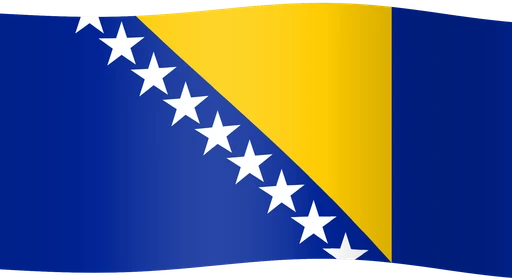
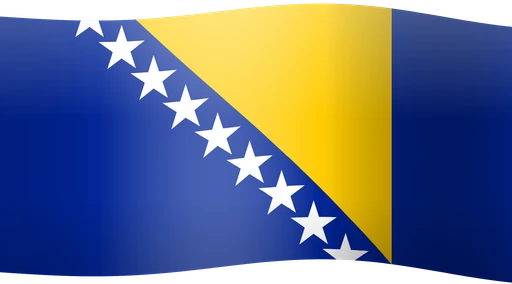
The Flag of Bosnia and Herzegovina
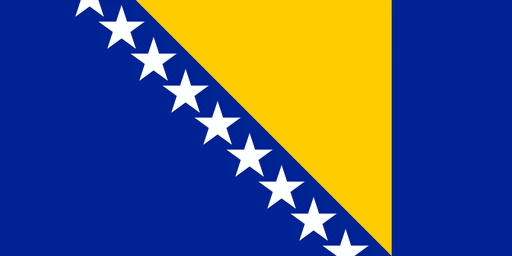
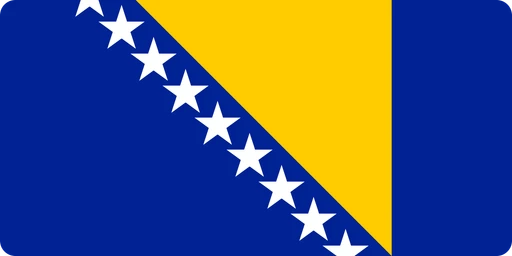
The flag of Bosnia and Herzegovina has a blue field with a yellow right triangle along the hoist side, and a line of white five-pointed stars running along the triangle's hypotenuse, seven full and two cut off at the top and bottom. The blue stands for Europe, the triangle for the three constituent peoples (Bosniaks, Croats, and Serbs), and the stars, which echo the European Union flag, for continuity.
Bosnia and Herzegovina's flag is one of the youngest in Europe and one of the few national flags anywhere designed not by a country's own citizens but by an international mediator. Adopted on February 4, 1998, it came out of the wreckage of the Bosnian War (1992-1995) as a compromise imposed by the Office of the High Representative, the international body overseeing the Dayton Peace Agreement. Its geometry, a blue field with a diagonal yellow triangle and a row of white stars running off both edges, was designed to avoid favoring any of Bosnia's three constituent peoples: Bosniaks, Croats, and Serbs. It carries no traditional heraldic charge, no historical coat of arms, and no religious or ethnic emblem.
A flag designed by diplomats
When the Dayton Agreement ended the Bosnian War in December 1995, the country did not immediately get a new flag. It kept flying the wartime banner with the medieval Kotromanić dynasty's coat of arms: a blue shield bearing golden fleur-de-lis. For Bosniaks that symbol carried centuries of meaning. For Bosnian Serbs and Croats it felt exclusionary, a flag belonging to one community rather than three.
The Parliamentary Assembly set out to find a replacement and could not. For over two years, every proposal was vetoed along ethnic lines. Serb representatives blocked designs they saw as too Bosniak. Bosniak and Croat delegates clashed over competing visions. Dozens of concepts were floated, debated, and discarded, while the country flew a flag that a third of its population refused to recognize.
Carlos Westendorp, the Spanish diplomat serving as High Representative, resolved it. In February 1998, after parliament missed another deadline, he imposed a flag by decree. He selected the current design from a shortlist prepared with input from the United Nations and modified it into its final form. The shortlist reportedly contained dozens of proposals.
The flag was first raised on February 4, 1998, and has not changed since. Unchanged does not mean uncontested: it has never been universally embraced by all three constituent communities.
Geometry as neutrality
Look at the flag and you will notice there is nothing on it that tells you which country it belongs to. No coat of arms. No crescent. No cross. No Cyrillic or Latin script. Every traditional ethnic or religious marker was deliberately stripped out.
What remains is pure geometry. A medium blue field holds a right yellow triangle whose vertices touch the top-left corner, the midpoint of the bottom edge, and the top-right corner, creating a long diagonal hypotenuse across the flag. Running parallel to that hypotenuse is a line of white five-pointed stars, with the top and bottom stars cut off by the flag's edges to suggest that the line continues beyond what you can see.
The triangle carries a double meaning. It represents the three constituent peoples of Bosnia and Herzegovina, and it echoes the country's roughly triangular geographic shape. The color choices were equally calculated. Blue and white stars evoke the flag of Europe, the Council of Europe and EU flag, tying Bosnia's identity to its European aspirations rather than to any heritage inside its borders. Yellow stands for the sun, hope, and generosity. Blue stands for peace and the European connection.
The proportions are 1:2. Color specifications follow the Pantone system: blue is Pantone 286, yellow is Pantone 116. It is a flag designed with the precision of a corporate brand guide, which is both its strength and, for some critics, its weakness.
Three peoples, three flags
The flag flies over government buildings in Sarajevo, but drive into Republika Srpska, the Serb-majority entity, and the entity's own flag dominates. In many Bosnian Croat communities it is the Croatian checkerboard that hangs from balconies and storefronts, not the Dayton triangle. The state flag sits in a kind of political limbo: legally supreme, emotionally secondary.
Bosniak political parties have periodically pushed to restore elements of the medieval fleur-de-lis symbolism, arguing it represents a Bosnian statehood that predates ethnic division. Serb representatives resist changes that might strengthen state-level identity over entity identity. The flag, in other words, is still being fought over, just with parliamentary motions instead of artillery.
International sporting events are a rare exception. When Bosnian athletes compete at the Olympics or World Cup qualifiers, the flag becomes a unifying symbol almost by default. Its first major international outing came at the 1998 Winter Olympics in Nagano, Japan, weeks after adoption and barely three years after the war. The state coat of arms, adopted the same day as the flag, mirrors its design with the same triangle and stars.
Public opinion surveys paint a complicated picture. Younger Bosnians, without direct memories of the war, tend to be more accepting of the flag. Older generations often see it as an imposition.
From the Kotromanić lilies to the Dayton triangle
Bosnia's relationship with its own symbols has always been turbulent. Medieval Bosnia under the Kotromanić dynasty (c. 1250-1463) used a blue shield bearing golden fleur-de-lis. That image became closely tied to Bosnian statehood and survived in collective memory long after the dynasty fell.
Under Ottoman rule (1463-1878), Bosnia had no distinct flag. Various Ottoman standards flew over the territory for four centuries. When Austria-Hungary took over in 1878, administrators introduced a red-and-yellow bicolor, a bureaucratic convenience with no organic connection to the land or its people.
The Yugoslav period brought more changes. Within the Kingdom of Yugoslavia and later Tito's Socialist Federal Republic, Bosnia and Herzegovina used variants of broader Yugoslav flags, with the Socialist Republic's version adding a red star to distinguish it from the other republics. None of these flags originated inside Bosnia.
Independence in 1992 brought back the fleur-de-lis. The Republic of Bosnia and Herzegovina adopted it as a wartime flag, and it flew over a country under siege. For Bosniaks it became sacred. For Serbs and Croats it confirmed their fear that the new state was a vehicle for one community's identity. The 1998 flag was a sharp break: the first Bosnian flag with no connection to any previous regime, dynasty, or empire.
Parallels and precedents
Bosnia is not the only country where flag design became an exercise in diplomatic geometry. Kosovo's flag, adopted in 2008, uses a similar approach: blue and gold, stars representing ethnic communities, the whole thing shaped by international input. Both flags came out of the same problem, which is how to symbolize a state when its people cannot agree on what the state means.
The externally imposed flag has few modern parallels. The closest cases are post-WWII flags in occupied Germany and Japan's briefly contested imperial symbol. Bosnia's situation is more unusual because the imposition happened not during occupation but during a negotiated peace.
Vexillologically, the diagonal triangle is highly unusual. No other sovereign nation uses a triangle positioned this way, which makes the flag recognizable at any distance. Some flag scholars praise its clean modernist geometry. Others argue it feels more like a corporate logo than a national symbol rooted in lived culture.
The design philosophy of neutrality through abstraction has influenced discussions about flag design in other divided societies, including Cyprus and Northern Ireland. Whether a flag can build unity by refusing to take sides is still an open question in Bosnia's own case.
References
[1] Office of the High Representative (OHR), "Decision Imposing the Law on the Flag of BiH," February 3, 1998. ohr.int
[2] Constitution of Bosnia and Herzegovina, Annex 4 of the General Framework Agreement for Peace (Dayton Agreement), 1995.
[3] Malcolm, Noel. Bosnia: A Short History. New York University Press, 1994.
[4] Flags of the World (FOTW), Bosnia and Herzegovina entry. crwflags.com
[5] Whitney Smith. Flags Through the Ages and Across the World. McGraw-Hill, 1975.
[6] International Olympic Committee, Nagano 1998 Winter Olympics records.
[7] Bartlett, William. Croatia: Between Europe and the Balkans. Routledge, 2003.
Common questions
- Why was Bosnia and Herzegovina's flag designed by a foreigner?
- After the Bosnian War ended in 1995, parliament couldn't agree on a new flag for over two years. Every proposal got vetoed along ethnic lines. So in 1998, Spanish diplomat Carlos Westendorp, the High Representative at the time, just imposed the current design by decree. It's deliberately abstract and geometric so it doesn't favor any of Bosnia's three main groups: Bosniaks, Croats, or Serbs.
- What does the triangle on the Bosnian flag represent?
- The yellow triangle actually has two meanings. It represents Bosnia's three constituent peoples (Bosniaks, Croats, and Serbs), and it also mirrors the country's roughly triangular shape on a map. The yellow color is meant to symbolize the sun, hope, and generosity.
- Why are the stars on the Bosnian flag cut off at the edges?
- That's intentional! The white stars run diagonally along the triangle's longest side, and the ones at the top and bottom are clipped by the flag's border on purpose. It's meant to suggest continuity and infinity, like the line of stars keeps going beyond what you can see.
- Why are blue and yellow the main colors on Bosnia and Herzegovina's flag?
- The blue background and white stars were picked to echo the flag of Europe (the Council of Europe and EU flag), tying Bosnia's identity to European aspirations instead of any single ethnic heritage. Yellow represents the sun, hope, and generosity. The whole design was meant to avoid traditional ethnic or religious symbolism.
- What flag did Bosnia and Herzegovina use before the current one?
- During the Bosnian War (1992 to 1995) and up until 1998, Bosnia flew a flag with the medieval Kotromanić dynasty's coat of arms, a blue shield with golden fleur-de-lis. It held meaning for Bosniaks, but Bosnian Serbs and Croats saw it as exclusionary. That's ultimately why it got replaced with the current neutral design.
Featured in these articles
Download this flag
Free in 12 styles, from 32px icons up to 2000px, as SVG, PNG, WebP and JPG.