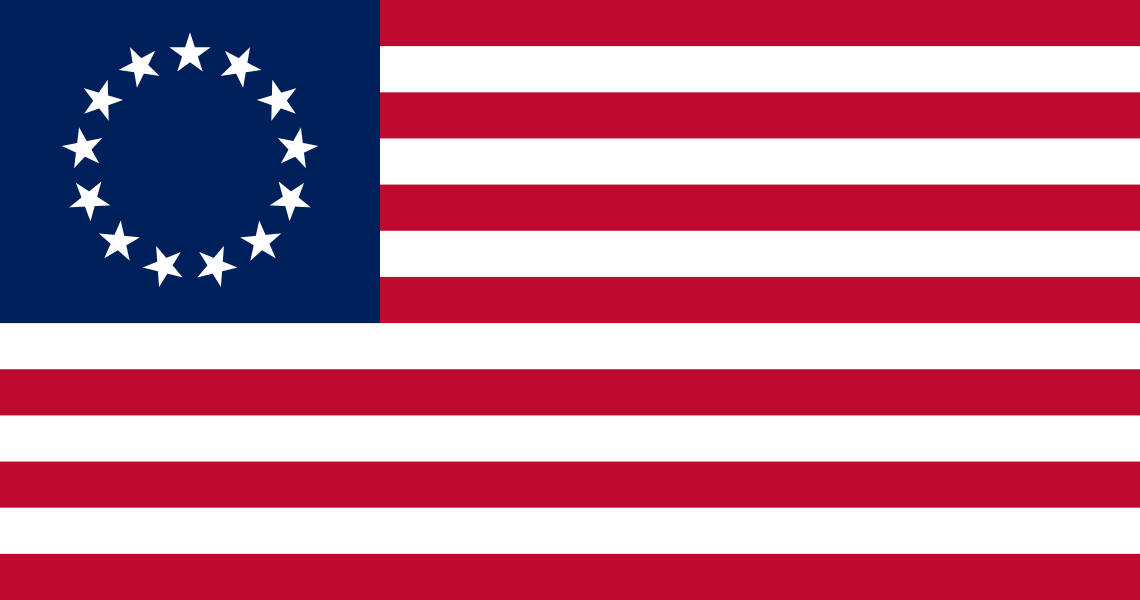
The Betsy Ross Flag
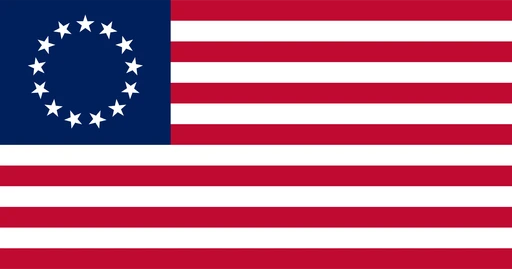
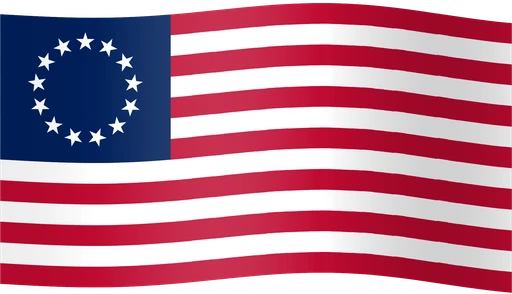
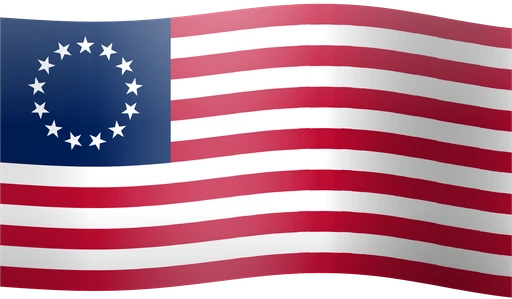
The Betsy Ross flag is an early design of the United States flag with thirteen white five-pointed stars set in a circle on a blue canton. The rest of the flag is thirteen stripes, seven red and six white. The stars and the stripes both stand for the thirteen colonies that declared independence, and the circle is read as a sign that no state ranks above another. The name comes from Betsy Ross, a Philadelphia upholsterer. A family story first told in public in 1870 says she sewed the first flag for George Washington. Historians have found no record from her lifetime to confirm it.
Thirteen stars in a ring, thirteen stripes, and a name that history has not been able to confirm. The Betsy Ross flag is the best-known early version of the Stars and Stripes, and it carries the name of a Philadelphia upholsterer whose part in it nobody has documented. Congress never chose the circle of stars either. The flag you know from classroom walls owes as much to a family story told in 1870 and a painting shown in 1893 as it does to anything decided in 1777.
One sentence from Congress
The whole legal basis for the flag is a single resolution. On June 14, 1777, the Second Continental Congress resolved "that the flag of the united states be 13 stripes alternate red and white, that the Union be 13 stars white in a blue field representing a new constellation."
That is all it says. It does not say how many points a star has, where the stars go, or how long the flag is. Makers filled the gaps themselves, and thirteen-star flags appeared with stars in rows, in circles and in other patterns. The ring is one answer among several. The file shown on this page uses the 10:19 shape of the modern United States flag, a convention and not a rule from 1777.
Congress gave the colours no meaning. The reading people repeat comes from 1782, when Charles Thomson reported to Congress on the Great Seal. In his report white signifies purity and innocence, red hardiness and valour, and blue vigilance, perseverance and justice.
Thirteen stars lasted eighteen years. The Flag Act of 1794, signed by George Washington on January 13, set fifteen stripes and fifteen stars from May 1, 1795.
The story Canby told
In March 1870 William Canby read a paper called "The History of the Flag of the United States" to the Historical Society of Pennsylvania. Canby was a grandson of Betsy Ross. He was eleven when she died in 1836, and he said he heard the account in 1857 from his aunt, Clarissa Sydney Wilson.
His paper puts Ross in her shop, sewing, when "several gentlemen entered." One was Colonel George Ross, an uncle of her late husband and a delegate to Congress. Another was George Washington. They said they were a committee of Congress appointed to prepare a flag, and Colonel Ross produced a rough drawing.
The stars in the drawing had six points. Ross said they should have five. Her answer to the committee was "Nothing easier." She folded a piece of paper, and with "one clip of her ready scissors" showed them a five-pointed star. Washington then redrew the design in pencil in her back parlor.
Canby gathered sworn statements from relatives to back the paper. Ross's daughter Rachel Fletcher signed one on July 31, 1871. She named Robert Morris as a member of the committee and dated the visit to June 1776, "or shortly before the Declaration of Independence."
What the records show
Elizabeth Griscom Ross was born in 1752 and died in 1836 at 84. She worked as an upholsterer in Philadelphia and married John Ross in November 1773. The link to Washington is real, at least as a customer. His ledger for September and October 1774 records bed furniture bought from the Ross shop.
She also made flags. A Pennsylvania minute dated May 29, 1777, orders payment to Elizabeth Ross of fourteen pounds, twelve shillings and two pence "for making ships colours." Those were flags for Pennsylvania's navy, and the entry does not describe them. Years later, before the War of 1812, she won contracts to make garrison flags for the United States Army.
The meeting itself has left no trace. No record shows a congressional flag committee in the spring of 1776. Washington had left Congress in 1775 to command the army. No letter or diary by Washington, Morris or George Ross mentions a flag that year.
Historian Marla Miller, who wrote a biography of Ross, thinks the legend asks the wrong question. The tale "is often told as a story of design, but it is not," she writes. She calls it "a story of construction, production and entrepreneurship." Even on Canby's own telling, Ross changed one thing: the number of points on a star.
The man who sent a bill
Francis Hopkinson has the only claim made at the time. He signed the Declaration of Independence and chaired the Navy Board in Philadelphia from November 1776 to August 1778, so he held that post when Congress passed the flag resolution.
On May 25, 1780, he wrote to the Board of Admiralty and listed the designs he had made for the government. The list included "the Flag of the United States of America." His price was "a Quarter Cask of the public Wine." The Treasury Board reported against him on October 27, 1780. Its main reason was that he was not the only person consulted on the designs.
No sketch of Hopkinson's flag survives. Nobody knows how he arranged his stars.
How the circle found her
Rings of stars turn up early in American art. Charles Willson Peale's 1779 portrait of Washington at Princeton shows a blue flag with thirteen six-pointed stars in a circle. Grace Rogers Cooper of the Smithsonian dated the first appearance of the ring on a striped flag to John Trumbull's 1792 painting of Washington at Trenton, and those stars have six points too.
None of this was tied to Ross until the 1890s. Canby's paper never mentions a circle. Charles Weisgerber's painting "Birth of Our Nation's Flag," nine feet by twelve, went on show at the World's Columbian Exposition in Chicago in 1893. It shows Ross with a flag of thirteen stars in a ring, and it is the earliest known link between her and that layout. Weisgerber sent prints to people who gave money to preserve the Betsy Ross House at 239 Arch Street in Philadelphia. The post office put Ross on a three-cent stamp in 1952, her 200th birthday.
Shoes, stadiums and inaugurations
The flag still gets official use. It hangs at presidential inaugurations. The Philadelphia 76ers have used a ring of thirteen stars since 1963.
It has drawn fire as well. In July 2019 Nike withdrew its Air Max 1 USA sneaker, which carried the flag, days before the Fourth of July. The Associated Press reported that Colin Kaepernick had told the company the flag recalls the era of slavery and has been taken up by white nationalist groups. Nike said it pulled the shoe "based on concerns that it could unintentionally offend and detract from the nation's patriotic holiday." Arizona's governor, Doug Ducey, answered by asking his state to withdraw incentives promised for a Nike plant.
The Anti-Defamation League keeps the flag out of its hate symbols database. "We view it as essentially an innocuous historical flag," said Mark Pitcavage of its Center on Extremism, who added that extremist groups have used it occasionally. Lisa Moulder, director of the Betsy Ross House, said she had never heard of it being used as a hate symbol.
References
[1] "Betsy Ross flag," Wikipedia. https://en.wikipedia.org/wiki/Betsy_Ross_flag
[2] William Canby, "The History of the Flag of the United States," paper read before the Historical Society of Pennsylvania, March 1870. https://www.ushistory.org/betsy/more/canby.htm
[3] Affidavit of Rachel Fletcher, July 31, 1871. https://www.ushistory.org/betsy/flagaffs.html
[4] Journals of the Continental Congress, entry for June 14, 1777.
[5] Independence Hall Association, "Betsy Ross and the American Flag: Did Betsy Ross make the first flag?" https://www.ushistory.org/betsy/flagpcp.html
[6] Marla R. Miller, "Citizen Seamstress," The American Legion Magazine, May 18, 2016. https://www.legion.org/information-center/news/magazine/2016/may/citizen-seamstress
[7] "Francis Hopkinson," Wikipedia. https://en.wikipedia.org/wiki/Francis_Hopkinson
[8] "Flag Acts (United States)," Wikipedia. https://en.wikipedia.org/wiki/Flag_Acts_(United_States)
[9] Erin Blakemore, "Betsy Ross likely didn't sew the first U.S. flag," National Geographic, July 1, 2021. https://www.nationalgeographic.com/history/article/betsy-ross-likely-didnt-sew-the-first-us-flag
[10] Associated Press, "Why Nike pulled Betsy Ross flag shoes after Kaepernick criticism," PBS NewsHour, July 3, 2019. https://www.pbs.org/newshour/nation/why-nike-pulled-betsy-ross-flag-shoes-after-kaepernick-criticism
Common questions
- Did Betsy Ross make the first American flag?
- Nobody has proved it. The story comes from her grandson William Canby, who presented it to the Historical Society of Pennsylvania in March 1870, 34 years after she died. No letter, diary or record of Congress from 1776 mentions the visit he described. Records do show that Ross made flags. On May 29, 1777, a Pennsylvania board ordered her paid fourteen pounds, twelve shillings and two pence for "making ships colours."
- Why are the stars in a circle?
- The 1777 Flag Resolution asked for thirteen stars but gave no arrangement, so makers chose their own. The circle is usually read as equality among the states, since no star sits above another. Canby's 1870 paper does not mention a circle at all. A sworn statement by Ross's daughter Rachel Fletcher in 1871 says the stars were to be "in lines or in some adopted form as a circle, or a star."
- Who designed the Betsy Ross flag?
- No designer is documented. Francis Hopkinson, a signer of the Declaration of Independence, wrote to the Board of Admiralty on May 25, 1780, and listed "the Flag of the United States of America" among his designs. He asked for a quarter cask of public wine in return. The Treasury Board turned him down that October. No sketch of his flag survives, so the layout of his stars is unknown.
- What do the thirteen stars and stripes mean?
- Both stand for the thirteen colonies that became the first states. Congress called the stars "a new constellation" in the resolution of June 14, 1777. It gave the colours no meaning. The meanings often quoted come from Charles Thomson's 1782 report on the Great Seal, where white signifies purity and innocence, red hardiness and valour, and blue vigilance, perseverance and justice.
- Is the Betsy Ross flag a hate symbol?
- The Anti-Defamation League does not list it in its hate symbols database. In July 2019, after Nike withdrew a sneaker that carried the flag, Mark Pitcavage of the ADL's Center on Extremism told the Associated Press, "We view it as essentially an innocuous historical flag." He added that extremist groups have used it on occasion.
- When did the United States stop using the thirteen-star flag?
- The Flag Act of 1794, signed by President George Washington on January 13 of that year, changed the flag to fifteen stripes and fifteen stars. It took effect on May 1, 1795. Thirteen-star flags of every arrangement were the national flag from June 14, 1777, until that date.
Download this flag
Free in 12 styles, from 32px icons up to 2000px, as SVG, PNG, WebP and JPG.