The Confederate Battle Flag
Confederate Battle Flag
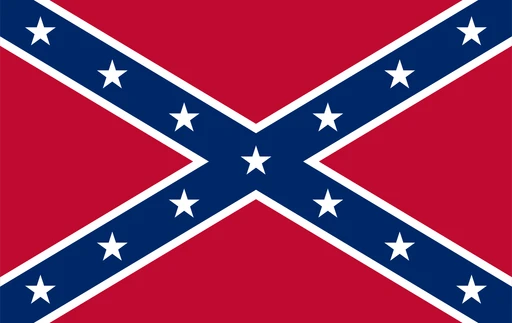
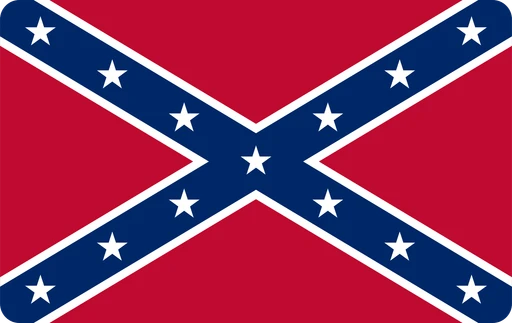
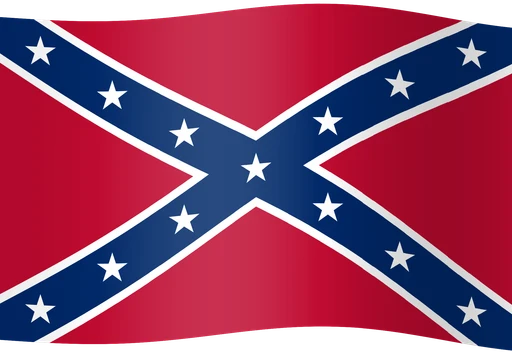
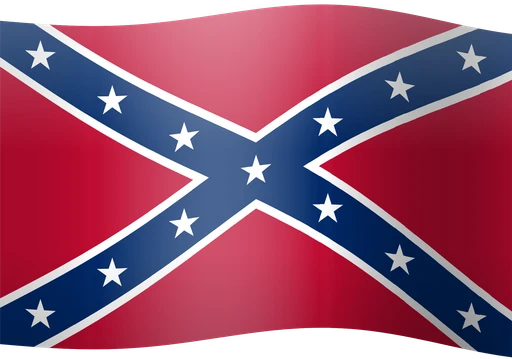
The Confederate battle flag is a red field crossed by a blue saltire, a diagonal cross, edged in white. Thirteen white five-pointed stars sit on the cross. The thirteen stars stand for the eleven states that seceded plus Missouri and Kentucky. Its original form was square. It was made for soldiers to follow on a battlefield, and it was never the national flag of the Confederate States. Since the 1948 election it has also been used against desegregation, and its display is disputed in the United States.
The Confederate battle flag has a plain design. A red field, a blue diagonal cross edged in white, thirteen white stars. It began in 1861 as a practical fix for soldiers who were unable to tell their own flag from the enemy's. Over the next 160 years it turned into one of the most disputed symbols in the United States. This page covers where the design came from, how armies used it and why states are still deciding what to do with it.
A mistake at Manassas
The story starts on 21 July 1861. At the First Battle of Manassas, the Confederate national flag, the Stars and Bars, looked a lot like the United States flag in the smoke. Some Confederate troops fired on their own comrades. Weeks earlier, Beauregard had handed out red flannel badges so his soldiers could be told apart from Federal troops.
After the battle, Johnston ordered units to carry their state flags. Only Virginia had supplied its troops with one. Beauregard wanted a new national flag and wrote to William Porcher Miles of South Carolina, who chaired the House Military Affairs Committee. That effort failed. So Beauregard asked his Louisiana officers for battle flag designs.
Who drew it
Miles looked at the colours Beauregard preferred and judged that they broke the rules of heraldry. He proposed a blue saltire with white stars on a red field. Beauregard accepted.
Johnston had a different idea. He wanted an ellipse with a red field and a blue saltire carrying one white star for each state. Johnston, Quartermaster General William L. Cabell and Beauregard met at Beauregard's Virginia headquarters in September 1861. Cabell argued for a square because it was quicker to make and wasted no cloth. Johnston outranked Beauregard, yet he accepted the square and ordered it.
About 75 women in Richmond were hired to sew the first flags. Johnston hoped to keep the design secret, but it was visible across the city the day after its adoption. The Confederate Congress declined to adopt it as the national flag. The Confederate War Department authorized the battle flag for the Army of the Potomac on 1 October 1861. It did not order other armies to follow.
Silk, cotton and wool
The first flags were silk. They were planned at 48 inches square for infantry, 36 inches for artillery and 30 inches for cavalry. Only a pink or rose red was available in bulk, and the silk flags carried yellow borders.
Supplies changed through the war. Cotton replacements of April and May 1862 averaged about 42 inches square. Wool bunting followed from May 1862, with orange borders at first and white from July 1862. Early flags had twelve stars. The wool issues of May 1862 introduced thirteen. The thirteen stars stand for the eleven seceding states plus Missouri and Kentucky. By late 1864 the infantry flag was a 48 inch square with a 5 inch cross and 4.5 inch stars.
From the field to the national flag
Other armies adopted the design, including the Army of Northern Virginia. The Army of Tennessee used a rectangular version introduced by Johnston, made from late 1863 to 1865. Infantry and cavalry flags measured 37 by 54 inches. Artillery flags measured 30 by 41 inches. The Confederate Navy used a rectangular battle flag as its second jack from 1863 to 1865.
The battle flag also reached the national flag. The Stainless Banner, adopted on 1 May 1863, put a battle flag canton on a white field. The canton took two thirds of the flag's width. On 4 March 1865, Major Arthur L. Rogers won a change that added a red vertical stripe at the far right. That version is the Bloodstained Banner.
After the war
For decades the flag appeared mostly at soldiers' reunions, memorials and Civil War battle commemorations. That changed in the middle of the 20th century. In 1948 the States' Rights Democratic Party, known as the Dixiecrats, adopted it as an emblem after the Democratic Party embraced civil rights. Historian John M. Coski writes that the flag took on a more specific meaning of resistance to the civil rights movement and to racial integration.
The Ku Klux Klan and the Citizens' Councils flew it while intimidating Black citizens. In 1956, two years after Brown v. Board of Education, Georgia put the battle flag emblem on its state flag. Georgia kept it until 2003. In 1961 South Carolina raised the flag over its Capitol dome. In 2000 it moved to a pole in front of the Statehouse. Alabama also flew it over its Capitol.
Coming down
On 17 June 2015, a white gunman killed nine Black parishioners at a church in Charleston, South Carolina. Dylann Roof had been photographed with the flag. Within weeks South Carolina passed Act 90, which removed the battle flag from the Statehouse grounds. The governor signed it on 9 July 2015. The flag was lowered on 10 July in a six minute ceremony, after 54 years. By law it was sent to the Confederate Relic Room for display.
In 2020 Mississippi followed. The legislature passed House Bill 1796 on 28 June, by 91 to 23 in the House and 37 to 14 in the Senate. Governor Tate Reeves signed it on 30 June. Mississippi had the last state flag in the United States with the battle emblem. The law created a nine member commission to design a new flag. The design had to leave out the battle flag and include the words "In God We Trust".
What you see today
The meaning of the flag depends on who holds it and where. Some people see a symbol of ancestors who fought in the war. Others see a symbol of slavery and of segregation. Historians trace the modern display largely to the civil rights era, not to the war itself.
The shape also changed. The 1861 flag was a square. The rectangle seen on car bumpers and banners descends from the rectangular versions made for the Army of Tennessee and the navy. The Confederate Congress turned the design down as a national flag.
References
[1] "A Brief History of the Confederate Flags," Mississippi Department of Archives and History. https://mshistory.mdah.ms.gov/issue/history-of-the-confederate-flags
[2] "SC Infantry Battle Flag of the Confederate States of America," Bill 897, Act No. 90, South Carolina Legislature, 2015. https://www.scstatehouse.gov/sess121_2015-2016/bills/897.htm
[3] "Confederate Battle Flag, Part 1," Flags of the World. https://www.fotw.info/FLAGS/us-csah.html
[4] "Flag of the Confederate States of America," Wikipedia. https://en.wikipedia.org/wiki/Flag_of_the_Confederate_States_of_America
[5] "How the Confederate flag became an enduring symbol of racism," National Geographic. https://www.nationalgeographic.com/history/article/how-confederate-battle-flag-became-symbol-racism
[6] "Mississippi governor signs law removing Confederate emblem from state flag," Jurist, 2020. https://www.jurist.org/news/2020/07/mississippi-governor-signs-law-removing-confederate-emblem-from-state-flag/
[7] "Confederate flag removed from South Carolina Statehouse," ABC News, 2015. https://abc13.com/south-carolina-statehouse-confederate-flag-taken-down/840335/
Common questions
- Is the Confederate battle flag the same as the Confederate flag?
- No. The Confederacy had three national flags: the Stars and Bars, the Stainless Banner of 1863 and the Bloodstained Banner of 1865. The battle flag was a military flag for the field. The Confederate Congress declined to adopt it as the national flag. The popular image people call the Confederate flag today is the battle flag, usually in a rectangle.
- Who designed the Confederate battle flag?
- William Porcher Miles, chairman of the House Military Affairs Committee, proposed the blue saltire with white stars on a red field. Beauregard had asked for designs, and Miles changed his colours because he judged them to break the rules of heraldry. Beauregard accepted. General Johnston and Quartermaster General William L. Cabell settled the final square shape in September 1861.
- Why does the flag have thirteen stars?
- The stars represent the eleven states that seceded from the Union plus Missouri and Kentucky. Those two states had secessionist factions. Early flags carried twelve stars. The thirteen star count appeared on the wool bunting issues of May 1862 and stayed for the rest of the war.
- Why was the battle flag square at first?
- Quartermaster General William L. Cabell argued that a square was quicker to make and wasted no cloth. Johnston, who had proposed an ellipse, accepted the square and ordered it. Infantry flags measured 48 inches on each side, artillery flags 36 inches and cavalry flags 30 inches. Later rectangular versions, such as the Army of Tennessee flag, spread the shape people now know.
- Why is the flag controversial today?
- After the Civil War the flag was used in memorials and, from 1948, by the States' Rights Democratic Party. The Ku Klux Klan and Citizens' Councils flew it against desegregation. Georgia put it on the state flag in 1956 and South Carolina flew it over its Statehouse from 1961. After a mass shooting in Charleston in 2015, several states removed it from official use.
Download this flag
Free in 12 styles, from 32px icons up to 2000px, as SVG, PNG, WebP and JPG.