The Flag of the Basque Country
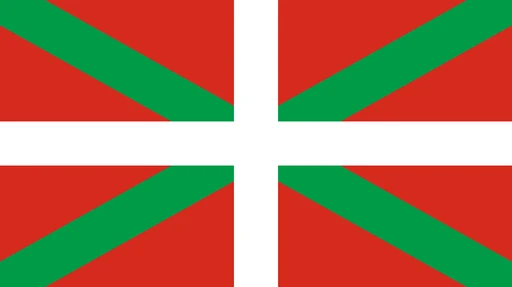
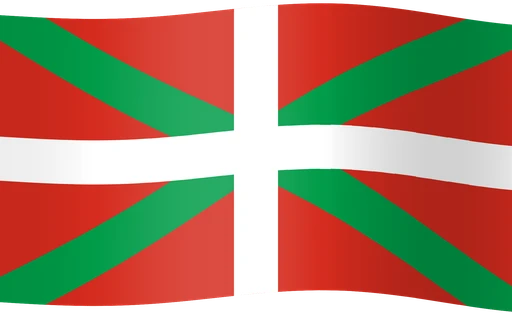
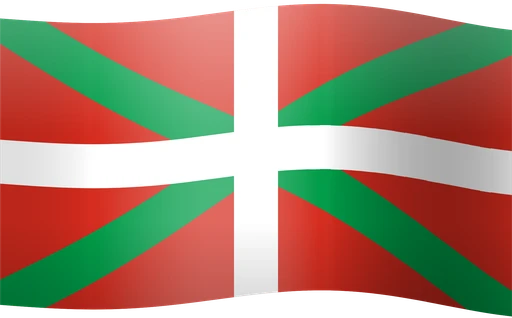
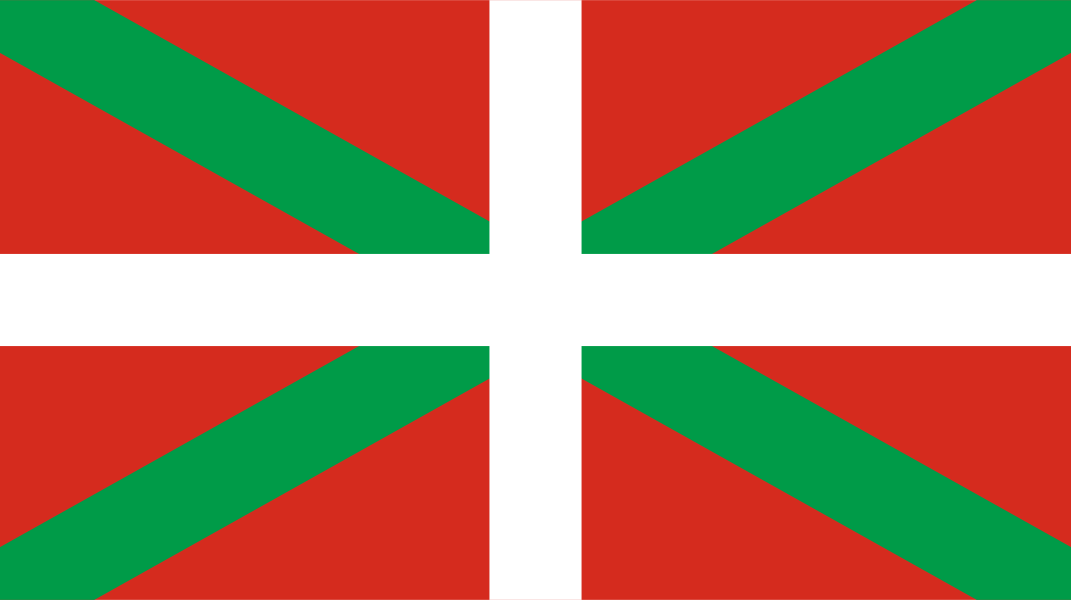
The flag of the Basque Country, called the ikurriña, has a red field crossed by a green saltire, with a white cross laid on top. Both crosses run to the edges of the flag and have the same width. Sabino Arana, who designed it with his brother Luis in 1894, tied the red field to the arms and people of Biscay, the green saltire to the Tree of Gernika, and the white cross to the Catholic faith. The flag is 14 units high and 25 wide. The Statute of Autonomy of 1979 defines it as a green saltire, a superimposed white cross and a red background.
The Basque flag is a red field, a green saltire and a white cross, stacked in that order. Basques call it the ikurriña. It was drawn in 1894 for one province, by two brothers who were building a political movement and wanted a flag for it. Within 42 years a government had made it official. For most of the 40 years after that it was illegal, and people sewed it at home and hid it under spare wheels.
Two brothers and a club in Bilbao
Luis and Sabino Arana designed the flag in 1894. They were the founders of the Basque Nationalist Party, and the flag was one piece of a larger kit that also held a name, a coat of arms and an anthem. Luis was an architect. The historian Luis de Guezala credits him as the likely author of the original sketch, which the Sabino Arana Foundation still keeps.
The flag was meant for Biscay only. The brothers' first outline gave each Basque territory its own flag, plus one more for the whole nation. None of the others caught on.
It flew for the first time in July 1894, at the opening of the Euskeldun Batzokija in Bilbao. The club had 94 founders. The oldest of them, Ciriaco de Iturri, raised the flag at six in the evening. That first ikurriña lasted a little over a year. The Spanish authorities seized it on 12 September 1895 when they closed the club.
What the three colours stand for
Sabino Arana explained the design through the arms of Biscay. The red field is the ground of that coat of arms and stands for the people of the province. The green saltire refers to the Tree of Gernika, the oak that symbolises Biscay's old laws. Arana also linked the saltire to Saint Andrew, on whose feast day a ninth-century battle was said to have been fought. The white cross stands for the Catholic faith. The arms of Biscay also carry wolves. He left them out.
The name is as new as the flag. Ikurrin comes from ikur, a word for a mark or sign. Ikurrina is the same word with the Basque definite article, and ikurriña is the Spanish spelling.
You will notice the resemblance to the Union Jack. Both lay an upright cross over a diagonal one and run both to the edges. The colours and the sources are different.
From party flag to official flag
The Basque Nationalist Party adopted the flag in 1895. For years it was a party symbol. That changed slowly. In 1925 the cultural society Euskaltzaleen Biltzarra began using it at its meetings. In 1931 the town of Durango asked Eusko Ikaskuntza, the Basque studies society, for its view. The society answered that flying the ikurriña was not tied to any party idea and expressed the unity of the Basques. In 1933 the party proposed it as the flag of the whole Basque Country.
The Civil War settled the matter. On 19 October 1936 the first Basque Government, under José Antonio Aguirre, made the ikurriña official by decree. The proposal came from Santiago Aznar, the Minister of Industry and a socialist.
Five days later a second decree changed the measurements. The first had given the cross and saltire bands of 0.20 metres on a flag of 5 by 2.80 metres. The decree of 24 October widened them to 0.43 metres so the crosses were easier to tell apart at a distance. The Basque Auxiliary Navy flew the flag as its jack during the war.
Hidden under a spare wheel
Franco's regime banned the ikurriña once it had defeated the Basque Government. Guezala writes that surviving flags were hidden and that the ban reached the colour combination itself.
The ban outlived Franco. In May 1976 the interior minister, Manuel Fraga, refused to authorise the Basque flag while allowing other regional ones. Then came a football match. On 5 December 1976 Real Sociedad hosted Athletic Club at Atotxa in San Sebastián. A Real Sociedad player, Josean de la Hoz, had planned the gesture. No shop sold the flag, so his sister sewed one. He drove it to the ground under the spare wheel of his Fiat 128, and police at a checkpoint searched the car without finding it.
Inside the stadium the flag went into the bag that held the sponge and water. Before kick-off Inaxio Kortabarria of Real Sociedad and José Ángel Iribar, Athletic's captain, carried it out at the head of both teams. Iribar had set one condition: every player had to agree. The police did not step in, and nobody was punished. De la Hoz did receive a death threat.
On 19 January 1977 the ikurriña was raised in the Plaza de la Constitución in San Sebastián. The flag was legal again that year.
The flag in law, and where the law stops
The Basque General Council confirmed the flag on 18 December 1978. A year later to the day, the Statute of Autonomy became law. Article 5 reads: "La bandera del País Vasco es la bicrucífera, compuesta de aspa verde, cruz blanca superpuesta y fondo rojo." In English, the flag is the one of two crosses, with a green saltire, a white cross over it and a red ground.
The Basque Government's specification keeps the 1936 measurements. The height is 56 percent of the width, which is 14:25. Each band is 8.6 percent of the width. The red is Pantone 485 C and the green is Pantone 347 C. The colours were left unregulated until 1999.
The statute covers the autonomous community of Araba, Bizkaia and Gipuzkoa. The flag travels further. In the French Basque Country it has hung on town halls beside the French tricolour since after the Second World War. It also forms part of the unofficial flag of Saint Pierre and Miquelon.
Navarre is the contested case. A regional law, Ley Foral 3/2017, repealed Navarre's earlier law on symbols, and several town halls took that as permission to fly the ikurriña. In January 2018 the Administrative Tribunal of Navarre ruled against Berriozar, which had hung one from its balcony during its festival. The tribunal held that official buildings there should show only the municipal flag beside those of Spain and Navarre.
References
[1] "Ikurriña: especificaciones técnicas," Gobierno Vasco. https://www.euskadi.eus/gobierno-vasco/contenidos/informacion/himo_ikurrina/es_461/ikurrina_especi_tecnicas.html
[2] "Ley Orgánica 3/1979, de 18 de diciembre, de Estatuto de Autonomía para el País Vasco," Boletín Oficial del Estado. https://www.boe.es/buscar/act.php?id=BOE-A-1979-30177
[3] Luis de Guezala, "Aberri Eguna 2020: the Ikurriña as a symbol of the Basque Homeland and of Freedom," About Basque Country. https://aboutbasquecountry.eus/en/?p=57213
[4] "Basque Country (Spain)," Flags of the World. https://www.fotw.info/flags/es-pv.html
[5] "A derby to recover the flag of a people," Ara. https://en.ara.cat/sports/derby-to-recover-the-flag-of-people_130_3935603.html
[6] "El Tribunal Administrativo de Navarra rechaza que ondeen ikurriñas en ayuntamientos navarros," El Independiente. https://www.elindependiente.com/politica/2018/01/30/declaran-nulo-hacer-ondear-ikurrinas-ayuntamientos-navarros/
[7] "Ikurriña," Wikipedia. https://en.wikipedia.org/wiki/Ikurri%C3%B1a
Common questions
- What does the Basque flag mean?
- Sabino Arana gave each part a meaning. The red field stands for the people of Biscay and comes from the colour of the province's arms. The green saltire refers to the Tree of Gernika, the oak that symbolises Biscay's old laws. The white cross stands for the Catholic faith. The Statute of Autonomy describes the design and assigns no meaning to it.
- Who designed the ikurriña?
- The brothers Luis and Sabino Arana designed it in 1894. They founded the Basque Nationalist Party. Luis was an architect, and the historian Luis de Guezala writes that he is the likely author of the original sketch, which the Sabino Arana Foundation keeps. The flag first flew in July 1894 at the brothers' club in Bilbao, the Euskeldun Batzokija.
- Why is it called the ikurriña?
- The word is a coinage of the Arana brothers' time. It comes from ikur, meaning mark or sign. Standard Basque spells the word ikurrin, and ikurrina is the same word with the definite article. Spanish writes it ikurriña. The Statute of Autonomy uses another name, la bicrucífera, the flag of two crosses.
- Why does the Basque flag look like the Union Jack?
- Both flags lay an upright cross over a diagonal one, and both crosses reach the edges. The colours and the origin differ. The ikurriña takes its red, white and green from the arms and the old flag of Biscay. The Union Jack combines the crosses of three patron saints in red, white and blue.
- When was the ikurriña banned?
- Franco's regime banned the flag after defeating the Basque Government in the Civil War. It stayed illegal for the rest of the dictatorship. In May 1976 the interior minister Manuel Fraga still refused to authorise it. On 5 December 1976 players from Real Sociedad and Athletic Club carried one onto the pitch at Atotxa, and the police did not act. It was legal again in 1977.
- What are the official proportions and colours of the Basque flag?
- The height is 56 percent of the width, a ratio of 14:25. The saltire and the cross have the same width, 8.6 percent of the flag's width. The Basque Government specifies Pantone 485 C for the red and Pantone 347 C for the green. The measurements go back to a decree of 24 October 1936, which set bands of 0.43 metres on a flag of 5 by 2.80 metres.
Download this flag
Free in 12 styles, from 32px icons up to 2000px, as SVG, PNG, WebP and JPG.