Search the flags of every country, territory, and dependency on Earth and you will find lions, eagles, dragons, swords, castles, and one sinking ship. Bermuda's flag is the only one anywhere that depicts a shipwreck, and not a generic one either. It shows a specific vessel, the Sea Venture, breaking apart on a specific reef in a specific storm in July 1609.
Most nations put their proudest moment on their flag. Bermuda put its founding catastrophe. The wreck is right there in the coat of arms on the fly side: a red lion holding a shield, and on the shield a three-masted ship going down by the bow against the rocks. To understand why a territory would fly its own maritime disaster from every government building, you have to go back to the storm that started everything.
The wreck of the Sea Venture, 1609
The Sea Venture was the flagship of a nine-vessel relief fleet sent by the Virginia Company of London to resupply Jamestown, England's starving toehold in North America. She carried around 150 people, including the colony's incoming acting governor, Sir Thomas Gates, and Admiral Sir George Somers.
In late July 1609 the fleet sailed into a hurricane. The ships scattered. The Sea Venture took on water for days as the crew bailed continuously, and by the time the storm eased she was sinking. Then came the sighting of land: Bermuda, an island group feared by Spanish sailors as the "Isle of Devils," ringed by reefs that had been tearing hulls open for a century.
Somers made a decision that turned a sinking into a founding. Rather than let the ship go down in open water, he deliberately drove her onto the reefs off what is now St. George's, wedging the hull fast so everyone aboard could get ashore. All hands survived. So did the ship's dog.
The castaways spent ten months on the uninhabited island, living off wild hogs, fish, and birds. They built two new ships from Bermuda cedar and the salvaged remains of the Sea Venture, named with an honesty you have to admire: Deliverance and Patience. In May 1610 they sailed on to Jamestown, completing what may be history's most productive shipwreck. Three years later, in 1612, England formally settled Bermuda; its first town, St. George's, remains the oldest continuously inhabited English town in the New World. Bermuda exists as a settled place because a ship hit it.
One more ripple: an account of the wreck by survivor William Strachey circulated in London, and many scholars believe it inspired Shakespeare's The Tempest, written soon after. Bermuda's shipwreck has a reasonable claim to being the only flag element with its own Shakespeare play.
What's actually on the flag
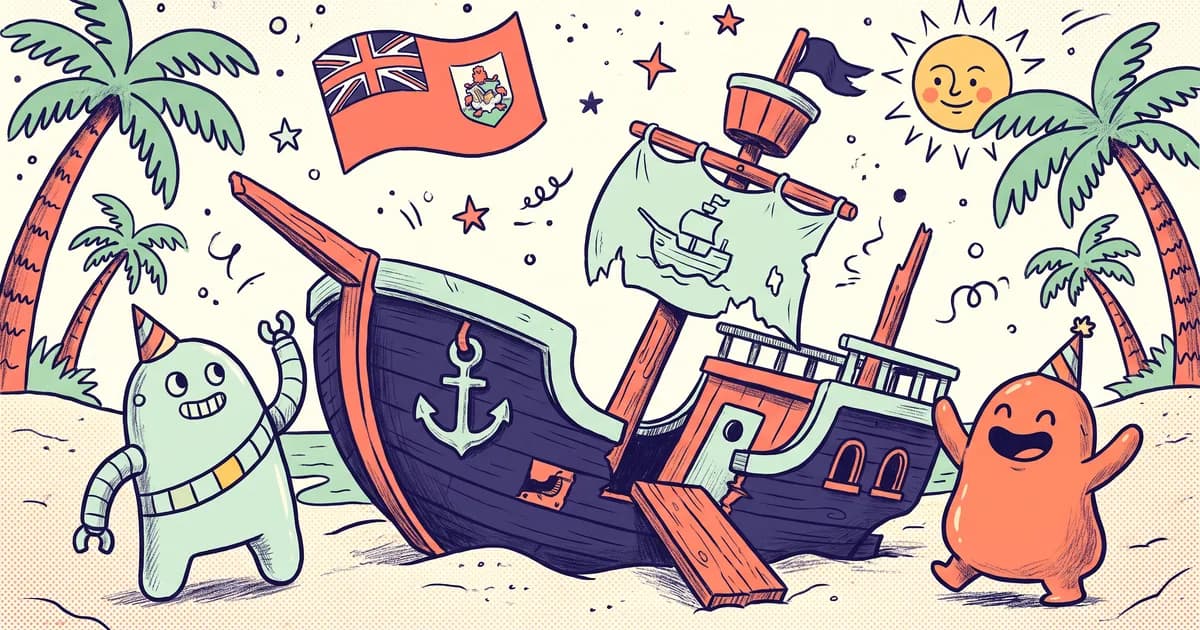
Bermuda's flag is a British Red Ensign: a red field with the Union Jack in the canton and the territory's coat of arms in the fly. The arms, formally granted on 4 October 1910, show a red lion "sejant affronté" (sitting, facing the viewer) holding a shield between its forepaws. The lion stands for Britain. The shield it protects shows the Sea Venture against blue and white waves, sails torn, striking the reef.
Beneath it runs the motto Quo Fata Ferunt: "Whither the Fates Carry Us." For a territory founded by people blown 600 miles off course, it is less a motto than a plain statement of fact.
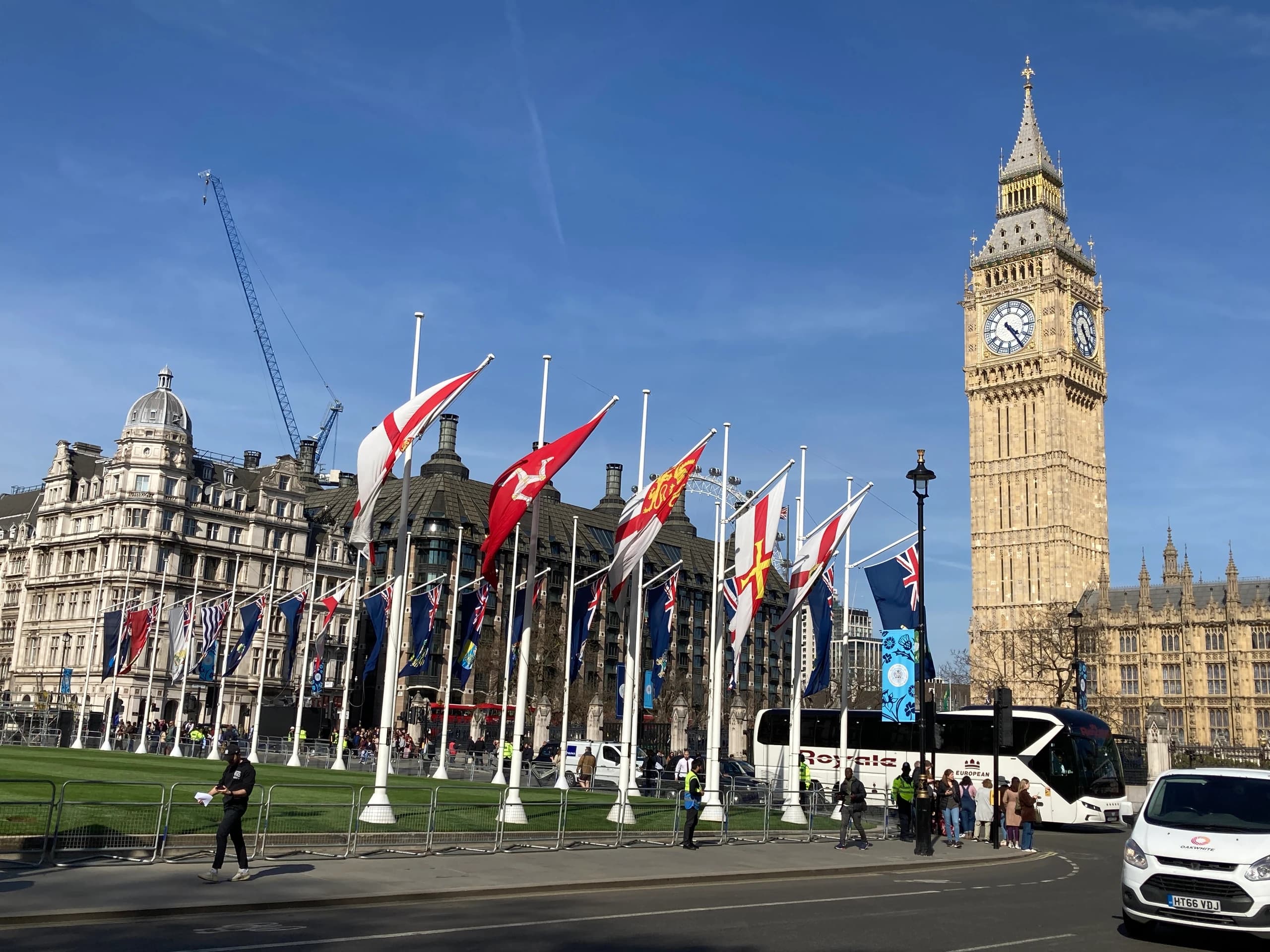
The red field is itself a quiet oddity. Nearly every British Overseas Territory flies a Blue Ensign on land: the Cayman Islands, the Falklands, Montserrat, the British Virgin Islands, all blue. Bermuda alone uses the red version, an unauthorized local habit that grew up in the early 20th century, echoing the onshore red ensigns of Canada and South Africa in their dominion days, and was only formally sanctioned in 1967. Whatever drove it, the habit makes Bermuda's flag instantly identifiable twice over: the only red one in the family, and the only one with a ship going down.
The Cayman Islands make a good comparison. Their arms also lean maritime, with blue and white wavy lines, a turtle, and a motto from Psalm 24, "He hath founded it upon the seas." But Cayman chose the sea in the abstract. Bermuda chose the moment the sea nearly killed everyone.
Why keep the shipwreck?
Plenty of places have rebranded away from less flattering origins. Bermuda has done the opposite and doubled down. The wreck appears on the flag, the coat of arms, and the local currency, and the 400th anniversary of the wreck, in 2009, was a year-long national celebration.
The reason is that the story reads as providence rather than failure. Every element of it bends toward the miraculous: the ship held together just long enough, the reef caught her instead of sinking her, all 150 people walked ashore onto an island with no predators, no disease, and no inhabitants, stocked with wild pigs left by earlier Spanish voyages. The castaways themselves read it that way; accounts from 1610 describe Bermuda's reputation as a devil-haunted death trap dissolving into something closer to paradise.
There is also a harder-nosed reading. Bermuda's entire subsequent history (shipbuilding, privateering, sailing, tourism, and its modern role as a maritime insurance capital) flows from its position astride Atlantic shipping routes and the reefs that made it a graveyard for everyone else's ships. Around 300 wrecks lie in Bermuda's waters, one of the densest concentrations in the Atlantic. The flag is honest about what built the place.
The answer to the quiz question
So, to settle the question that likely brought you here: the country flag with a shipwreck on it belongs to Bermuda, a British Overseas Territory in the North Atlantic. The ship is the Sea Venture, wrecked deliberately on Bermuda's reefs by Sir George Somers in 1609 to save everyone aboard, an act that led directly to the island's settlement. No other national or territorial flag shows one.
Flags usually commemorate victories, revolutions, and dynasties. Bermuda's commemorates the day everything went wrong in exactly the right way, and four centuries later it remains the best argument in vexillology that a disaster, survived well, is worth flying.