Dressed for the Coronation: Why So Many Caribbean Flags Are Still Wearing Britain's Blue
Julio Song · · 9 min read
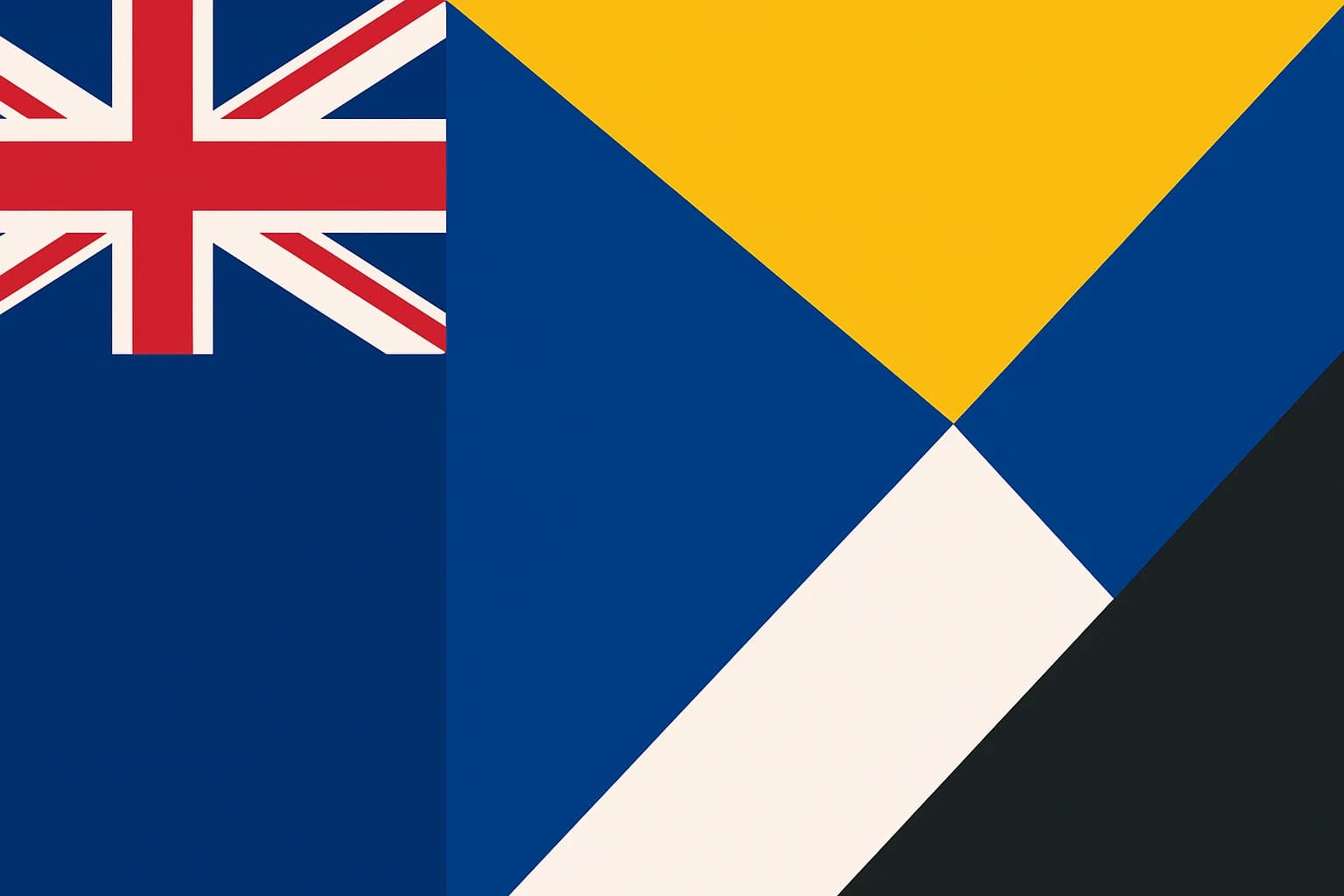
Lay out the flags of a dozen Caribbean nations and territories side by side and a visitor from another planet might reasonably conclude that a single empire still runs the region. A deep, almost electric blue dominates. It shows up in Barbados, in Saint Kitts and Nevis, in the Cayman Islands, in Turks and Caicos. Some of these countries have been independent for over half a century. Others never left British rule. The blue endures either way.
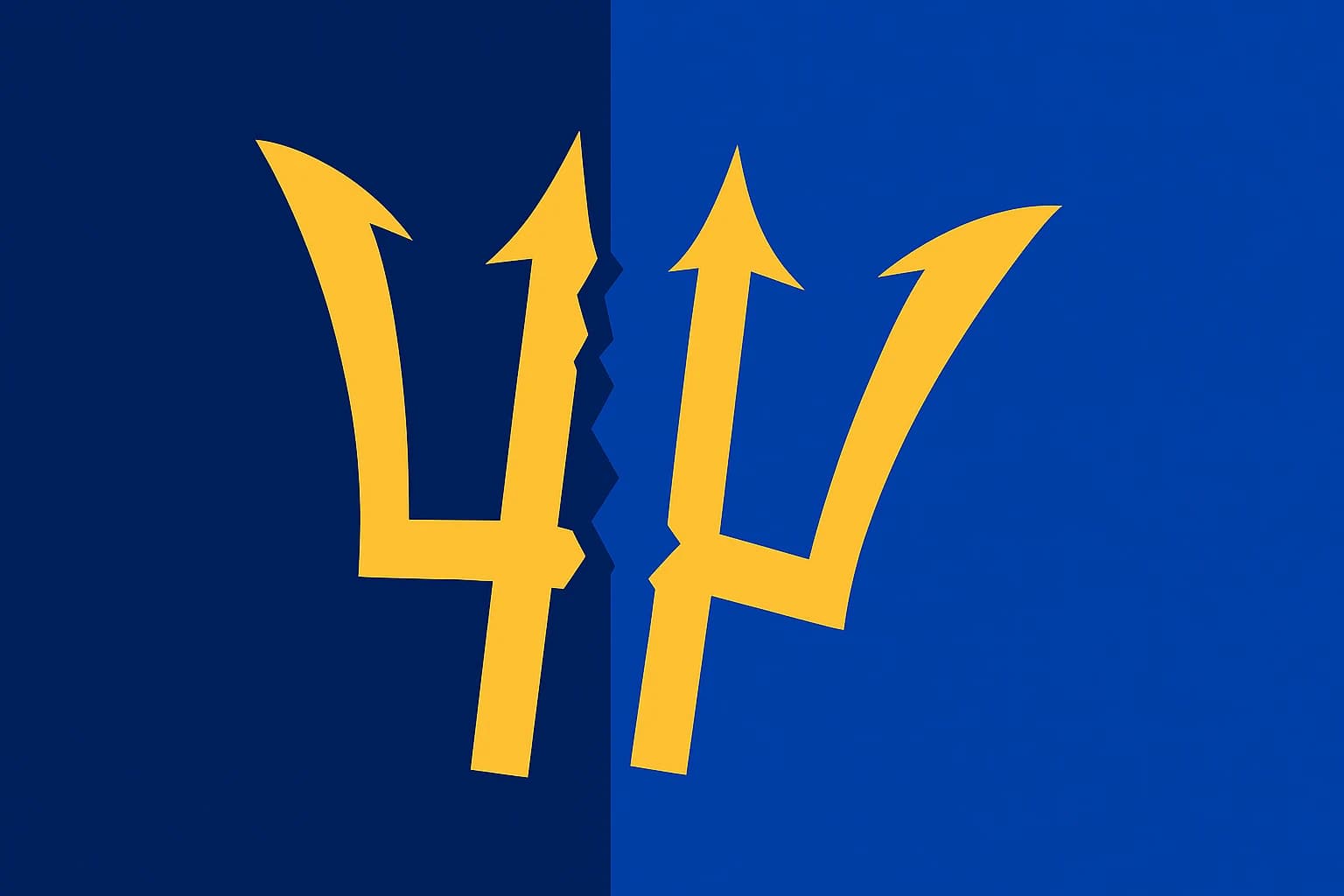
Consider Barbados. It became a republic in 2021 with enormous fanfare, removing the Queen as head of state, installing its first President, and naming Rihanna a National Hero in a single evening. The flag flying over that ceremony was still, structurally, a descendant of the British Blue Ensign, and the shade had barely changed.
That is not a design accident. Tracing a single color across a cluster of Caribbean flags gets you a more honest account of postcolonial sovereignty than most political histories offer: not a clean break, but negotiation, inertia, pride, and occasional deliberate forgetting.
Britain's blue franchise system
The Blue Ensign design is simple: a dark blue field (roughly Pantone 280) with the Union Jack in the canton. Originally made for British government vessels, the template was adapted by the Colonial Office in the 19th century for every territory under the Crown.
Each colony received a "defaced" Blue Ensign, meaning the Union Jack stayed in the upper left corner and the colonial badge went in the fly, the right side of the flag. Same blue, same canton, different logo, applied across an empire.
By the early 20th century, dozens of territories from Fiji to Jamaica to British Guiana were flying near-identical flags distinguished only by their badges. The Blue Ensign is arguably the most replicated flag template in history.
These flags were administrative tools, not national symbols. They identified a ship's registry or a governor's office and were never designed to inspire patriotic feeling. When independence came, many territories inherited them as de facto national flags anyway, often without much public debate about what they represented. The Caribbean is a concentrated case study: the Blue Ensign template survived independence in some islands, was modified in others, and was only partially shed even by governments that thought they were making a clean break.
The inertia flags: when nobody got around to changing it
For many Caribbean territories, particularly smaller ones, the Blue Ensign persisted because flag reform costs more than it looks. Changing a flag requires legislation, design competitions, sometimes public referenda, and international re-registration across embassies, treaties, and maritime records. For a small island government juggling healthcare, hurricane preparedness, and tourism policy, a redesign sits far down the list.
Take the Cayman Islands. A British Overseas Territory with no active independence movement, it has kept its Blue Ensign essentially unchanged since 1958. The blue there is administrative continuity, not national identity. Nobody voted for it and nobody voted against it. It persists because changing it would take political energy nobody has reason to spend.
The Turks and Caicos Islands are similar. The flag has gone through minor badge revisions over the decades, but the blue field has never been seriously challenged, and reform ranks low against tourism revenue and offshore finance policy, the two engines that keep the territory running.
Some of this is structural. Post-independence governments inherited colonial-era civil services, and the same officials who administered the old flag often administered the new one.
Inertia is not endorsement, though. Several Caribbean leaders have publicly acknowledged the colonial origins of their blue flags while deprioritizing any change, which says something about how postcolonial governance actually works: you deal with the urgent, not the symbolic.
When blue became a deliberate choice
Not every blue flag in the Caribbean is a leftover. In some cases the deep blue field was an active decision.
Saint Kitts and Nevis gained independence in 1983 and abandoned the Blue Ensign format entirely. Its diagonal flag, with bands of green, red, black, and yellow, is unmistakably its own. It still uses a deep blue as a background element, explicitly chosen to represent the Caribbean Sea and the sky. The shade is similar to the old one. The meaning is not.
Barbados is the more instructive example. At independence in 1966, the new flag broke from the Blue Ensign with a vertical triband of ultramarine, gold, and ultramarine, and a broken trident at the center. The trident was Britannia's, snapped at the shaft to represent severed colonial ties. The blue was kept but reframed: it now meant the sea and sky, not the Crown.
Vexillologists (flag scholars, for the uninitiated) call this semantic drift. The same color gets drained of one meaning and refilled with another through official narrative, public ceremony, and school curricula. A generation of Barbadian children learned that the blue on their flag meant the ocean, and the fact that it started as a British administrative color faded from collective memory.
Many Caribbean flags were designed by committee between the 1960s and the 1980s, often under time pressure as independence dates approached. The choice of blue frequently reflected both pragmatic continuity and a real desire to assert a Caribbean maritime identity. When you live on an island surrounded by that water, the color feels natural regardless of who used it first.
Barbados 2021: a republic that kept its flag
November 30, 2021. Barbados removes the Queen as head of state, installs Dame Sandra Mason as its first President, and throws a ceremony watched around the world. Rihanna is named a National Hero. Fireworks go off over Bridgetown.
The flag flying at that ceremony was structurally identical to the one adopted at independence in 1966: two bands of ultramarine flanking a gold center stripe, with the broken trident. No flag change accompanied the republic declaration. None was proposed.
The reason is that the flag had republican symbolism built into it from the start. The broken trident shaft was an explicit reference to breaking with colonial rule, decided by a committee in 1966, thirty-five years before the republic became reality. By 2021 the flag was already doing the symbolic work.
The ultramarine of the Barbados flag is still visually indistinguishable from British Blue Ensign blue to most observers. Whether that counts as successful reclamation or a lingering ghost depends on whether you think identity lives in the pigment or in the story people tell about it. When a colonial color stops being colonial is not a question with a clean answer.
The ones that broke from blue entirely
Some Caribbean nations made a total break from the blue field, and looking at them explains why so many others did not.
Jamaica, independent since 1962, flies a flag of black, gold, and green. At the time of its design it was the only national flag in the world containing neither red, white, nor blue. That was deliberate. The colors represent African heritage, natural wealth, and hope, and the diagonal saltire gives it a shape unlike any colonial template.
Trinidad and Tobago, also independent from 1962, chose a red field with a black-and-white diagonal stripe. Designed by the Trinidadian artist Carlisle Chang, it repudiates the Blue Ensign completely. Red was chosen for the energy and warmth of the people, not for any administrative tradition.
Guyana, independent from 1966, went further. The "Golden Arrowhead" flag was designed by Whitney Smith, an American vexillologist brought in partly to make sure the design carried no residual colonial visual DNA. It uses green, white, gold, black, and red. Not a trace of blue.
The nations that broke from blue most decisively tended to have stronger pan-African political movements, more confident design leadership, or both. Jamaica's flag was a Pan-Africanist statement. Guyana's was an act of deliberate vexillological hygiene. The persistence of blue elsewhere is partly a story about which postcolonial governments had the bandwidth and the confidence to invest in visual sovereignty.
What the blue means now
In 2026, the blue in Caribbean flags is doing at least three jobs at once, and they rarely get separated in public conversation.
The first is colonial legacy. For critics of postcolonial governance, British blue on an independent nation's flag is evidence that the visual grammar of empire was never fully dismantled. Caribbean scholars and reparations activists have pressed this argument in recent years, connecting flag symbolism to broader questions about economic dependence and institutional inheritance.
The second is tourist branding. Blue flags signal stability and a certain kind of safe island identity to international tourists and investors. For territories like the Cayman Islands, the Blue Ensign is practically a brand asset, associated with British legal frameworks and financial reliability. Changing it would, in a narrow commercial sense, cost money.
The third is Caribbean identity, plainly. The sea is blue and the sky is blue. For many islanders the blue in their flag is not British at all. It is the water they grew up swimming in. The colonial origin of the shade is not part of how they experience their own flag day to day.
All three are true at once, and which one dominates depends on who is looking. A flag means something different to the person who designed it, the government that flies it, the tourist who photographs it, and the citizen who grew up under it.
The future of blue in Caribbean vexillology
Given the ongoing global conversation about colonialism and reparations, amplified in the Caribbean by movements in Barbados, Jamaica, and elsewhere, is flag reform likely?
Probably not soon. Jamaica has seen intermittent public discussion since the early 2010s about updating its flag, which is, ironically, the one that broke most cleanly from colonialism, while nations with far more residual colonial blue have seen almost no equivalent pressure. Most vexillologists and political scientists agree that flag reform is extremely hard to accomplish without a galvanizing national moment: independence, a republic declaration, a revolution. Absent that, blue persists by default.
Barbados in 2021 is the useful model. A political transformation that could have triggered a flag change didn't, partly because the existing flag was already semantically rich enough. That is the likely pattern for the region going forward: reinterpretation rather than erasure, keeping the color and changing what it is said to mean.
Julio Song
Writer
Julio is a staff writer at FlagDB. He studied Mathematics at the University of Madrid and has a passion for vexillology.
More from Julio Song →Related articles
Diagonal Lines and Divided Futures: How Guyana, Tanzania, and Saint Kitts and Nevis Used Slashes to Tell Stories of Struggle
Black Is Not Nothing: The Radical Political Statement Hidden in Jamaica's Flag