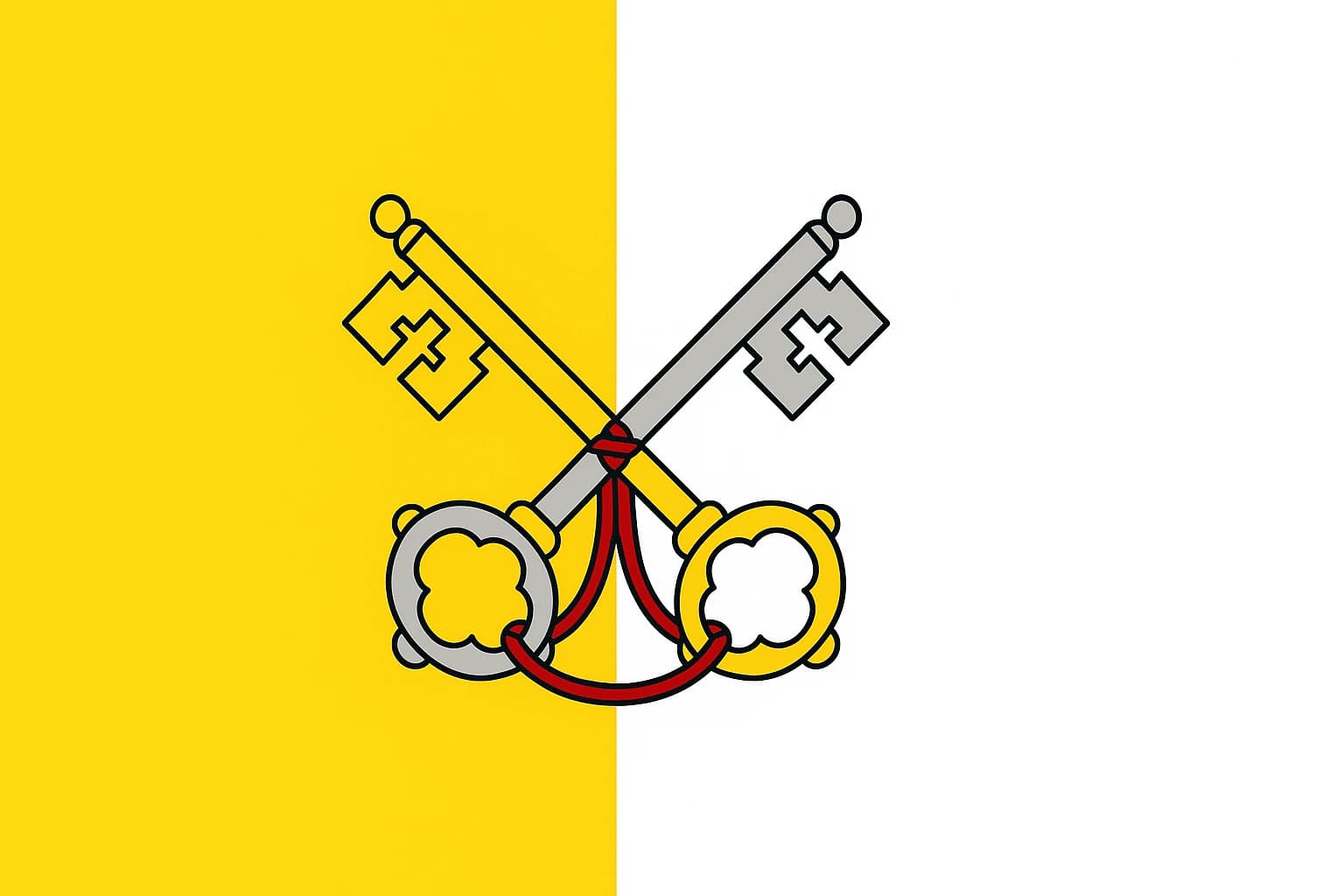
Vatican City is a sovereign state of 44 hectares, smaller than a lot of golf courses, with a population of roughly 800. Over it flies a square gold and white flag that is probably the most symbolically dense national flag anywhere. Every element, from the unusual square shape to the crossing angle of two medieval keys, encodes a theological claim traceable to one sentence attributed to Jesus in the Gospel of Matthew.
It is also extremely well travelled. It is seen by the 1.4 billion Catholics who look to Rome, printed on souvenirs from St. Peter's Square, and flown at papal nunciatures in nearly every country. Very few people can say what the crossed keys mean, why one is gold and one silver, or what the triple-crowned tiara above them is for.
A square among rectangles
Most national flags are rectangles. The Vatican's is not. It is one of only two square sovereign-state flags in the world, the other being Switzerland's.
The 1:1 ratio comes from the traditional shape of papal military banners carried by the Palatine Guard and the Noble Guard. Those units used square standards to distinguish themselves from the rectangular flags of secular armies, which makes the flag's proportions themselves an argument.
The two vertical bands, gold rendered as yellow and white, are equally loaded. In heraldic tradition gold stands for temporal power and earthly authority, silver or white for spiritual purity and heavenly authority. Put side by side they assert the papacy's double claim, governance of the world and supremacy of the soul, in one office.
The colours are more recent than most people assume. Pope Pius VII adopted yellow and white in 1808, replacing the earlier red and gold of the Papal States after Napoleon's forces co-opted those colours. The new palette was an act of visual rebellion against French occupation. Every time you see that yellow and white flag, you are looking at a middle finger raised at Napoleon Bonaparte. Politely, of course. In silk.
The flag as we know it was formally established on June 7, 1929, following the signing of the Lateran Treaty between the Holy See and Mussolini's Italy on February 11 of that year. That makes the Vatican flag's design inseparable from one of the 20th century's most controversial political bargains: the Catholic Church recognizing Fascist Italy in exchange for sovereignty over a few dozen hectares.
The keys of St. Peter
The two crossed keys at the centre of the flag are the whole point; everything else is framing. They refer to Matthew 16:19, where Jesus tells the apostle Peter: "I will give you the keys of the kingdom of heaven; whatever you bind on earth will be bound in heaven, and whatever you loose on earth will be loosed in heaven." That one verse is the scriptural foundation for the entire institution of the papacy.
The gold key, placed on the dexter (right) side in heraldic terms, symbolizes the power to bind and loose in heaven: spiritual authority that transcends the earthly realm. The silver key represents temporal authority, the pope's power to govern on Earth. Their crossing signifies the inseparability of these two powers in the person of the pope. You don't get one without the other.
Look closely and the wards, the business end of the keys, point upward toward heaven while the handles point down toward the viewer. That is deliberate: the power originates with God and is merely administered by his earthly vicar. A red cord binds the two keys at the handles, for the unity of both authorities in one office.
None of this iconography began with the flag. The crossed keys first appeared in papal heraldry under Boniface VIII (1294 to 1303), the pope who made the most aggressive claims of papal supremacy over secular rulers in his bull Unam Sanctam (1302). It was a political weapon aimed at kings and emperors, not a decorative flourish.
By the time the keys migrated to the Vatican flag in 1929 they carried over 600 years of accumulated meaning, from medieval power struggles between popes and emperors to the Counter-Reformation's reassertion of papal primacy at the Council of Trent (1545 to 1563). That is a lot of baggage for two pieces of illustrated metalwork.
The triple tiara
Above the crossed keys sits the papal tiara, the triregnum, a beehive-shaped triple crown and probably the most loaded piece of headgear ever made. Each of the three crowns carries a separate claim: the pope as Father of Princes and Kings, as Ruler of the World, and as Vicar of Christ on Earth.
The tiara accumulated those crowns slowly. It began in the early medieval period as a plain white cap, the camelaucum. A single crown was added around the 10th century. Boniface VIII added a second circa 1301, again during his power struggle with Philip IV of France. The third appeared by 1342, under Benedict XII or Clement V depending on which historian you trust. Each addition stacked a new claim of authority on the last.
Then it stopped. During the Second Vatican Council, Pope Paul VI placed his tiara on the altar of St. Peter's Basilica on November 13, 1964, and never wore it again. It was later sold at auction, bought by Cardinal Francis Spellman of New York for $1 million. No pope since has worn one.
The tiara is still on the flag in 2026, which leaves a gap between the Church's post-conciliar humility and its state heraldry. The flag continues to claim universal sovereignty. The popes stopped dressing like it.
Pope Benedict XVI deepened this split in 2005 when he replaced the tiara on his personal coat of arms with a bishop's mitre. Pope Francis has continued that practice, further widening the gap between the living papacy's visual identity and the flag that represents its state.
From Papal States to microstate
The flag's symbols predate the Vatican state by over half a millennium. The crossed keys and tiara were the arms of the Papal States, a sprawling territory across central Italy that the popes governed as temporal monarchs from the 8th century until Italian unification dissolved them in 1870.
Between 1870 and 1929, the period known as the Roman Question, the popes were effectively prisoners in the Vatican, refusing to recognize the Italian state that had seized their territory. Across those 59 years the papal symbols carried on appearing on unofficial banners and ecclesiastical documents. The heraldry stayed alive without a state to fly it over, a flag waiting for a country to come back.
The Lateran Treaty of February 11, 1929, resolved the Roman Question. It created Vatican City State, granting the Holy See sovereignty over 44 hectares in exchange for the pope's recognition of the Kingdom of Italy with Rome as its capital.
Article 20 of the treaty specifically addressed the new state's flag and coat of arms, codifying centuries of papal heraldry into the legal framework of a modern sovereign entity.
That makes the Vatican flag a rare case: not a symbol designed for a new nation but ancient institutional heraldry retrofitted onto a 20th-century microstate. The identity came first and the state was built underneath it.
What changes with each pope, and what does not
The state flag itself stays stable, but the version displayed at papal audiences and on official documents varies in small artistic details from pontificate to pontificate. The shape of the tiara's crowns, the ornamentation of the keys and the style of the connecting cord have all had minor aesthetic updates.
The biggest of these soft changes came under John Paul II, whose long pontificate (1978 to 2005) standardized a simplified, bolder rendering of the coat of arms for modern media reproduction. It was a practical acknowledgment that the symbolism now had to read on television screens and web pages rather than on silk banners viewed from horseback.
Pope Francis's papacy (2013 to present) has made no changes to the state flag. His personal choices pull the other way, though: the simple pectoral cross, the refusal to live in the Apostolic Palace, the modified coat of arms with a star and spikenard flower. The flag says supreme sovereign. The pope says bishop of Rome.
The design is governed by the Fundamental Law of Vatican City State, last revised in 2000 under John Paul II, so any formal change would need legislative action. Even the world's smallest absolute monarchy has bureaucratic procedure.
How it compares to other religious flags
The Vatican is not the only state whose flag carries explicit religious symbolism, but it is the most theologically specific.
Israel's flag, adopted in 1948, features the Star of David, a symbol more ethno-cultural than theological. It makes no specific doctrinal claim comparable to the Vatican's keys-and-tiara assertion of divine authority vested in one person.
Iraq's flag includes the Arabic inscription "Allahu Akbar" (God is Great), added by Saddam Hussein in 1991 and retained through subsequent redesigns. While explicitly religious, the phrase is a broad declaration of faith rather than a claim about institutional authority.
Saudi Arabia's flag, bearing the shahada (Islamic declaration of faith) and a sword, is perhaps the closest parallel in terms of doctrinal weight. It proclaims the foundational creed of Islam. But even this flag lacks the institutional specificity of the Vatican's imagery, which points not to a faith in general but to a single office and its claimed divine mandate.
Among Christian-majority nations, many flags incorporate crosses. The Scandinavian countries, Greece, Georgia, the United Kingdom, all feature them.
None of them approach the Vatican's level of theological detail. A cross on a flag says Christian heritage. The Vatican flag says the Bishop of Rome holds the keys to heaven, exercises authority over all earthly and spiritual matters, and wears a triple crown of universal sovereignty. That is not a difference of degree.
Which is what makes it strange as a national flag. It is a medieval power claim that survived Napoleonic invasion, Italian unification and a treaty with fascism, and it now flies over 44 hectares of Roman real estate, still asserting everything it asserted in 1302.