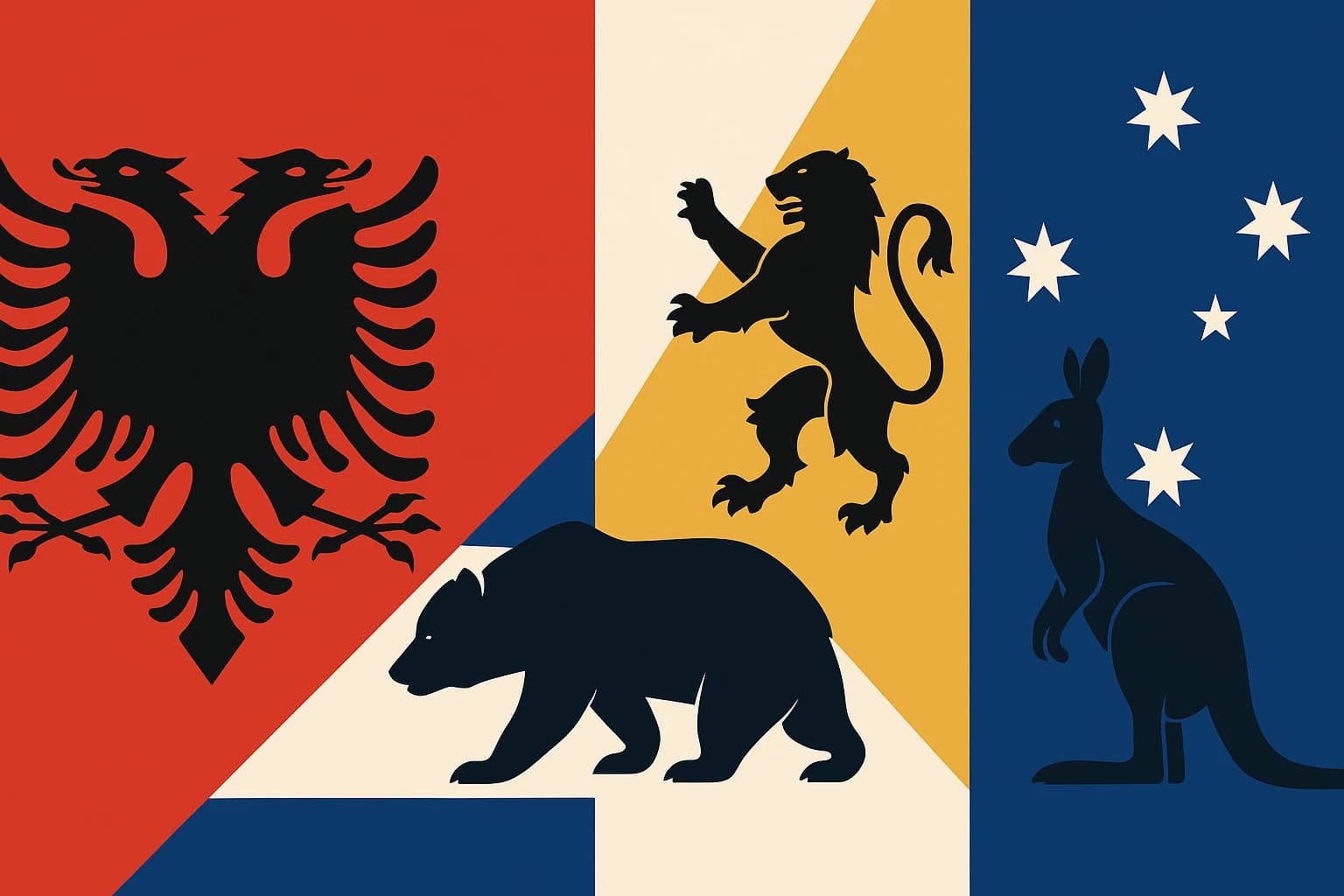
Animals turn up on national flags and emblems far more often than you would expect from pure design logic. An animal is harder to draw than a stripe and harder to reproduce at small sizes, so when a country puts one on its flag it usually has a reason. Historically animals carried associations with power, wisdom and fertility, and a country adopting one is borrowing those associations for itself.
The dragon of Bhutan
Bhutan's flag carries the Druk, or Thunder Dragon, lying white across the line that divides the yellow upper triangle from the orange lower one. It stands for the protection of the country, and the jewels clutched in its claws for the country's wealth. It is a creature that has never existed in nature, which is a rarer choice on a national flag than the lions and eagles it sits alongside.
The beaver of Canada
The beaver is not on the Canadian flag, but it is a national emblem all the same. It is known for building and for not stopping, which made it an obvious stand-in for hard work in a country with a lot of wilderness to get through.
The eagle in the United States and Mexico
The eagle belongs to both American and Mexican national symbolism, in each case for strength and freedom and the obvious appeal of a bird that flies high. Mexico's version is more specific: the eagle grips a snake while standing on a prickly pear cactus, an image from the Aztec legend of the founding of Tenochtitlán.
Local animals, local meanings
Native species make their way into national emblems because they are already familiar. Australia's kangaroo and New Zealand's kiwi are recognizable as those countries before anything else is said about them.
Different countries also pick the same animal for different reasons. Eagles appear all over the world's flags and emblems, and the meaning attached to each one comes from its own local history rather than from any shared code.
How the symbols change
Animal symbolism does not sit still. Countries update how their emblems are drawn, and those revisions tend to set off arguments about tradition against modernity. The arguments are worth having, since they are really arguments about what the country now claims to be.
Vexillology, the study of flags, is where this shows up as a design question rather than a cultural one. Bhutan's flag is a good case: elaborate animal symbolism worked into a design that still has to read clearly on a pole.