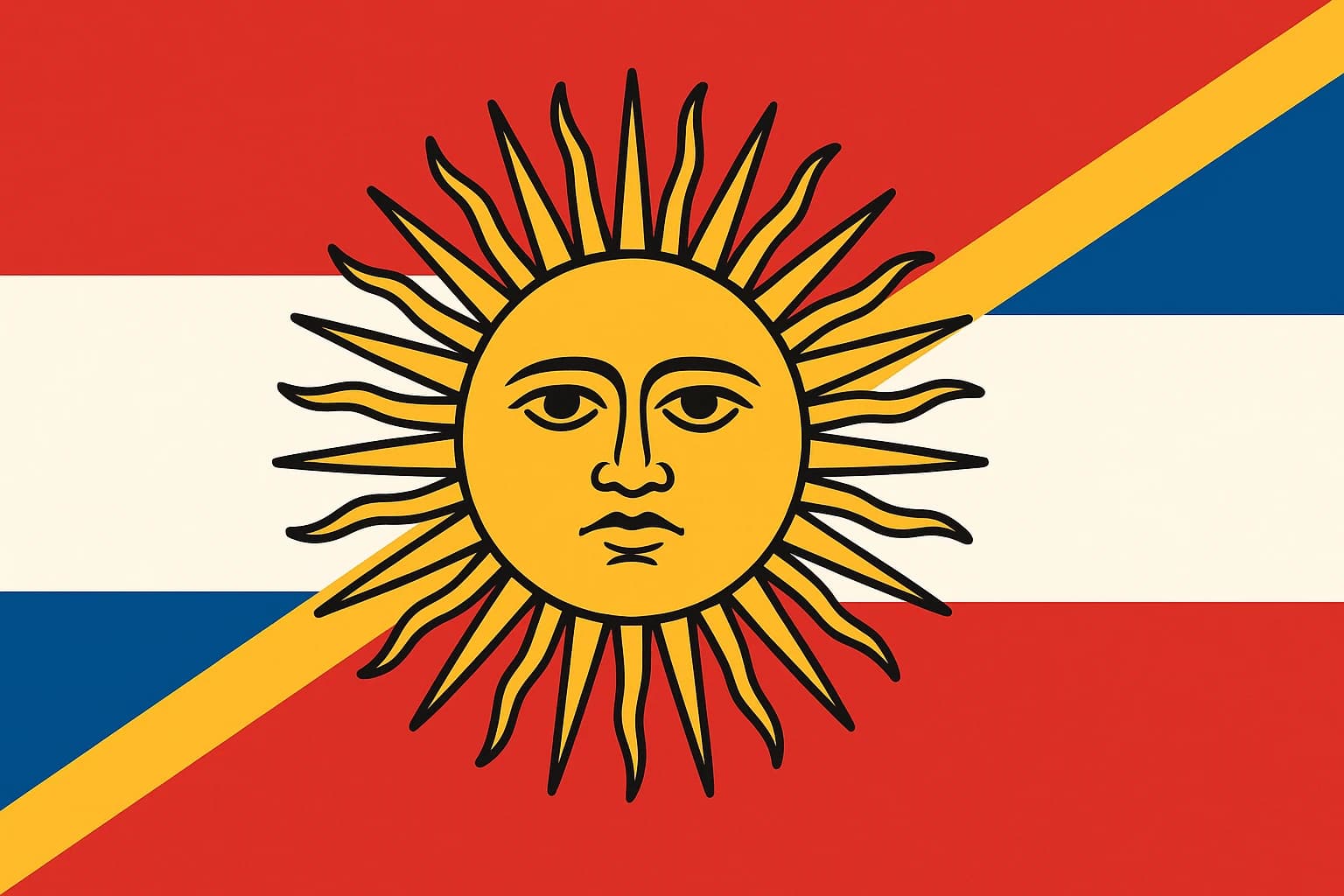
Argentina and Bolivia sit at opposite ends of the Andes, and their flags took different routes to saying who they are. One looks up at the sky. The other looks down at the ground and at what can be dug out of it.
Argentina's sky and its sun
Argentina's flag has three horizontal bands, light blue and white, with a sun in the middle.
That sun is El Sol de Mayo, the Sun of May. It points to the Inca sun god Inti and to the May Revolution of 1810, a step towards Argentine independence. The light blue and white are traditionally read as sky and clouds, a reading the flag itself never states outright.
Bolivia's red, yellow and green
Bolivia's flag is red, yellow and green.
Red is for the soldiers who fought for the country, yellow for its mineral wealth, green for fertility and farming. The coat of arms at the center puts an Andean condor above mountains and a rising sun, standing for protection and sovereignty. The design has been changed more than once, and each revision tracked a shift in Bolivian politics.
What the mountains have to do with it
The Andes dominate the landscape in both countries, and both flags draw on colors and symbols tied to mountain country and to indigenous roots that predate the Spanish. The range gives the two nations a shared point of reference even where their flags diverge.
Where they part company
Argentina's flag is celestial and revolutionary. Bolivia's is closer to an inventory: what the land holds, who defended it, what it grows. Both were adopted by countries breaking away from colonial rule, and both use strong color to say so plainly.