Purple, White and Green: How the Suffragettes Turned Three Colors Into a Uniform
Julio Song · · 8 min read
In June 1908, the suffragette newspaper Votes for Women ran an advert for a motor scarf. It was white Japanese silk with green and purple stripes, it cost two shillings and elevenpence, and its selling point was the laundry. The scarf washed well, "the colours, like the principles of the Union, being fast".
That line is a sales pitch and a manifesto at once. It also tells you how the Women's Social and Political Union thought about color. The WSPU treated purple, white and green as a uniform, a fundraising scheme and a flag, and it rolled out all three in the space of a few weeks.
Before the purple, there was red
The WSPU started small. Emmeline Pankhurst and her daughter Christabel founded it on 10 October 1903 at 62 Nelson Street, Manchester, the family home.
In those early years the WSPU flew red and white flags. Why red? Nobody is sure. The historian Elizabeth Crawford has said it is unclear whether the choice was meant to show solidarity with socialism.
The change came from Emmeline Pethick-Lawrence, the WSPU's treasurer. In autumn 1907 she and her husband Frederick founded Votes for Women and edited it together. In the spring of 1908, with the union planning its biggest rally yet, she chose purple, white and green to promote the organization and show it as one body.
What the three colors were supposed to mean
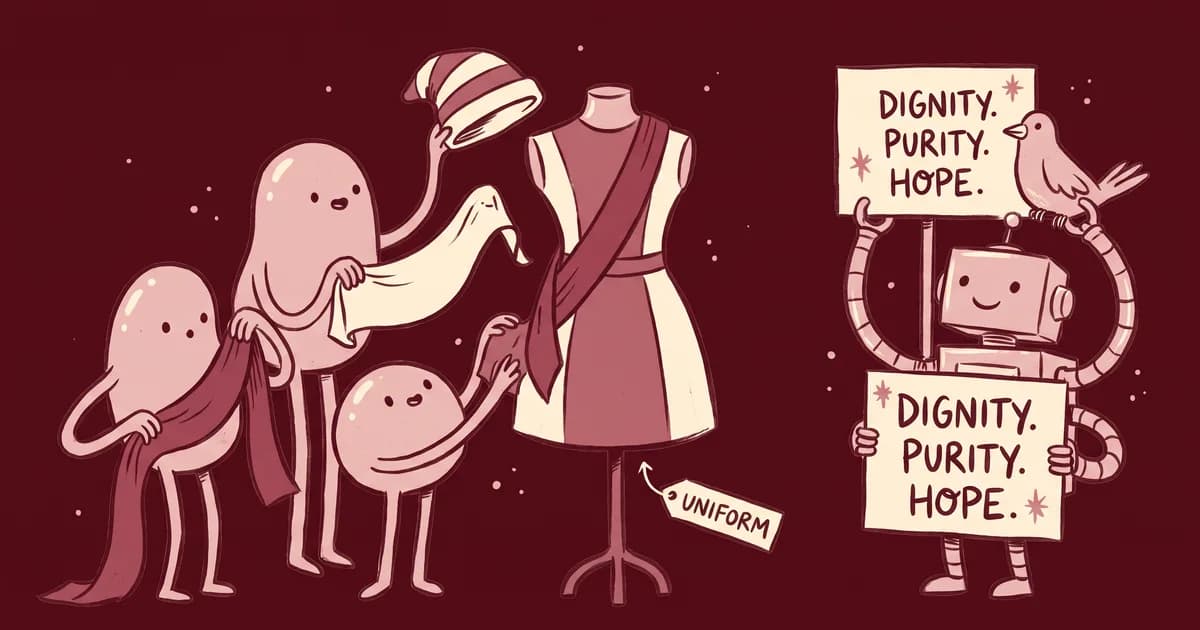
Pethick-Lawrence explained her choice in print, and she did not hold back. "Purple as everyone knows is the royal colour," she wrote. It stood for "the royal blood that flows in the veins of every suffragette, the instinct of freedom and dignity". White stood for "purity in private and public life." Green was "the colour of hope and the emblem of spring."
Notice what she did there. Purple belonged to monarchs. Pethick-Lawrence handed it to every woman who signed up to a union whose whole purpose was winning them the vote. The palette claimed a status the law refused to grant.
You have likely heard a different story. A popular reading says green, white and violet spell out G, W, V, for "Give Women Votes," and that suffragettes wore the code in secret jewelry. A Flags of the World contributor who chased the story found no confirmation that it was the designer's intent. The WSPU's motto was "Votes for Women", and Pethick-Lawrence's own explanation says nothing about initials. The acronym is folklore. The royal purple is on the record.
Women's Sunday: launching a palette in one afternoon
The colors went public on 21 June 1908, at a rally in Hyde Park the WSPU called Women's Sunday. It was the union's first "monster meeting", and it worked like a product launch.
Marchers came into London on special trains and formed up in seven processions that converged on the park. The instructions were simple. Wear white, and add purple and green where possible. The palette was cheap to join. A ribbon or a scarf turned a white dress into part of the design.
London's shops caught on fast. The Daily Chronicle reported that "white frocks will be prominent in the windows with a plentiful supply of dress accessories in violet and green". In the two days before the rally, more than 10,000 scarves in the colors were sold, at two shillings and elevenpence each. Men who came along wore ties in them.
The leaders wore something new. A woven sash in purple, white and green, with "Votes for Women" in the center, made its debut on the leaders that day. From August 1908 it went on sale to every member, with dressing instructions printed in the paper: "the regalia will be worn over the right shoulder and will be fastened under the left arm."
How big was the crowd? Estimates vary. Accounts drawing on The Times put it at up to 500,000 people, and other reports gave up to 300,000. Either way, hundreds of thousands of people saw the new colors on the same afternoon. The Standard called the rally "daringly conceived, splendidly stage-managed, and successfully carried out."
Notice the order. The WSPU did not raise a flag and ask people to salute it. It put the colors on bodies first. The flag followed the uniform.
Every member an advertiser
From Hyde Park on, the palette spread into everything the union sold. A ribbon badge in all three colors was made by the London firm Toye & Co. for the rally itself. There were tea sets too. A bone china plate from H. M. Williamson & Sons in Longton carries the WSPU's trumpeting angel badge in green and purple, an insignia designed by Sylvia Pankhurst.
Artists joined in. The enamellist Ernestine Mills made a brooch in the suffragette colours, with "Votes for Women" in white on a purple ground inside a green wreath. Mills was not formally tied to any suffrage society. The colors had become something you bought into, as well as something you joined.
Christabel Pankhurst spelled out the strategy. In a 1909 article for Votes for Women titled "The Political Importance of the Colours," she told members that "every member of the Union will become an advertiser for the Exhibition". The money mattered. So did the visibility. A woman in a green and purple scarf on a London bus was a walking poster.
The palette also carried rank. Sylvia Pankhurst designed the Holloway brooch, a silver portcullis, the symbol of Parliament, with a prisoner's broad arrow in purple, white and green enamel across it. The union first presented it to former prisoners at the Albert Hall on 29 April 1909. The broad arrow was the mark printed on prison uniforms. The colors turned a mark of shame into a medal.
And the colors became flags in the plain sense too. One surviving 1910 tricolor reads "Votes for Women" across the middle, stencilled with the address of the union's headquarters at 4 Clements Inn. In 1913, suffragettes in Bradford swapped the flags on two golf greens at Bradford Moor Golf Club for purple, green and white WSPU flags. Even a protest about the vote ended with a flag on a pole.
Rival palettes, same idea
The WSPU was not the only suffrage group in Britain, and the others noticed what color had done for it.
The Women's Freedom League had split from the WSPU in 1907, founded at Caxton Hall on 12 October with Charlotte Despard as president. Its members picked their own colors in a vote of the branches in 1908. They chose green, gold and white. A democratic group picked its palette democratically.
The National Union of Women's Suffrage Societies, the oldest and largest of the campaigns, had used red and white. In late 1909, as the militant unions grew, it added green and urged members to "use the colours prominently" on badges, flags, ribbons and posters.
So by 1910, a woman's politics showed from across the street. Purple meant the militant WSPU. Gold meant the Freedom League. Red meant the constitutional suffragists of the National Union. Each palette did the work of a flag, whether or not anyone hoisted it.
The colors cross the Atlantic
The idea traveled with the people. Alice Paul worked with the WSPU in England and brought its tactics home to the United States. She brought the color strategy too, with one swap.
American suffragists already had gold. In 1867, Kansas campaigners adopted the sunflower, their state flower, as a symbol, and gold became linked with the national movement. Paul's National Woman's Party took the WSPU's purple and white and paired them with gold, a combination no other American suffrage group used. A newsletter of 6 December 1913 said purple stood for "loyalty, constancy to purpose, unswerving steadfastness to a cause." White meant purity. Gold meant light and life.
Then the party did something no British group did. In 1919 it began sewing a star onto its purple, white and gold flag for each state that ratified the Nineteenth Amendment. The flag had room for 36 stars, the number of ratifications needed.
The method mirrors the national flag. The Flag Act of 1818 set the rule for the Stars and Stripes: one star added to the union "on the admission of every new state". The National Woman's Party used the same logic to count its own progress, state by state, until the count was complete.
Why the uniform outlived the union
The WSPU did not last. Emmeline Pethick-Lawrence, who had chosen its colors and co-edited its newspaper, was expelled in 1912 after a split over militant tactics. When war began in 1914, the union stopped publishing The Suffragette, and in April 1915 it launched a new journal, Britannia.
The colors outlasted all of it. Today purple, green and white are the official colors of International Women's Day, which credits them directly to the WSPU in 1908. The day's organizers keep the old meanings for purple and green and admit that white, for purity, is "a controversial concept."
Go back to that washing label. Pethick-Lawrence did not design a flag with a crest and a motto. She picked three colors anyone would wear, sell and recognize at a glance, and the union showed them to hundreds of thousands of people in one afternoon. More than a century later, the colors are still fast.
Julio Song
Writer
Julio is a staff writer at FlagDB. He studied Mathematics at the University of Madrid and has a passion for vexillology.
More from Julio Song →