On July 9, 2011, as crowds flooded the streets of Juba in 98-degree heat, a brand-new rectangle of cloth went up a flagpole for the first time. South Sudan had become the 193rd country recognized by the United Nations, the youngest sovereign state on Earth, born out of Africa's longest-running civil war.
Before the treaties, and before the ballots of the independence referendum were even counted, someone had to answer a simple-sounding question: what does this country look like?
The flag was not an afterthought. It was a compressed, high-stakes negotiation over color, shape, and meaning that had to work for more than 60 ethnic groups, honor decades of armed struggle, and mark a traumatized new nation as separate from the country it had fought to leave.
A nation before a flag
The Second Sudanese Civil War (1983 to 2005) killed an estimated 2 million people and displaced 4 million more. For southern Sudanese communities, independence was a survival question rather than an abstract political one.
The 2005 Comprehensive Peace Agreement brokered a six-year interim period that would end in a self-determination referendum. During that window, leaders had to build an entire national apparatus from scratch: a constitution, a currency, an anthem, and a flag. All of it while fighting political battles over borders, oil revenue, and the disputed Abyei region.
When the January 2011 referendum returned a staggering 98.83% vote in favor of independence, the flag design process had its mandate. It also had decades of sacrifice to answer to.
Most modern nations inherit their flags or let them evolve over centuries. The Union Jack accumulated its crosses over 400 years. France's tricolor emerged from revolutionary chaos and then stuck around. South Sudan had roughly six years to consciously design its primary national symbol, and a country to build around it at the same time.
How a rebel banner became a national flag
The Sudan People's Liberation Movement/Army, known as the SPLM/A, was founded by John Garang in 1983. Throughout the civil war the movement flew its own banner: a horizontal tricolor of black, red, and green with a blue triangle and gold star. For millions of southerners this was already their flag. It had draped coffins, flown over liberated towns, and been sewn by hand in refugee camps.
So when the interim government began formal discussions about a national flag, the SPLM banner was the obvious starting point.
It was also a controversial one.
Critics argued that adopting a rebel movement's flag wholesale would alienate non-SPLM political factions, ethnic groups that had fought on the government side, and citizens who wanted a clean break from war symbolism. A guerrilla banner carries a specific kind of weight. It says "we fought." It doesn't necessarily say "we're all in this together."
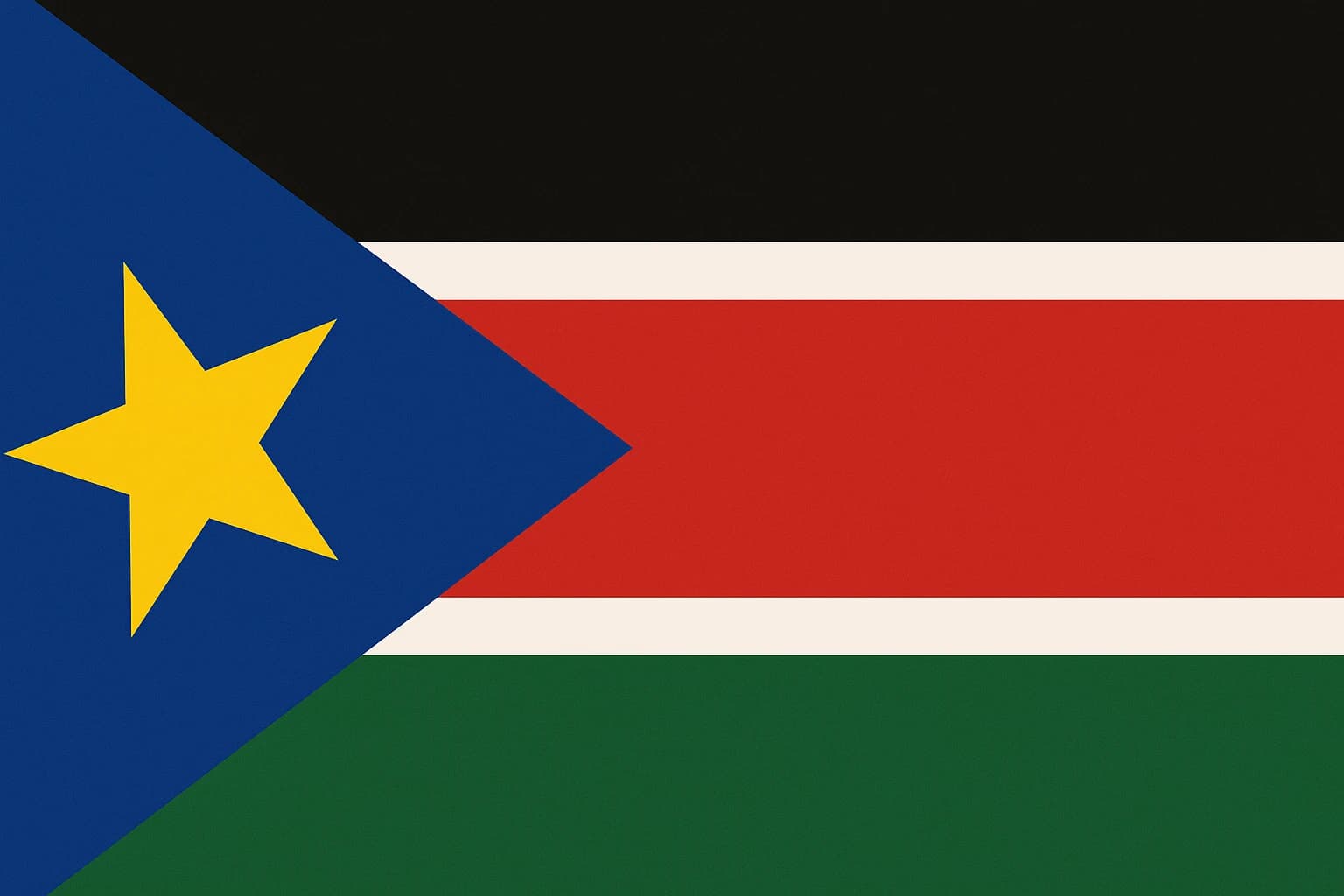
The final design kept the SPLM banner's layout almost entirely: three horizontal stripes (black, red, green) separated by thin white lines, with a blue equilateral triangle at the hoist bearing a gold five-pointed star. The political compromise was in the framing. The story was not that South Sudan had adopted the SPLM flag. The story was that the SPLM had donated its flag to the nation. That distinction sounds like wordplay. It wasn't. It cast the movement as giving its identity to the country rather than claiming the country as its own.
John Garang, the SPLM's founding leader, died in a helicopter crash in 2005, weeks after the CPA was signed. He never saw his movement's banner become a national flag. His absence hung over the process. Factions debated whether the flag honored his inclusive vision for a "New Sudan" or the narrower secessionist agenda that won out after his death. That argument was never settled.
What every color and symbol means
Black represents the people of South Sudan, specifically the indigenous African population whose marginalization by Khartoum's Arab-dominated government was a root cause of both civil wars. This comes directly from the Pan-African color tradition codified by Marcus Garvey's Universal Negro Improvement Association in 1920.
Red stands for blood shed during the struggle for independence. Post-colonial flags use that symbolism constantly, to the point where it can read as boilerplate. In South Sudan it doesn't. Virtually every family lost someone to the wars.
Green is the land, agriculture, and natural resources of the south, which was a pointed reference. An estimated 75% of Sudan's oil reserves fell within what would become South Sudanese territory, and that made land and resources central to the independence dispute.
The blue triangle represents the waters of the Nile, which flows through South Sudan and served as a lifeline for communities during the conflict. The gold star inside it, sometimes called the "Star of Bethlehem" in a nod to the predominantly Christian south, stands for unity among the states and hope for the future.
The white stripes separating the three horizontal bands stand for peace. This was aspirational rather than descriptive. Internal ethnic tensions, particularly between Dinka and Nuer communities, would erupt into civil war again by December 2013, barely two years after independence.
And then there's what's not on the flag. No reference to Islam or Arab culture, a deliberate distancing from Sudan. No specific ethnic symbols, which would have been politically explosive with 60-plus groups. No traditional southern motifs, though several were proposed and rejected as too regionally specific. The absences tell you as much as the colors do.
Pan-African echoes
South Sudan's black-red-green palette places it firmly in the Pan-African color family. But the specific arrangement, and the addition of blue, gives it a visual signature that prevents confusion with continental neighbors.
The resemblance to Kenya's flag is hard to miss. Both use black, red, and green horizontal stripes separated by white lines.
This isn't coincidental. Kenya was a key supporter of South Sudanese independence, SPLM leaders spent years in Nairobi, and Kenyan Pan-Africanism was an intellectual influence on the movement. The blue triangle and gold star are what keep the two flags apart at a glance.
The flag also echoes and rejects its northern neighbor's design at the same time. Sudan's flag uses the Pan-Arab colors (red, white, black, green) in a horizontal tricolor with a green triangle.
Almost a mirror image in structure, but drawn from a completely different symbolic tradition. South Sudan's flag is, in part, a chromatic declaration of African rather than Arab identity.
The same argument runs across the Horn of Africa. Eritrea's blue triangle and olive wreath assert a Mediterranean and peace-oriented identity.
Ethiopia's green-yellow-red tricolor, the original Pan-African palette, claims continental primacy.
Flags in this region are arguments about which cultural world a country belongs to.
Not the only new flag
South Sudan isn't the only country to have faced this design problem in recent decades, and comparing it with two other young nations shows how differently liberation movements handle the move from guerrilla banner to state symbol.
Eritrea (independent 1993) was in a very similar position: a new nation born from a decades-long war of separation, needing a flag that honored the Eritrean People's Liberation Front while building a broader national identity. Its solution, a modified EPLF flag with a red triangle, blue field, and gold olive wreath, closely parallels the SPLM-to-national-flag transition.
Timor-Leste (independent 2002) went the other way. Its flag was chosen through a more open public process, with the Constituent Assembly selecting from multiple proposals. The winning design drew on the resistance movement FRETILIN's banner but was substantially redesigned, a more deliberate break from guerrilla-movement aesthetics.
All three cases share a tension between honoring the armed struggle, which gives the new state its legitimacy, and signaling a fresh start, which gives citizens some reason to think peace will be different from war. How much of the liberation movement's flag survives intact is often a fair measure of that movement's grip on post-independence politics.
Of the three, South Sudan's flag changed least from movement banner to national flag. That reflects the SPLM's political dominance, and it foreshadows the internal power struggles that would fracture the party, and the country, within years of independence.
A flag for a fractured nation
By December 2013, South Sudan had plunged into a devastating civil war between forces loyal to President Salva Kiir (a Dinka) and Vice President Riek Machar (a Nuer). The flag that was supposed to represent unity became a contested symbol, still flown by both sides, each claiming to represent the "real" South Sudan.
Its meaning has been further complicated by the displacement of over 4 million South Sudanese, many of whom encounter it mainly in refugee camps in Uganda, Kenya, and Ethiopia. For the diaspora it has become the symbol of a homeland that exists more as an idea than as a functioning state, a piece of cloth carrying the weight of an unfulfilled promise.
Social media has given it a parallel life that no earlier new-nation flag has had. South Sudanese youth share it as emoji, profile frames, and digital art, sometimes reclaiming it from the political factions that co-opt it. Its meaning is being contested and remade in real time, in ways the designers of 2005 to 2011 could not have anticipated.
Flags designed during liberation struggles carry that tension by construction. They are monuments to division, us against them, rebels against government, repurposed as symbols of inclusion. South Sudan's flag carries the contradiction openly.
And yet, despite everything, it remains one of the few symbols that virtually all South Sudanese recognize and claim. In a country with over 60 ethnic groups and multiple active armed factions, that minimum level of shared identity, thin as it looks, is not nothing.
When the flag first rose over Juba in July 2011 it carried the hopes of 8 million people and the memory of 2 million dead. More than a decade later it flies over a country that has known almost as many years of internal war as it has of independence. It endures anyway. It never solved the problem of national unity, but it did give that problem a shape people could point at.