The Flag of Sudan
Republic of the Sudan
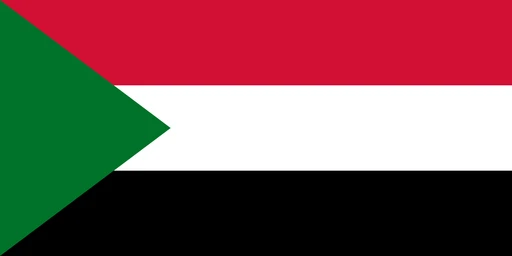
The flag of Sudan is a horizontal tricolor of red, white, and black with a green triangle at the hoist. Red is for the struggle for independence and the lives it cost, white for peace, black for Sudan itself (the country is often called the 'Black Land', for its people and for the dark soil of the Nile), and green for Islam, agriculture, and the productivity of the land.
The flag of Sudan is a horizontal tricolor of red, white, and black with a green triangle at the hoist. It was adopted on May 20, 1970.
Two flags, two answers to the same question
The first flag of independent Sudan, flown from 1956, was a blue, yellow, and green tricolor. It said nothing in particular about the region, and that turned out to matter: it left the new country without a visible position on where it belonged.
The 1969 coup led by Gaafar Nimeiry supplied an answer. The flag adopted the following May took the Pan-Arab colors, which had been popularized by the Arab Revolt against Ottoman rule and were by then in use across the Arab world. Swapping one flag for the other was a foreign policy statement as much as a design change.
The colors and the name
Red is the blood shed in the struggles for independence. White is peace. Green, in the triangle at the hoist, is Islam, prosperity, and the agriculture the economy depends on.
The black band is the most literal element on the flag. "Sudan" comes from the Arabic bilad al-sudan, land of the blacks, so the black stripe is the country naming itself.
Flying it
The flag is displayed on government buildings, in public spaces, and at national events. Protocol requires that it be hoisted during daylight hours and lit if it is flown at night, that it never touch the ground, and that it fly above any other flag displayed with it. Government departments and military units use variants carrying their own insignia.
Similar flags
Plenty of Arab states use red, white, black, and green, and Sudan's flag is most often compared with Egypt's and Yemen's, which arrange the same colors in horizontal bands. The green triangle is what sets Sudan's apart. It also carries no star or crescent, which several other flags in the region do.
In Sudanese life
The flag is the object people gather around at national celebrations and commemorations, and it turns up in music, writing, and public art. In a country with as many ethnic groups and cultures as Sudan has, that shared reference point does more work than it would elsewhere.
References
[1] Government of Sudan - Ministry of Information (sudan.gov.sd)
[2] Flag Institute's Guide to Flags of the World (flaginstitute.org)
[3] Smith, Whitney. "Flags Through the Ages and Across the World."
Common questions
- What do the colors on the Sudan flag mean?
- Red stands for the blood shed for independence, white for peace, black for the country itself ('Sudan' means 'land of the blacks'), and the green triangle for Islam and the productivity of the land.
- Why does the Sudan flag feature Pan-Arab colors?
- Red, white, black, and green come from the Arab Revolt against the Ottomans and were adopted across the region as a mark of shared political and cultural history. Sudan took them up in 1970.
- When did Sudan adopt its current flag?
- On May 20, 1970, following the coup of the previous year and the shift in national identity that came with it.
- How is the Sudan flag different from others in the region?
- The green triangle at the hoist. Without it the flag would be difficult to distinguish from Egypt's or Yemen's, which use the same Pan-Arab colors in horizontal bands.
Featured in these articles
- One Poem, Two Flags: How the Arab World's Colors Split Into Rival Family Trees
- Stripes That Tell the Wrong Story: How the Horizontal Band Became the Default, and What Countries Lost When They Copied It
- One Nation, Two Flags: How Myanmar's 2010 Redesign Erased a Socialist Past Overnight
- Born from War: How South Sudan Designed a Flag for the World's Newest Country
Download this flag
Free in 12 styles, from 32px icons up to 2000px, as SVG, PNG, WebP and JPG.