Sixteen Rays Too Many: How a Tomb Ornament Cost North Macedonia Its First Flag
Julio Song · · 9 min read
On 8 April 1993 the United Nations admitted a new member and left its flag off the pole. The Macedonian Heraldry Society calls it the first time in UN history that a country got its seat but its flag stayed out of the display in front of the New York headquarters.
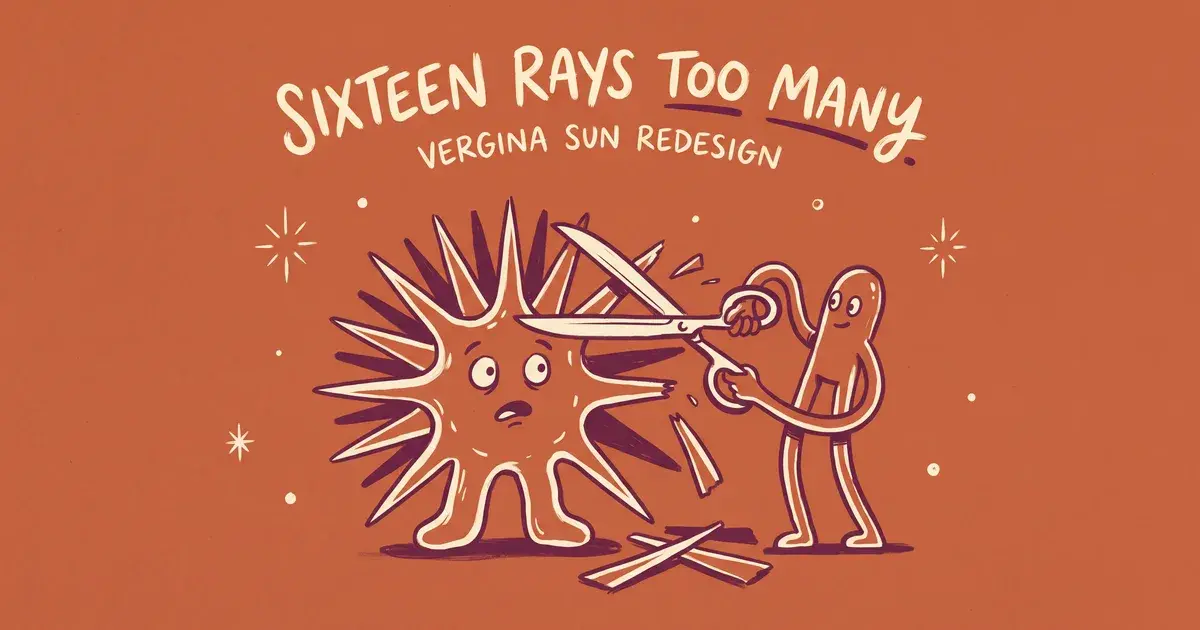
The flag was red with a golden sun. The sun had sixteen rays. Greece said the sun was Greek.
What followed is one of the odder flag disputes in modern Europe. It took in an archaeologist, a closed border, a treaty that banned a symbol without naming it, a court case in The Hague and a public utility rolling up a carpet. Diplomats redrew this flag twice. Here's how.
A sun dug out of the ground
The story starts in a Greek field. In 1977 the archaeologist Manolis Andronikos excavated a royal tomb at Vergina in northern Greece. The Macedonian Heraldry Society describes the find as a sarcophagus assumed to belong to King Philip of Macedon, the father of Alexander the Great. Its decoration included a golden sunburst.
Note the word "assumed." The attribution to Philip is disputed, and Flags of the World points out that the same ornament appears on ancient objects with a variety of numbers of arms. So the sun was never one fixed drawing.
That didn't stop two countries from claiming it. For Greece the sun was part of its own heritage, and the Heraldry Society notes it was already in use by the Greek province of Macedonia. North of the border, the same society records, Macedonians in the diaspora were using it from the late 1980s.
Three years under the Kutlesh sun
When the Republic of Macedonia left Yugoslavia, it replaced the flag it had used under the 1974 constitution. The idea of the tomb sun came from MP Todor Petrov, and the architect Miroslav Grčev made the technical drawing. Parliament fixed the design in a flag law dated 11 July 1992, published in the Official Gazette as number 50/92.
The specification was exact:
- a golden sun on a red field
- eight primary rays alternating with eight secondary ones, sixteen in all
- a flag in the proportion 1:2
- a central disc one-seventh of the flag's width
Macedonian sources call this emblem the sun of Kutlesh. Greece called it the star of Vergina. Two names for one drawing tells you most of what you need to know about the next three years.
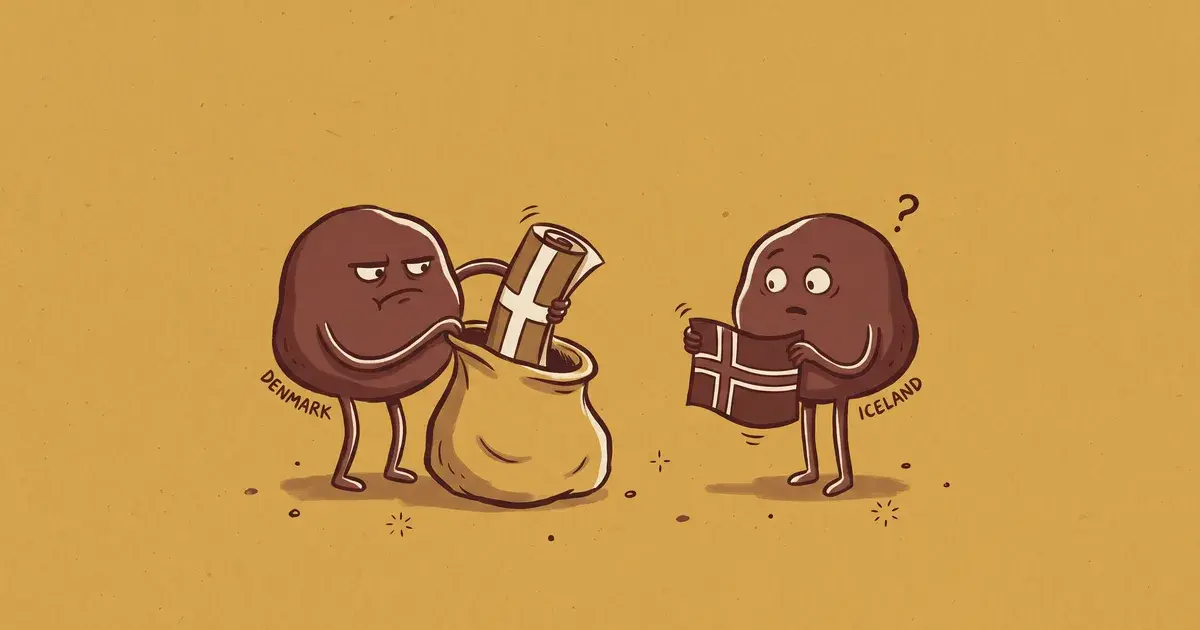
Greece objected from the start and read the flag as a claim on Greek history and on its northern province. Greece's own national flag, blue and white with a cross, carries no sun at all. The quarrel was over an emblem, and over who had the right to it.
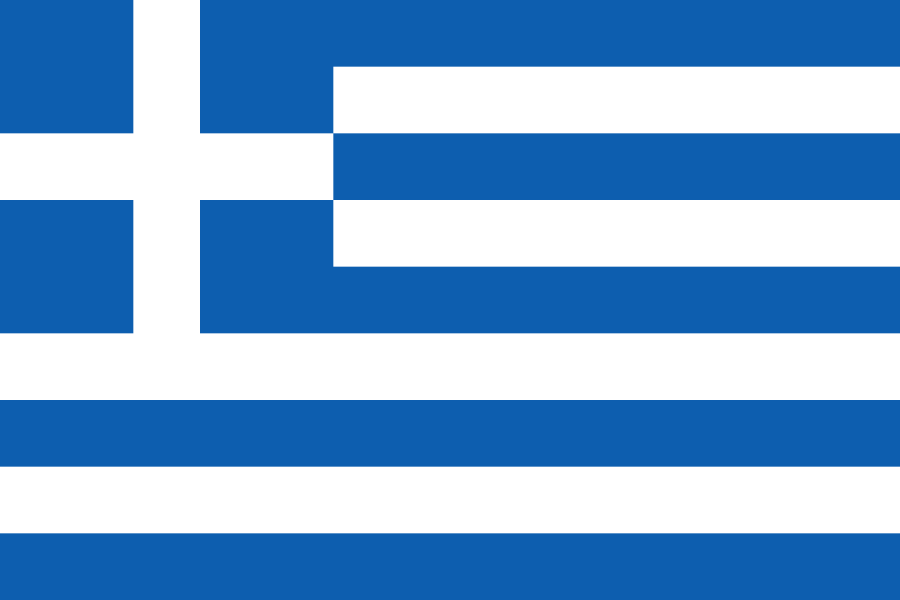 GreeceView flag →
The blockade that closed a port
Talks went nowhere. On 16 February 1994 Greece closed its border with its landlocked neighbour. In an essay for The New York Times in March 1994, the financier George Soros wrote that the move cut the republic off from the port of Salonika (Thessaloniki), "its main gateway to the outside world."
Soros set out Greece's demands. Recognise the existing borders, which the republic had already done. Delete the references in its constitution to protecting Macedonians outside the country. And remove from its flag "the star of Vergina, an old Greek emblem."
Think about that list for a second. A country lost its main route to the sea, and one condition for getting it back was a change to sixteen triangles on a piece of cloth.
The treaty that wouldn't say the word
The fix came in New York. On 13 September 1995 the Greek foreign minister Karolos Papoulias and the Macedonian foreign minister Stevo Crvenkovski signed the Interim Accord. The UN special envoy Cyrus Vance signed as witness.
Article 7, paragraph 2 is the flag clause. On entry into force, it says, the Macedonian side "shall cease to use in any way the symbol in all its forms displayed on its national flag prior to such entry into force."
Read it twice. The treaty bans a symbol and never names it. The name turns up in a separate letter from the Greek foreign minister to Vance, dated the same day and printed with the treaty in the UN Treaty Series. The letter confirms that "the symbol referred to" is "the Sun or Star of Vergina, in all its historical forms."
So Greece's name for the symbol went on the record in a letter that only Greece signed. Skopje signed a ban on a design it had described in its own law, without repeating the Greek name. It's careful drafting, and it worked.
The Accord also set a clock. It entered into force on the thirtieth day after signing. The flag had to change before then.
A sun that runs off the edge
The government went back to Grčev. According to Meta.mk, the architect was asked to prepare designs for the new flag, and his last proposal, a sun with rays spread across the whole surface, was the one chosen.
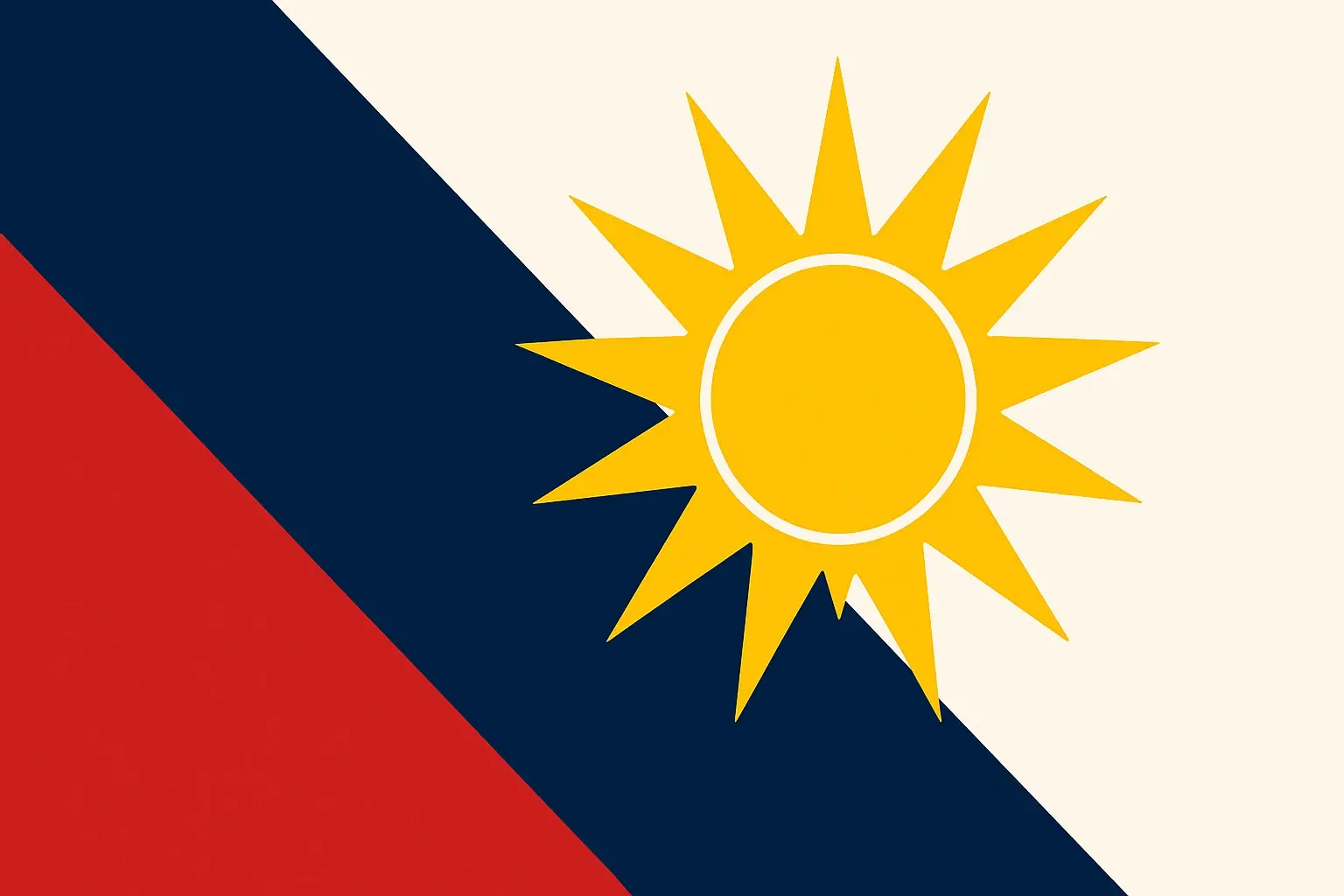
Parliament adopted it on 5 October 1995 under a new flag law, Official Gazette 47/95. The new sun has eight rays, not sixteen. They widen as they move outward and run all the way to the edges, meeting along the diagonals and the horizontal and vertical centre lines. A red circle separates the rays from the disc.
Here's the twist. The Macedonian Heraldry Society records that the adopted version departed from Grčev's proposal and that he opposed it. His draft used proportions of 10:16. Parliament kept 1:2, the ratio of the 1992 flag. The designer of the current flag did not sign off on the final version of it.
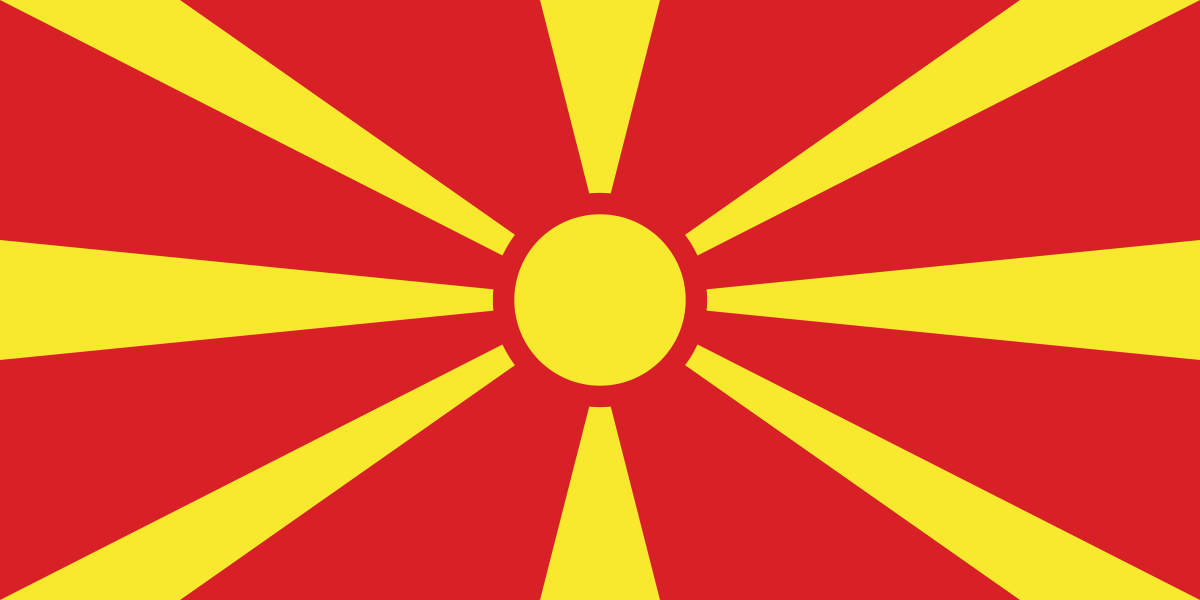 North MacedoniaView flag →
The new flag first went up on 7 October 1995 at the parliament building in Skopje. On 22 October 1995 it was raised outside UN headquarters in New York, according to the Heraldry Society. Two and a half years after joining, the country had its flag in the row with everyone else's.
Why eight rays worked when sixteen didn't
Put the two designs next to each other and the bargain is plain.
The 1992 sun is a compact badge in the middle of a red field. It reads as an emblem, the one from the Vergina find. The 1995 sun is a pattern that fills the cloth. Its rays touch every edge, so the red survives only as eight wedges between them. The ray count halves, and the alternating long and short rays are gone.
The colours did not change. Red and gold stayed, and so did a sun. Macedonia kept the elements its citizens recognised. Greece got the specific sixteen-ray star off the flag. Neither side settled who owned ancient Macedon. They settled a drawing.
The sun comes back, and goes again
The ban held, mostly. In 2008 Greece objected to the country's NATO candidacy at the Bucharest summit, and Skopje took Greece to the International Court of Justice under the Interim Accord.
On 5 December 2011 the court ruled 15 to 1 that Greece had breached Article 11 of the Accord. The UN News report notes that only one breach on the Macedonian side was established: the use of a prohibited symbol in 2004. The ICJ's own summary says the country's army had used the symbol, and that the use stopped the same year. One military use, and it still ended up in a judgment at The Hague.
The final settlement came at Lake Prespa. The two governments signed the Prespa Agreement on 17 June 2018, and it entered into force on 12 February 2019. The country became North Macedonia. Article 8, paragraph 3 went further than the 1995 text. It bars the country from using the former flag's symbol again in any way or form, and gives it six months to remove the symbol from all public sites and public uses. Archaeological artefacts are exempt.
The Macedonian Heraldry Society put it plainly in October 2018. Macedonia, it wrote, was losing the sun of Kutlesh for the second time.
A carpet in a director's office
The removal was oddly domestic. A Nezavisen report from August 2019 says the public enterprise Water and Sanitation started on 13 February, the day after Prespa took effect. It took a carpet bearing the sun out of the director's office, then some pictures with the same motif.
Municipalities with the sun in their coats of arms had to change them. The big monuments in downtown Skopje stayed up, with signs describing them as part of the ancient Hellenic period. The government also said the agreement created no obligations for private individuals or private companies. Wear a T-shirt with the sixteen-ray sun in Skopje and nobody would punish you for it.
That split between public and private is how the deal worked. The state gave up the symbol. Its citizens did not have to.
What the redraw tells you about flags
North Macedonia's flag is a design set by treaty. Plenty of national flags come out of a revolution, a contest or a committee. This one came out of a negotiation with a neighbour, with a closed border and a UN envoy in the background and an article number attached.
If you want to read a flag like this, start with what it leaves out. The red field and the golden sun are what Macedonia kept. The eight missing rays, and a disc that grew into a pattern covering the whole cloth, are what it gave away.
Next time you see the eight-ray sun at a football match or over a ministry, count the rays. Eight is the number two governments agreed to live with.
Julio Song
Writer
Julio is a staff writer at FlagDB. He studied Mathematics at the University of Madrid and has a passion for vexillology.
More from Julio Song →