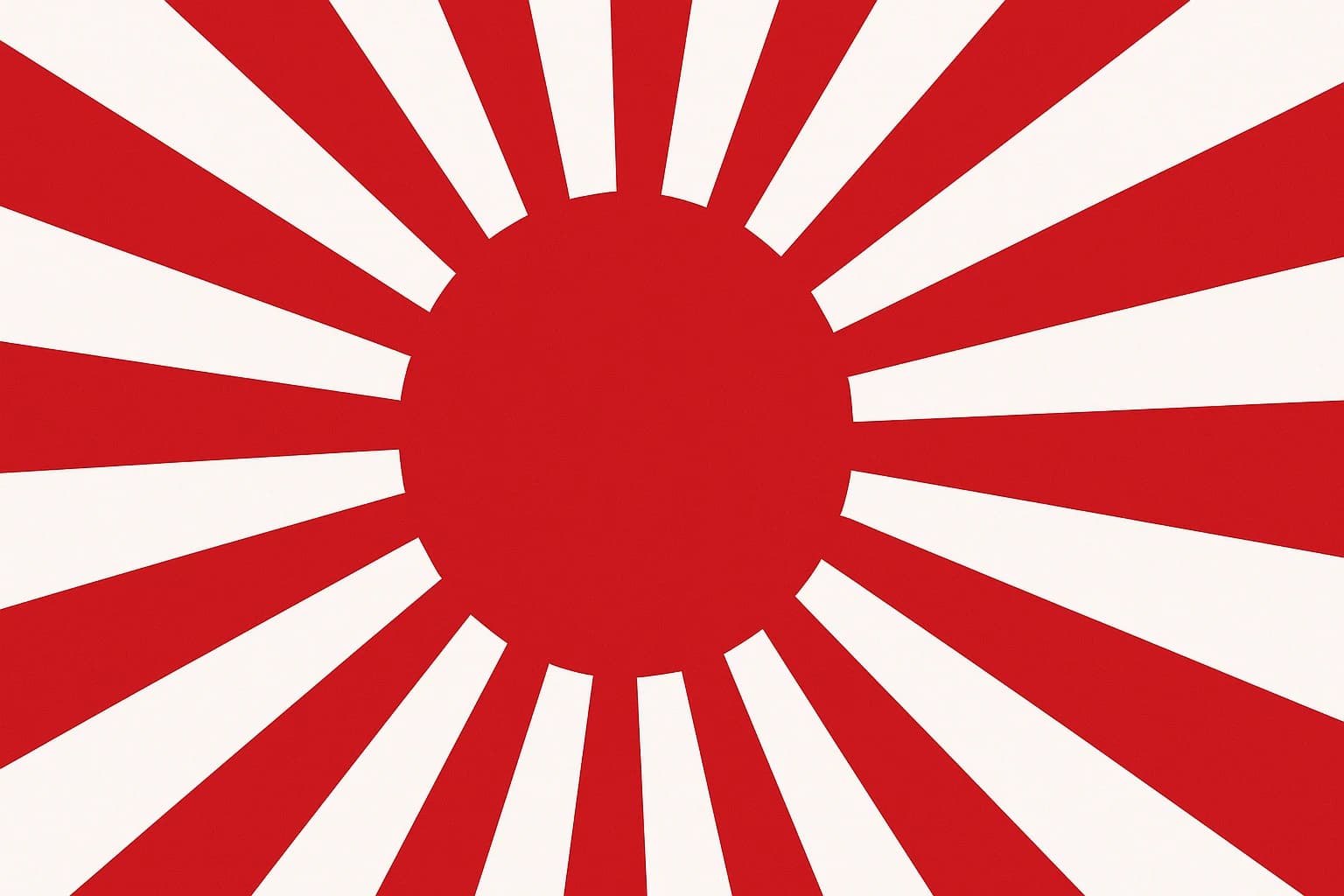
Most national flags that feature a sun keep things simple. Japan gives you a red disc. Bangladesh does something similar. Laos offers a clean white circle. These are suns reduced to geometry, stripped of personality, and they work beautifully for it.
Then there is Uruguay.
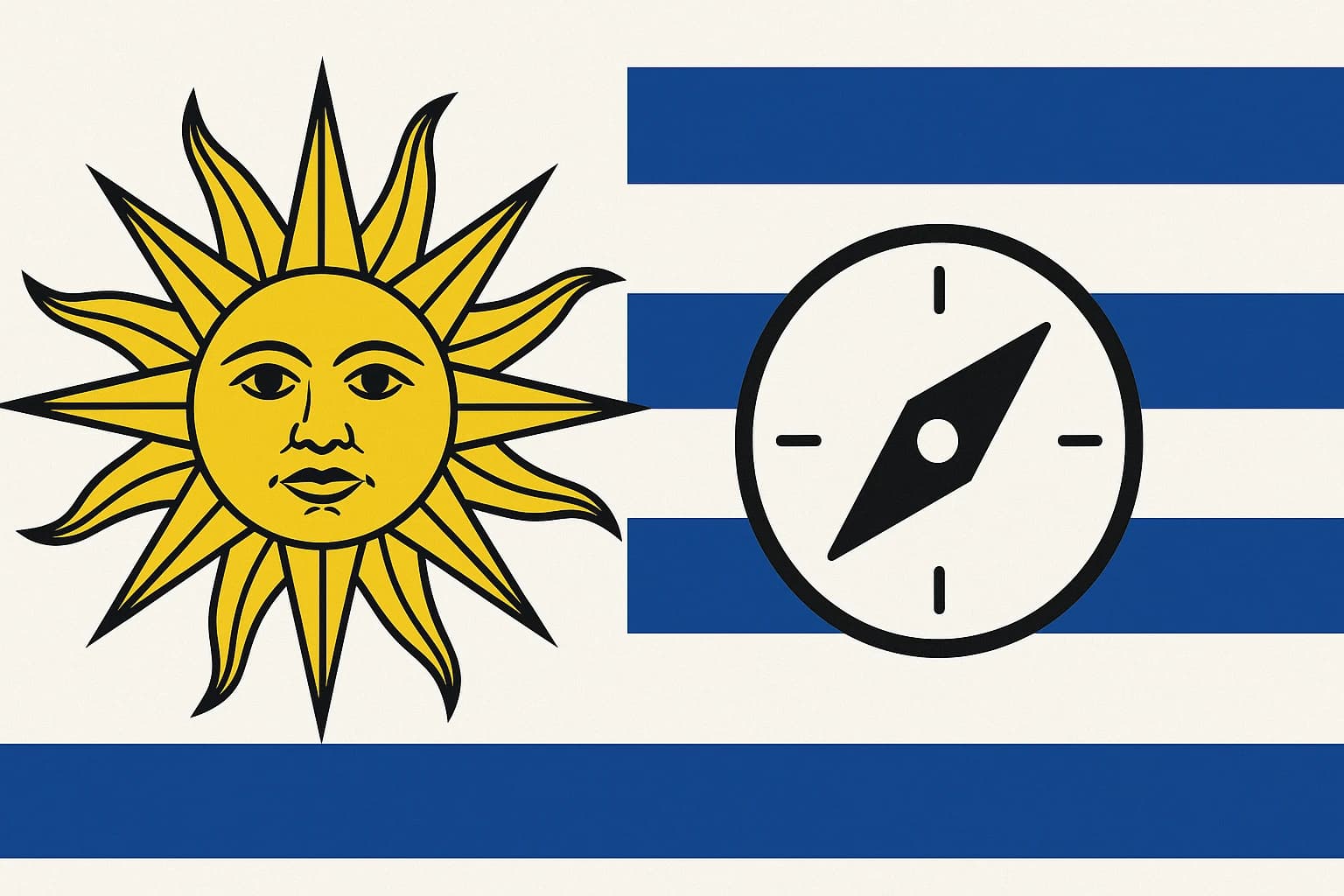
Its sun stares back at you. Eyes, a nose, a mouth, and 16 rays, eight straight and eight wavy, arranged with a precision that borders on obsessive. None of that is whimsy. Every element was chosen under political pressure by people who had just fought a revolution and needed their new nation to feel ancient and legitimate at the same time.
So why would a brand-new republic in 1828 put a human face on its flag, and what was the face supposed to say to whoever looked at it?
A sun that predates the country
The story starts with Inti, long before Uruguay existed.
Inti was the Incan sun deity, shown with a human face radiating golden rays and worshipped as the divine ancestor of the Sapa Inca. He was not a metaphor for power; he was the thing itself, the cosmic guarantor of imperial legitimacy for an empire that stretched from modern Ecuador to Chile.
When Spanish conquistadors arrived at Coricancha, the Temple of the Sun in Cusco, they described finding a massive golden disc shaped as an anthropomorphic sun face surrounded by radiating rays. The structure is nearly identical to what would later become the Sun of May. The Spanish didn't erase this imagery. They partially absorbed it, folding it into colonial Catholic iconography. The monstrance shape in churches, the "sol" motif in religious art. By the 18th century, a face-bearing sun was embedded in the visual culture of the entire Río de la Plata region, recognized by Indigenous populations and criollo elites alike.
So by 1810, when revolution broke out, the anthropomorphic sun was not invented but inherited. The revolutionaries did not have to explain it to anyone. Everyone already knew that a sun with a face meant divine power, ancient authority and the right to rule.
May 25, 1810: the day the sun became political
Buenos Aires, May 25, 1810. An overcast morning. Crowds gathered in the Plaza Mayor as the criollo junta moved to depose the Spanish Viceroy. The famous story, possibly apocryphal but politically potent, is that the clouds broke and the sun appeared at the decisive moment.
Whether or not the weather cooperated on cue, the story took hold immediately. The sun that appeared that morning became the Sun of May, a sign that heaven had endorsed the revolution, and a founding myth only has to be useful.
The first physical object bearing this politicized sun was the 1813 silver real, minted by the United Provinces of the Río de la Plata, showing a radiant sun with a human face. That coin is the direct design ancestor of both the Argentine and Uruguayan flag symbols. The face mattered on a coin specifically because coins circulate, and a face on a coin is a portrait of authority. Traditionally the monarch's. Replacing the king's face with the sun's said that sovereignty no longer came from a man in Madrid but from the cosmic order.
The United Provinces did not stay united, though, and when they fractured both successor states reached for the same sun.
One sun, two flags
Modern Uruguay, then called the Banda Oriental (the Eastern Shore), was contested territory throughout the 1810s and 1820s, fought over by the United Provinces, Brazil, and local independence fighters under José Gervasio Artigas. It was a rough neighborhood.
Argentina's flag, formally adopted in 1818, incorporated the Sun of May in its center, establishing a direct visual claim: this sun belongs to our revolution, our republic.
Uruguay declared independence in 1825, with formal recognition coming in 1828 via the Treaty of Montevideo. The new nation needed a flag. And it adopted its own version of the Sun of May, placing it in the upper-left canton against horizontal stripes modeled partly on the United States flag.
That was politically loaded. Using the same symbol as Argentina claimed shared revolutionary heritage and asserted an independent identity at once: we share this origin, but we are not you. The sun worked for that message because it belonged to the region's revolution rather than to any single state.
The differences are where the argument lives. Uruguay's sun has 16 rays, 8 straight and 8 wavy. Argentina's has 32, 16 and 16. The alternating pattern and the face are shared; the ray count is the point of divergence, and it is a small but real act of differentiation.
Decoding the face
The Sun of May usually wears a serene, slightly stern expression. Not joyful, not wrathful. Compare it to a smiling sun or an angry one and the difference in what it communicates is immediate: serenity signals permanence and impartiality. It is a face that witnesses rather than celebrates.
The 16 rays carry their own reading. The 8 straight rays stand for directness, clarity and rational Enlightenment thought, which the revolution had absorbed from France and needed some way of putting on display. The 8 wavy rays stand for warmth and the organic life-giving force of the sun. Together they say the new republic is both reason and nature, which is a fairly complete cosmological statement to encode in alternating lines.
That fits a wider 19th-century habit of manufactured antiquity in nation-building. Newly independent states across Latin America, the United States and Europe all reached for ancient or mythological imagery to make themselves feel legitimate. The American eagle borrows from Rome. France's Marianne draws on classical allegory. Uruguay's sun looks Incan, feels cosmic, and makes the republic feel inevitable rather than invented.
Set that against the minimalist suns on Japan's flag or Bangladesh's. Those work precisely because they are abstract: a circle is universal and apolitical. The Sun of May takes the opposite approach, specific and historical and personal, a sun that watched a particular event and carries the memory of it in its face.
Which is what the face is for. It is not there to make the sun friendly. It is there to make the sun a witness, so that the revolution of 1810 and the nation that came out of it happened under the gaze of something older than either.
The stripes, borrowed from America
The Sun of May gets all the attention, but Uruguay's nine horizontal stripes, alternating white and blue, are worth a look. They were explicitly modelled on the US flag's stripes, a point noted by Uruguayan historians and by the nation's first Assembly.
Why the United States? By 1828 the American republic was over 40 years old, prosperous, and had come through post-independence nation-building intact. Borrowing its visual grammar was a statement of intent about the kind of republic Uruguay meant to be.
The difference is in the canton. The US flag puts stars there: plural, equal, anonymous. Uruguay replaced that field of stars with one dominant, humanized sun. The US imagined its states as a constellation of equals; Uruguay, following Argentina, imagined its revolution as a single divinely witnessed event.
There is a design footnote worth having. The stripes originally numbered 19, one for each of Uruguay's departments, and were cut to 9 in 1830 to improve legibility. That is a rare case of a flag being simplified for purely practical reasons: 19 thin stripes are hard to read from a distance, particularly on a ship at sea. The designers swallowed their symbolic ambitions and chose clarity, which is a reminder that flag design is always constrained by wind, distance, sunlight and the limits of the eye.
How a revolutionary symbol became permanent
Revolutionary symbols usually get revised or retired as the politics shift. The Sun of May has held up across Argentine and Uruguayan governments of wildly different kinds, liberal and conservative, military junta and democracy alike.
The reason is that its origin story is pre-political. Rooted in a weather legend from 1810, it predates the ideological splits of later decades, so no faction can claim exclusive ownership of it and every faction shelters under it.
The Sun of May appears on Argentina's coat of arms, its flag, its currency and numerous official seals, and Uruguay's version does the same. It manages to be both a shared regional heritage symbol and a point of national distinction between the two countries, and neither is willing to give it up.
Plenty of other flags use solar imagery. North Macedonia's sun is geometric and faceless; the Philippine sun is stylized and also faceless. Which is the norm. A sun with a face is a deliberate and loaded decision, and nearly 200 years later Uruguay's still carries it on the surface.
The face has outlasted the revolutionary generation that put it there, which is the clearest evidence that whatever the founders meant by those serene, stern features, it worked.
The chain of decisions behind one face
The face is not decoration or folklore. It is the end of a specific chain: Incan iconography absorbed into colonial visual culture, seized on by a revolutionary moment in 1810, stamped onto a coin in place of a king's face, then put on a flag to argue that a new nation's legitimacy came from something older than any European monarch.
It is how Uruguay told the world, and itself, that it had always existed, at a point when it plainly had not.