The Only Flag on Earth That Isn't a Rectangle
Julio Song · · 8 min read

Every national flag on Earth is a rectangle, except one. Nepal's flag is a double pennant, two triangular banners stacked and fused into a shape closer to a mountain peak than a piece of cloth. It stands taller than it is wide. It has no straight top edge. And unlike every other flag in the world, its shape is not a matter of custom. It is a mathematical formula, written into Nepal's constitution line by line.
A shape built from two rival banners
The design did not start as one flag. It started as two, flown by Nepal's two centers of power at once.
The Shah dynasty held the throne, and its royal house flew a crescent moon on a crimson pennant. Starting in 1846, the Rana family took the office of prime minister and made it hereditary, ruling Nepal from behind the throne for over a hundred years while the Shah kings sat as figureheads. The Ranas flew their own pennant too, a sun on the same crimson field.
Jung Bahadur Rana, the dynasty's founder, combined the two into the double pennant still flown today, a flag adopted around 1856 with both the sun and the moon wearing small human faces. This version kept a green border for decades, replaced with the current blue sometime around 1930. The faces themselves lasted until 1962.
Turning a folk banner into law
The Rana family's grip on power ended in 1951, when a popular uprising restored real authority to the Shah monarchy and opened the door to a new constitution. This constitution, which took effect on December 16, 1962, formally standardized the flag for the first time in the country's history. King Mahendra asked Shankar Nath Rimal, a civil engineer, to fix its exact proportions.
Rimal kept the double pennant and the crimson field, but he erased the faces from the sun and moon, replacing them with clean geometric versions. The moon gained eight points, one for each phase it passes through in a lunar month. The sun kept twelve rays, one for each month of the year. The crimson points to Nepal's national flower, the rhododendron, and to a national self-image built around bravery. The blue border stands for peace. When the flag needed standard printing colors for the 2012 London Olympics, organizers settled on Pantone 186 for the red and Pantone 287 for the blue, numbers now sitting alongside the constitutional geometry as the closest thing Nepal has to an official color chart.
The geometry problem hiding in the constitution
Here is the part most flag guides skip past. Nepal's constitution does not describe the flag's outline in prose. It walks through the construction the way a geometry textbook walks a student through a proof: draw this line, mark this point, strike this arc from a fixed center.
Considered on its own, the red field has a tidy 3:4 ratio of width to height, nothing stranger than a sheet of paper. But once the blue border wraps around the field, following the specific angles the law lays out, the arithmetic stops cooperating. The finished flag's ratio of height to width settles at an irrational number, close to 1.219 to 1, the smallest root of a quartic polynomial with coefficients running into the quadrillions. The number is strange enough to earn its own listing in the Online Encyclopedia of Integer Sequences, a reference built for exactly this kind of oddity.
This isn't a footnote for hobbyists. A rectangle scales at any size once you fix its ratio, because two straight edges and a right angle carry all the information a printer needs. Nepal's flag doesn't scale so simply. Anyone reproducing it accurately, a textile mill, a government sign shop, an embassy ordering a new one, has to work from the constitutional construction diagram itself rather than eyeballing a width-to-height guess, or the proportions drift with every copy. No other country has ever needed to legislate a solution to a problem this specific, because no other country's flag has a shape this stubborn.
A shape the Olympics did not know how to handle
The shape causes real problems outside Nepal's borders too. At the 2016 Rio Olympics, organizers displaying national flags along the standard 2:3 rectangular grid did not have a slot for a shape like Nepal's, so they printed the pennant onto a white rectangular background instead of showing its true outline. Flag enthusiasts noticed immediately, and criticism spread online, framing the substitution as a small erasure of the one flag refusing to look like every other flag in the parade.
The International Olympic Committee later confirmed Nepal's flag stays in its actual shape rather than getting boxed into a rectangle to match the rest of the field. Ted Kaye, secretary of the North American Vexillological Association, called Nepal "this holdout that connects to the history flags of Asia," a nod to how common pennant-shaped banners once were across the region, before the rectangle became the default everywhere else.
The flag the revolution left standing
The kings who commissioned the geometry did not last. In 2008, after a decade of civil war and mass protest, Nepal's constituent assembly voted to abolish the 239-year-old monarchy and declare a republic. On May 29, 2008, the royal standard, a separate red square banner bearing a lion, came down from the palace for the last time.
The national flag did not come down with it. The double pennant flew on, and when Nepal adopted its current constitution in 2015, the same shape and the same geometric construction carried over largely unchanged. A flag born from two rival seats of power, a throne and the family running it from behind the scenes, ended up outliving the monarchy it once represented and the government finally responsible for writing its shape into law.
Nepal takes the rule further than anyone else
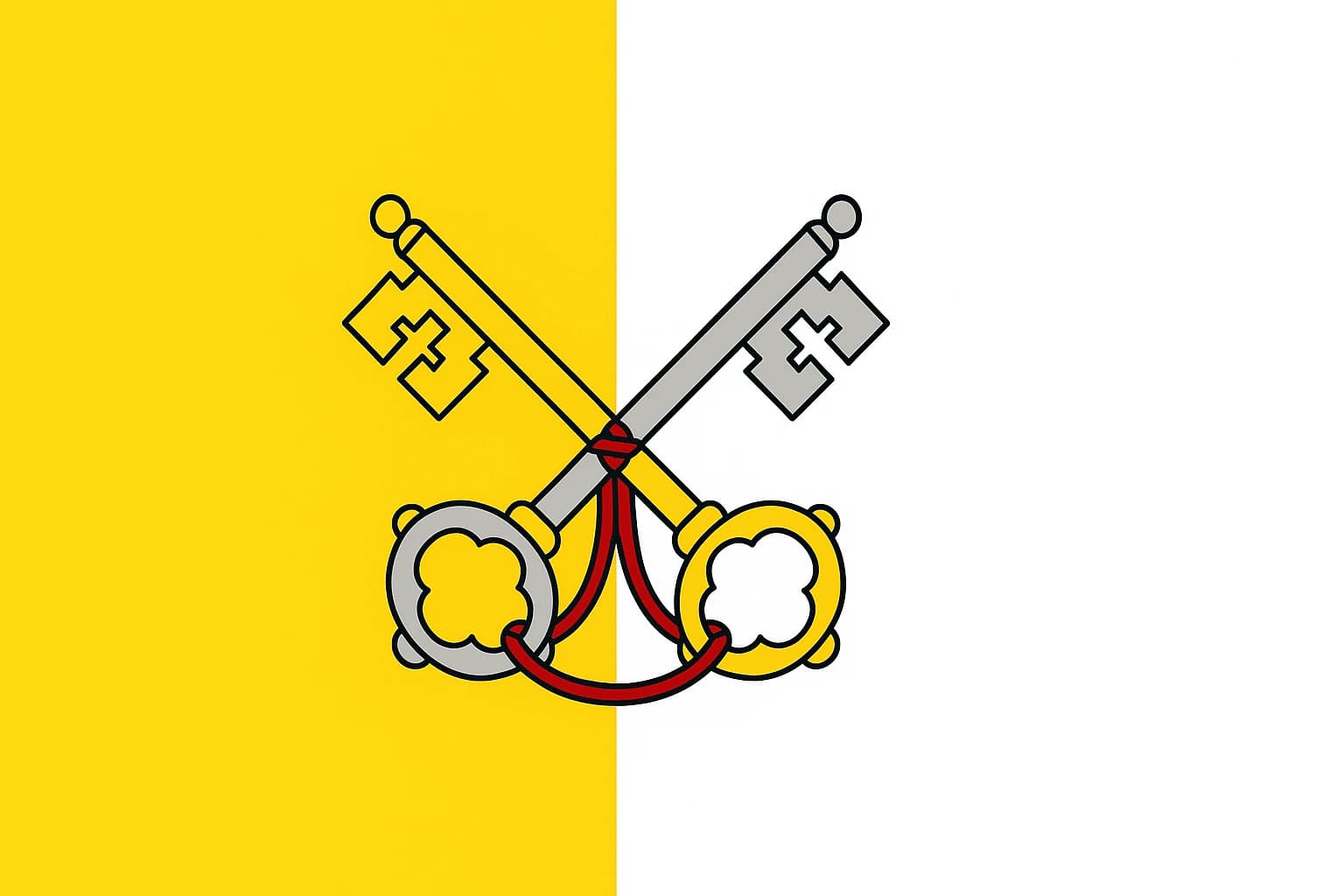
Most countries treat the rectangle as an unwritten habit rather than a real requirement, and two of them have quietly stepped outside it. Switzerland and Vatican City fly the world's only square national flags, a 1:1 ratio in place of the usual 2:3 or 3:5.
Switzerland's white cross on red traces to military banners from the Battle of Laupen in 1339, but the square proportion came later. The Tagsatzung, the Swiss federal diet, formally adopted Carl Stauffer's square design on October 11, 1841, fixing the flag's total width at four and a half feet. Switzerland still keeps a separate rectangular ensign, adopted in 1953, for ships flying its colors at sea. On land, the square holds.
Vatican City's flag became official on June 7, 1929, the day the Lateran Treaty took effect and created the state around it. The design was not invented from scratch. The yellow and white colors came from the merchant flag the Papal States flew between 1825 and 1870, before Italy absorbed the territory, while the square proportions were borrowed from a separate flag entirely, the one carried by the Papal Infantry in 1862. Papal authorities fused the two lineages into a single square banner in 1929. The colors stand for the metals of the crossed keys of Saint Peter shown under the papal tiara on the white side, gold for one key, silver for the other. Article 23 of the current Fundamental Law of Vatican City State still specifies the same 1:1 square adopted in 1929.
Both flags break from the rectangle by picking a different, equally simple ratio. A square needs no formula beyond equal sides. Nepal breaks from the rectangle entirely, and the price of breaking it was inventing new mathematics to hold the result together.
A flag with a higher bar to change
Most governments change a flag's colors or add a new symbol with a single vote. Nepal's flag answers to something stricter. Any redesign would need a new geometric construction to survive the same constitutional process the current shape went through in 1962, spelled out point by point, arc by arc, the way the original was.
This is a strange kind of protection for a national symbol, but it fits a flag whose whole identity rests on refusing to sit inside four straight corners. The double pennant traces back to a throne and the family running the country in its name, a moon and a sun fused into one crimson field. What survived this arrangement, a civil war, and a revolution is a single shape, still climbing, its exact proportions locked into law by a number no other country has ever needed.
Julio Song
Writer
Julio is a staff writer at FlagDB. He studied Mathematics at the University of Madrid and has a passion for vexillology.
More from Julio Song →Related articles
The White That Isn't Empty: How Libya, Japan, and Switzerland Turned Minimalism Into a Statement
The White Flag That Isn't Surrender: How Switzerland, Georgia, and the Holy Roman Empire Turned a Blank Canvas Into Bold Identity