Imagine a national flag with nothing on it. No eagle, no star, no cross, no stripes. A single, unbroken field of color. Most people would assume it was unfinished. A placeholder. A mistake.
From 1977 to 2011, Libya flew exactly that flag: a solid rectangle of green. Nothing else. It was not an oversight. It was an argument.
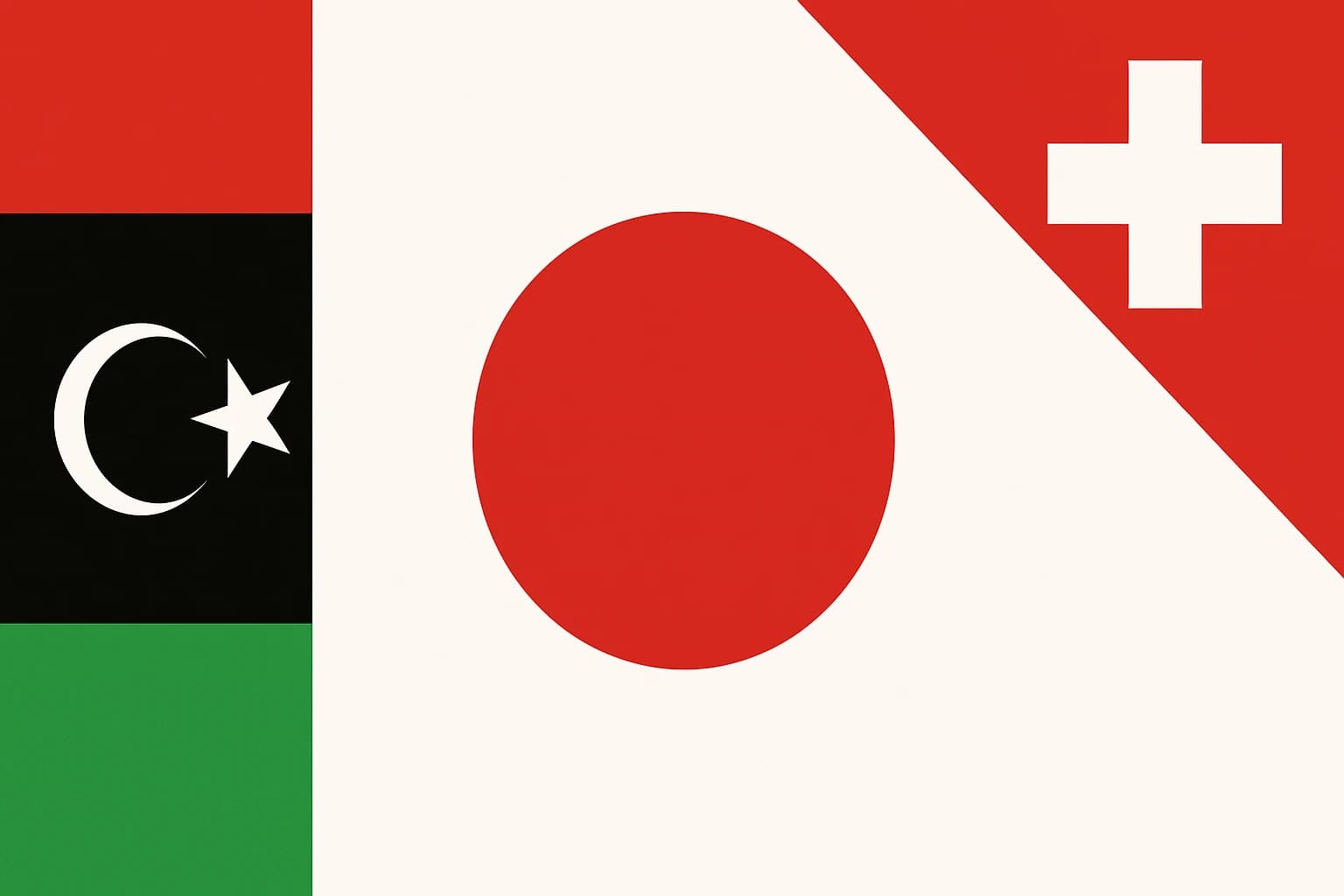
In vexillology, what a flag leaves out is as politically loaded as what it puts in. Flag scholarship obsesses over symbols, heraldic charges, the precise shade of a crescent or the number of points on a star. But restraint is a symbol too. The flags of Libya, Switzerland, Bangladesh, and Japan make the case that minimalism on a flag is never accidental.
The most radical dialect of flag design
Flags work on a simple grammar. Color fields carry cultural or heraldic meaning. Symbols (animals, stars, crosses, crescents) layer on ideology and identity. The more elements you stack, the more a flag tries to tell you, and the less it tends to stand out.
Think of the old Habsburg coat-of-arms flag, crammed with eagles, crowns, shields within shields. Now think of Japan's Hinomaru: a white field, a red circle. Which one do you remember?
Call the alternative vexillological restraint, the deliberate choice to reduce a flag to its minimum viable statement. The North American Vexillological Association (NAVA) published five principles of good flag design and simplicity sits at the top: a child should be able to draw it from memory. But NAVA's framework doesn't account for flags that turn emptiness into a weapon, and the four below use minimalism as the message.
Green and nothing else: Libya, 1977 to 2011
Adopted on November 19, 1977, Libya's flag was a pure rectangle of Al-Fateh green. No emblem, no text, no secondary color, no canton. It was the only national flag in the world at that time to consist of a single color.
The source was direct: Muammar Gaddafi's "Green Book," first published in 1975, and his Third Universal Theory, which rejected both capitalism and Soviet communism. Green was the color of Islam, of revolution, of Gaddafi's "third way." But the absence of any other symbol was the real point. There was no room for a competing idea on the flag because there was no room for one in the state.
What came before makes the point. From 1969 to 1977, Libya flew a red-black-green pan-Arab tricolor with a white Hawk of Quraish, a flag full of symbolic content. Stripping everything except green was a public act of ideological purification, and every element removed was a tradition denied.
Internationally, the flag was mocked as the world's most boring, as lazy and unfinished. That reaction misses the point. The blankness was aggressive, a monologue with no room for reply.
Its end says as much as its beginning. After the 2011 civil war and Gaddafi's fall, Libya reverted to its pre-1969 tricolor of black, red and green with a white crescent and star. Bringing the symbols back undid the monolith.
Switzerland's recursive cross
Switzerland's flag is worth attention for what it does with geometry. A square red field (one of only two square national flags, the other being Vatican City) bearing a white equilateral cross, its arms one-sixth longer than they are wide. Most of the flag is red, and the cross is white negative space carved out of it.
The origins trace to the Battle of Laupen in 1339, and the white cross on red marked Swiss Confederation soldiers for centuries before its formal codification in 1848. The flag predates the modern state it represents.
Then it turns recursive. In 1863, Henry Dunant of Geneva founded the International Committee of the Red Cross (ICRC) and deliberately inverted Switzerland's flag. White cross on red became red cross on white, a tribute to Swiss neutrality. The ICRC emblem is Switzerland's flag in negative. The national flag and the world's most recognized humanitarian symbol are each other's photographic inverse.
Switzerland's white cross isn't decoration, then. It's a claim about Switzerland's self-image as a neutral, humanitarian space, and the white space carries peace, medicine and non-belligerence in geometry.
The square format works the same way. Most national flags are rectangular, built to stream and ripple. Switzerland's square sits still. For a country that has defined itself by not taking sides since 1515, the shape does some of the arguing.
Bangladesh's off-center sun
Bangladesh's flag looks straightforward: a dark bottle-green field with a red disc.
The disc is not centered. It is shifted toward the hoist (the left side, closest to the flagpole) by approximately one-twentieth of the flag's length. That's not a printing error but engineering.
The flag's designers, working after independence in 1971, understood something about optics. When a flag flies and ripples in the wind, a centered circle appears to drift toward the fly end (the right, free-waving side). The off-center placement corrects for this illusion. In motion, the disc appears centered. At rest, it looks wrong. In the wind, it looks right. The negative space on the fly side is calculated, not accidental.
The symbolism is straightforward. Green stands for the landscape of Bangladesh, and the red disc for the rising sun and the blood of those who died in the 1971 Liberation War against Pakistan. The original 1971 version included a gold silhouette of Bangladesh's map inside the red disc, removed in 1972. Taking the map out left only the sun, another deliberate reduction.
Even the "empty" green space to the right of the disc is calibrated. The distance between the disc's edge and the fly end has a precise, intentional measurement, which makes the negative space an optical equation rather than an afterthought.
Bangladesh's designers didn't leave that space because they ran out of ideas. They positioned it because the eye reads absence spatially.
Japan's Hinomaru
Japan's flag is a white rectangle with a single red disc centered on the field. No text, no additional symbols, no border. It is among the world's most recognizable flags and one of the barest.
The Hinomaru ("circle of the sun") appeared on Edo-period ships and held de facto national status long before it was codified. Japan did not formally designate it as the national flag until the Act on National Flag and Anthem in 1999, meaning the country flew an unofficial flag for most of its modern history.
The white field works as silence. Japan's aesthetic tradition of "ma" (間), meaningful negative space in art, architecture, and music, finds a national expression in cloth. The white does not represent anything specific in the official record, which sets it apart. Gaddafi over-explained Libya's green. Switzerland's red carries centuries of documented meaning. Japan's white is left open.
The politics are messier. The Hinomaru is not universally embraced in Japan, since it carries associations with imperial expansion and the Second World War, and teachers and civil servants have faced legal and social consequences for refusing to stand during its display. Its blankness makes it a screen onto which history gets projected, so the emptiness that gives the flag its elegance also gives it its ambiguity.
What restraint argues
Across these four cases, a typology emerges. Libya's minimalism was exclusion, the erasure of all competing symbols. Switzerland's is precision, a carefully bounded claim about national identity and international purpose. Bangladesh's is engineering, negative space calculated for perceptual accuracy. Japan's is confidence, white space left semantically open.
That undercuts the usual assumption that good flag design means clear symbolism. The flags most people can draw from memory (Japan, Switzerland, Bangladesh) are minimalist, and so was Libya's, which carried one of the most aggressive ideological messages of any 20th-century flag. Restraint and aggression are not opposites here.
One counterpoint is worth raising. Some minimalist flags are genuinely ambiguous or historically underdetermined. The flags of Ukraine and Poland, simple horizontal bicolors, predate the modern states that use them.
Not all simplicity is a statement. What distinguishes deliberate minimalism from incidental minimalism is documented intent and historical context. The designers of Bangladesh's flag left records. Gaddafi wrote a book. Japan's silence itself was a choice. These flags earned their emptiness.
As flag redesign debates continue in 2026, with ongoing discussions about the flags of New Zealand, Australia, and several Canadian provinces, the question of what to remove is as important as what to add. Every element cut is an argument made.
The point of what's missing
That solid green rectangle flew over Libya for 34 years. The world laughed at it, and it meant every inch of it.
The flags that stick in visual memory are not the ones that tried hardest to explain themselves. Libya's green was a political monologue with no room for reply. Switzerland's white cross is a humanitarian claim encoded in geometric inversion. Bangladesh's red disc is an optical equation solved in cloth. Japan's white field has absorbed an empire's worth of meaning without stating any of it.
Restraint in vexillology is not humility. It is argument by omission, which is why a flag that looks simple usually repays a second look: something was taken out, and whatever was taken out was the point.