Bingu's Flag: Why Malawi Raised a Full Sun in 2010 and Pulled It Down Two Years Later
Julio Song · · 8 min read

In July 2010, the president of Malawi announced that his country's sun had finished rising. The red half-sun that had sat on the national flag since independence came down, and a full white sun went up in the middle. Twenty-two months later the president was dead, and parliament voted the old sun back.
The episode lasted less than two years. It still says a lot about who a flag belongs to, and what happens when one man decides the answer is him.
A party flag with a sun on top
You need to start in 1953, more than a decade before independence. According to a 1981 flag guide by Whitney Smith, cited by Flags of the World, the Congress Party in what was then Nyasaland adopted a black, red and green striped flag that year. It looked like the future national flag in every way except one. It had no sun.
When Nyasaland became independent as Malawi on 6 July 1964, the new national flag kept the party's three stripes and added a red rising sun in the black band. The sun had 31 rays. The official meanings, as Flags of the World records them from the founding legislation, go like this:
- Black for the people of the African continent
- Red for the blood of the martyrs of African freedom
- Green for Malawi's evergreen nature
- The rising sun for the dawn of hope and freedom for Africa
Notice that the sun is about Africa as a whole, not Malawi alone. In 1964 most of the continent was still under colonial rule or had left it within the past few years. A sun halfway over the horizon was a statement about the moment.
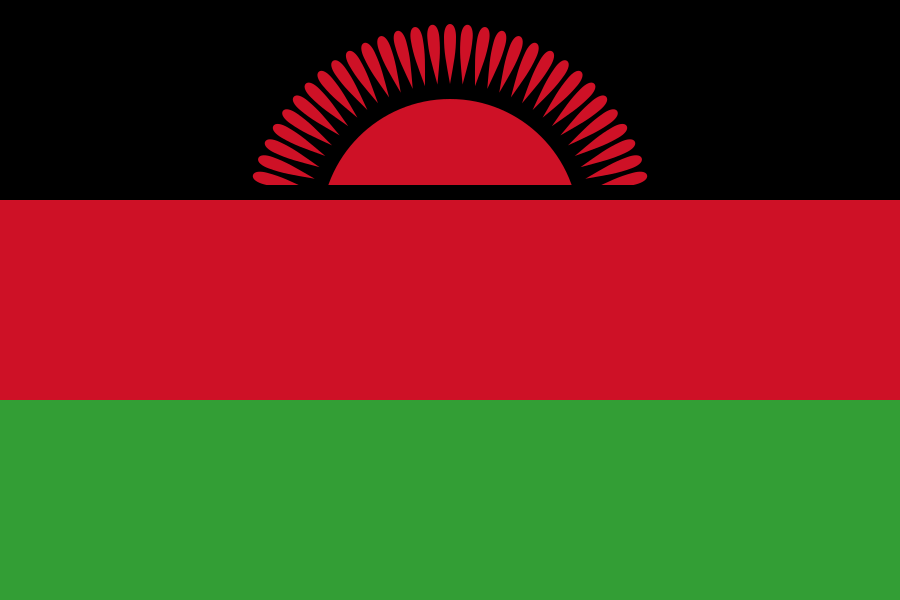 MalawiView flag →
The colours themselves belong to a larger family. Marcus Garvey's Universal Negro Improvement Association adopted its red, black and green flag on 13 August 1920 at a convention in Madison Square Garden. Malawi's stripes ran in a different order, black on top, but the palette was the same. Its exact shades match the ones on Kenya's flag too.
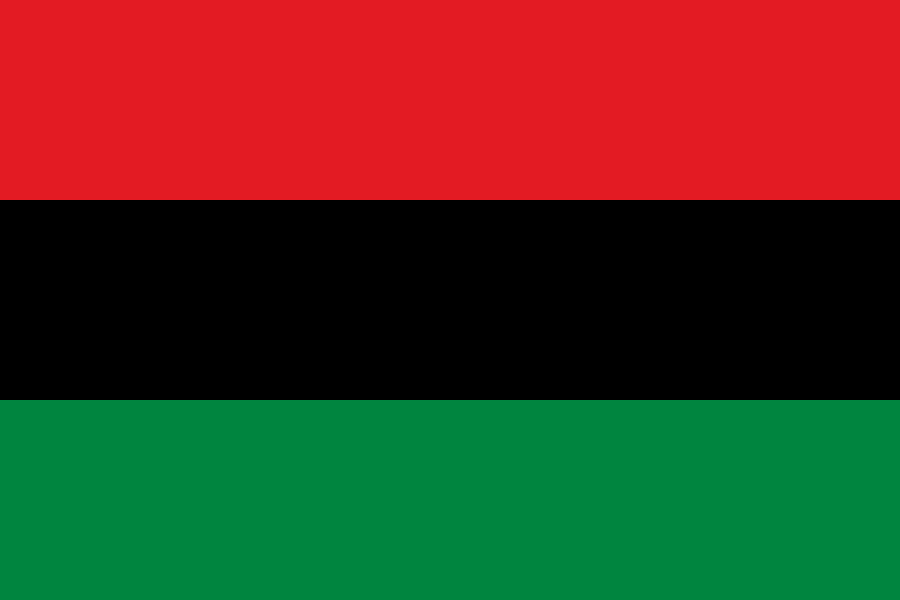 Pan-African FlagView flag →
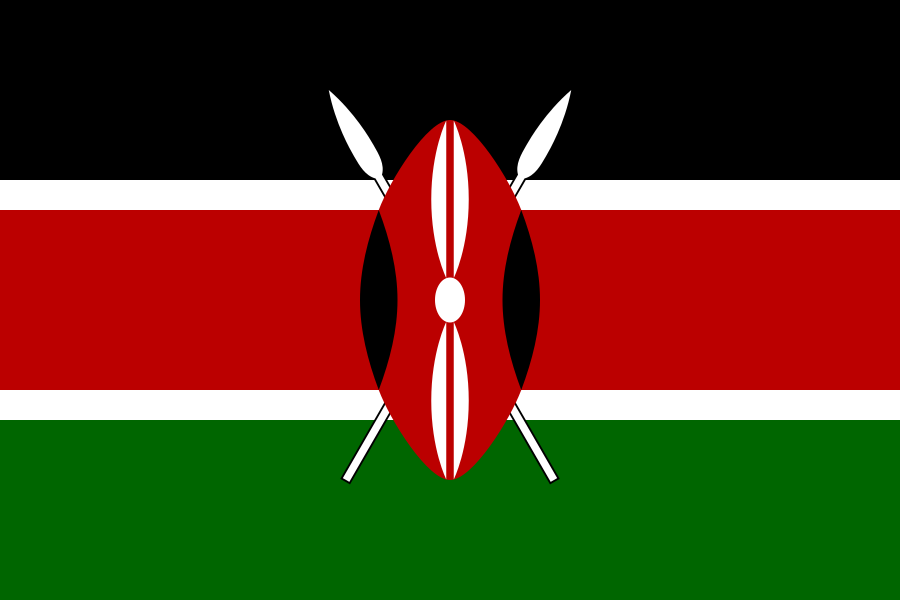 KenyaView flag →
The flag that looked too much like a party
Borrowing a party's flag for the nation has a catch. When the party loses power, its rivals start to see the national flag as the old regime's banner.
That is what happened after Malawi's one-party era ended. In 1995, according to Flags of the World, Justice Minister Peter Fachi proposed changing the national flag because it looked too much like the flag of the Malawi Congress Party. The motion was dropped after the MCP switched to a different party flag, a green one with a rooster.
The truce did not last. The MCP went back to its striped design, and in April 2004 the High Court in Lilongwe ordered the party to stop using it, as The Nation reported at the time. So for years the national flag carried a question mark. Was it Malawi's flag, or the MCP's flag with a sun stitched on?
When the 2010 change finally came, MCP spokeswoman Nancy Tembo called it disrespectful to the nation's history. The party that had once been accused of owning the flag was now the one defending it.
"We cannot permanently live in the past"
Bingu wa Mutharika became president in 2004 on the United Democratic Front ticket. A year later he left the UDF and founded the Democratic Progressive Party. By 2010 he wanted a flag that matched his story about the country, and he had what Daily Maverick later called a supine parliament to pass it.
The process moved fast. On 2 July 2010, parliament approved the bill while opposition MPs walked out in protest. On 11 July the UDF took the change to court. On 29 July, Mutharika signed the Protected Flags, Emblems and Names Amendment Bill into law.
The new design reordered the stripes to red, black and green, top to bottom. It replaced the red half-sun in the top stripe with a full white sun in the centre of the flag. The new sun had 45 rays, spaced exactly 8 degrees apart. Flag researcher Ralph Kelly looked for a meaning in the number and found none. The new stripe order matched Garvey's 1920 flag, red over black over green.
The government's stated reason was development. An Under Secretary in the Ministry of Information said the full sun stood for economic progress since independence. Minister Reckford Thotho insisted, "We are not changing the flag. We are simply modifying it."
Mutharika went further. "The new flag depicts the status of our development," he said. "We cannot permanently live in the past." He also described the old flag as an inheritance from the British colonisers, who had used the rising sun to claim they brought light into darkness.
That last claim is worth a second look. The 1964 stripes came from a nationalist party flag, not from Britain. And the founding legislation tied the sun to the dawn of African freedom, not to colonial light.
Who paid for the sunrise?
Swapping a national flag means replacing far more than flags. "We have to change everything that bears the old flag," a group of Catholic priests complained. According to local press reports cited by Foreign Policy, the change cost Malawi more than $10 million.
The work did not stay inside Malawi either. The government sent the new specifications to Flagcraft, a South African flag maker, with Pantone references for the red and green and a ratio of 2:3. Malawi had also adopted a new vehicle number plate in 2010 that showed the flag. When the flag changed back in 2012, the plates had to change as well.
Critics lined up quickly. The same priests pointed out that parts of Malawi faced starvation that year and the money had better uses. The country's bishops called the flag an expensive distraction and said the president had not consulted the public, as the Christian Science Monitor reported. Others argued that a referendum should have decided it.
The government's response did not help. It warned that people displaying the old flag faced arrest and prosecution.
Then there was the timing. In November 2010, a few months after Mutharika declared Malawi developed, the UN Human Development Index ranked it the 17th least developed country in the world, a fact the Monitor's Jina Moore set right beside his speech. Much of the public gave the new design a nickname that stuck: "Bingu's flag". People saw it as his flag, not theirs.
Sunset, then sunrise
Mutharika died of a heart attack on 5 April 2012, aged 78. His vice-president, Joyce Banda, was sworn in two days later. Mutharika had expelled her from the DPP in 2010 after she refused to back his brother Peter as successor, and she had gone on to found the People's Party.
Banda moved on the flag within weeks. On 18 May 2012 she announced a bill to restore the independence flag. Her cabinet's reasoning was blunt: "In the opinion of Cabinet, there was no compelling reason for changing the independence flag." She said the 2010 change had lacked adequate national consultation.
Justice Minister Ralph Kasambara presented the bill. "A flag has got a very fundamental significance," he said, linking it to the independence struggle, and he called Mutharika's claim that Malawi was prosperous absurd.
On 28 May 2012, parliament voted to restore the rising sun. The DPP, now in opposition after losing nearly half its MPs to Banda's party, objected that a second change was economically short-sighted. As Daily Maverick noted, this was the same party that had spent the money two years earlier. "One starts doubting their credibility," said Billy Banda of the rights group Malawi Watch.
By that summer the red half-sun was back in public, flying at the London Olympics.
What Malawi's two-year flag teaches you
Strip the episode down and one pattern stands out. Both serious attempts to change Malawi's flag came from a party in government trying to separate the nation from something. In 1995 the target was the MCP. In 2010 it was the past itself, as Mutharika defined it. The first attempt was dropped once the MCP changed its own flag. The second died with its sponsor.
If you are judging a flag redesign anywhere, the Malawi case gives you three questions to ask:
- Who asked for the change, and did anyone outside the ruling party get a say?
- Does the new symbolism describe the country, or one government's claims about it?
- Who pays, and does the public think it is worth it?
On the record above, Bingu's flag failed all three. The rising sun had one thing its replacement never did: it came from the independence moment, not from a sitting president.
The flag is still protected by law. When Malawi's parliament removed the offence of insulting the president from the Protected Flag, Emblems and Names Act in November 2022, the national flag kept its protection. And the sun on that flag sits halfway over the horizon again, where it sat in 1964.
Julio Song
Writer
Julio is a staff writer at FlagDB. He studied Mathematics at the University of Madrid and has a passion for vexillology.
More from Julio Song →