The Flag North Korea Called Superstition: How One Peninsula Split an Ancient Cosmology in Two
Julio Song · · 8 min read
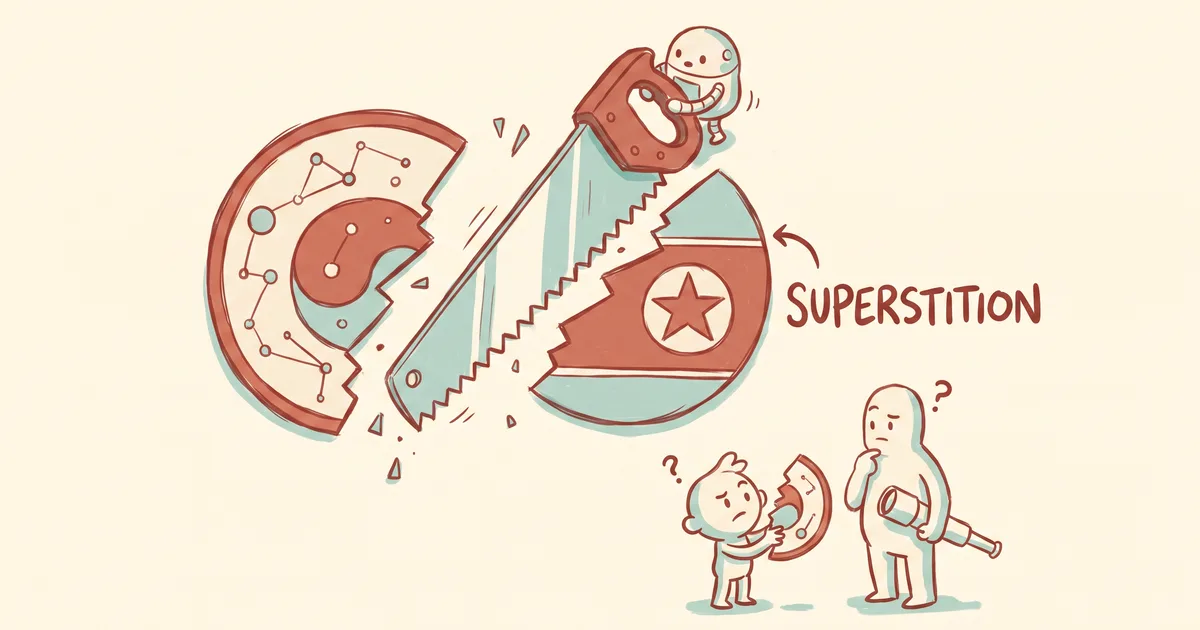
In August 1948, a Korean Workers' Party theorist named Kim Tu-bong sat down to explain why his country needed a brand new flag. He didn't soften the argument. Korea's existing flag, he wrote, was "overly complex, unintelligible, and rooted in superstition." That flag was the Taegeukgi: a red and blue circle wrapped in four black trigrams that Korea had flown since 1883.
Weeks earlier, in Seoul, the other half of the same peninsula had made the opposite call. Keep the Taegeukgi exactly as it was, trigrams and all, and eventually write laws to protect it. Same flag. Same country until 1945. Same ancient cosmology behind the design. One government called it superstition. The other built a legal framework around defending its dignity.
That split says more about the two Koreas than most history chapters manage. It's a story about who gets to decide what a national symbol means, what happens when two governments inherit the same one, and why neither side has stopped arguing about it since, right up to a constitutional amendment passed in Pyongyang earlier this year.
A diplomat draws a flag from ancient cosmology
Before 1882, Joseon Korea had no national flag at all. Korean records show a version of the taegeuk and trigrams already flying in ceremonies tied to the Korea-US treaty signed that year, credited to the scholar Yi Eung-jun. The design that stuck came a few months later, when the Joseon diplomat Bak Yeong-hyo sailed for Japan as an envoy and flew his own version aboard ship in September 1882. A British ship captain travelling with him reportedly suggested cutting the eight trigrams of the I Ching down to four, since eight made the flag too busy to read at a distance. Bak agreed, fixing the arrangement that survives today.
King Gojong made it official soon after. According to South Korea's Ministry of the Interior and Safety, he proclaimed the Taegeukgi the kingdom's national flag by royal order on March 6, 1883.
The design borrows directly from the I Ching, the Chinese classic that maps the universe through opposing forces. The central circle represents yin and yang: blue for the negative, receptive force, red for the positive, active one, locked together in what the government describes as "the harmony between the negative cosmic forces and the positive cosmic forces." The four trigrams around it, geon, gon, gam and ri, stand for sky, earth, water and fire. The white field behind all of it isn't a leftover background either. South Korea's own government describes the white as standing for "brightness, purity, and peace," with the full design meant to embody a people who, like the universe itself, keep creating and renewing themselves. Read together, the whole flag describes a universe in constant, balanced motion, not a static coat of arms.
Banned, painted over, hidden in a temple
Japan annexed Korea in August 1910, ending the Joseon dynasty and, with it, the Taegeukgi's official status. Japanese colonial authorities went further and banned the flag outright, a restriction that lasted through 1945. Producing or displaying it became an act of open defiance. The ban fit a wider pattern. According to Teaching Korea's research on the period, the colonial administration also suppressed the Korean language in public life and pressured Koreans into adopting Japanese names. Flying a banned flag sat inside that same fight over identity.
People made their own anyway. One surviving example, the Jingwansa Temple Taegeukgi from around 1919, only came to light in 2009. According to Teaching Korea's account of the object, it was painted in ink directly over an existing Japanese flag, with holes and fire damage still visible across its top left corner. Nobody recorded who made it or why the cloth underneath was Japanese to begin with. The flag survives today, scorched and reused, evidence that the design mattered enough to risk making it from whatever fabric was on hand.
Korea writes its old flag into law
When Japanese rule ended in 1945, both halves of the divided peninsula kept flying the Taegeukgi, at least for a while. South Korea moved to formalize it almost immediately. The new government set up a National Flag Correction Committee in January 1949, and on October 15 of that year the Ministry of Education and Culture issued the National Flag Production Law, fixing the flag's ratio at 3 to 2 and standardizing where the taegeuk and trigrams sat.
Oddly, the colors themselves stayed undefined for decades. The design saw minor adjustments again in 1984, according to a history compiled by Flags of the World, before a presidential ordinance on October 25, 1997, finally pinned down the exact reds and blues using the Munsell and CIE color systems, with a further refinement in 2011. By 2007, South Korea had gone as far as passing the Act on the Flag of the Republic of Korea, a law built specifically to "inspire patriotism" and defend the flag's dignity. It requires damaged flags to be disposed of by incineration and bans display in any manner that would cause offense. A flag that started as one diplomat's sketch on a ship now has its own statute book.
Moscow's objection: "superstition"
North of the new border, the story went the opposite direction, and it started with an argument over cosmology itself. According to Pak Il, a Korean interpreter who worked with the Soviet occupying authorities, Soviet Major General Nikolai Lebedev rejected the Taegeukgi in 1947, calling its I Ching foundations superstition with no place in a modern state. Kim Il Sung assembled a design team that November. Their first attempt, reviewed in January 1948, was a plain white disc with no internal symbol. The following month, Kim ordered specific changes: add a five-pointed red star inside the disc, shift the disc toward the hoist, and change the flag's proportions to 1 to 2.
The design moved through official channels fast. North Korea's Constitutional Reform Committee accepted it on February 20, 1948. A special committee of the assembly confirmed it on April 28. The new flag was introduced on July 10, and it became law when the country's first constitution passed the 1st Supreme People's Assembly on September 8, 1948.
The change didn't go unopposed inside North Korea itself. The politician Lyuh Woon-hyung called the switch "not right," and the Chondoist Chongu Party reportedly refused at times to march under the new banner. A delegate named Chong Chae-yong defended the old Taegeukgi as a shared symbol of liberation that belonged to the whole peninsula, not to the south alone. Kim Tu-bong's pamphlet, published that August, was the government's answer to those objections. His "superstition" line wasn't a throwaway insult. It was the official justification for erasing 65 years of shared visual history in a single year.
A new vocabulary of color
Where South Korea kept explaining its flag through yin, yang and the elements, North Korea built an entirely new vocabulary for its replacement. A 2013 article in the state newspaper Rodong Sinmun, citing Kim Il Sung directly, laid out the official meaning: red stands for "anti-Japanese fervour" and the blood shed by Korean patriots, white represents "one bloodline, one land, one language, one culture," and blue expresses a "gallant visage" and the spirit of the fight for world peace. The red star, tied to the ruling party's leadership, replaced the trigrams' cosmic directions with a political one. The National Flag Law, adopted on October 22, 1992, locked these specifications into North Korean statute, much as Seoul had done for its own flag decades earlier.
Two governments, one shared ancestor, and by the 1990s neither one described its flag in terms the other would recognize.
Redrawing the line, 78 years later
The story didn't stop there. On March 23, 2026, North Korea's Supreme People's Assembly ratified a constitutional amendment changing the flag's proportions again, this time from 1 to 2 to 1 to 1.65, expressed as the whole numbers 20 to 33. Article 166 of the amended constitution, as reproduced by the newsletter Pyongyang Examiner, also widened the flag's white stripes to roughly a third of the width of the blue ones and repositioned the internal elements, with the white disc's diameter now set at half the flag's width and the red star's axis fixed a third of the way in from the hoist.
It's a small technical change on paper. It's also a reminder that North Korea has now revised its national flag's specifications at least twice in under 80 years, first by replacing the Taegeukgi entirely in 1948, then by re-engineering its own replacement's geometry in 2026. South Korea, by contrast, has spent nearly as much regulatory energy defending its Taegeukgi's stability. Even the exact shade of blue on the South Korean flag has only ever changed through a presidential ordinance, in 1997 and again in 2011, and the flag's overall dignity now sits behind an act of the legislature. Neither change came from a single leader's decree.
One diplomat's sketch, drawn on a ship bound for Japan in 1882, ended up splitting into two flags that no longer share a vocabulary. One still reads like a page out of the I Ching, cosmic forces held in balance over a white field the law now protects by statute. The other has been rewritten by committee, by pamphlet, and now by constitutional amendment, each version a fresh argument about what a nation is supposed to look like. They started as the same piece of cloth. They haven't agreed on anything since.
Julio Song
Writer
Julio is a staff writer at FlagDB. He studied Mathematics at the University of Madrid and has a passion for vexillology.
More from Julio Song →