The Sun That Never Sets: How One Simple Circle Became Asia's Most Loaded Symbol
Julio Song · · 8 min read
In July 2024 in Paris, South Korean athletes and officials filed a formal protest over spectators waving Japan's Imperial Rising Sun flag in the Olympic stands. The story barely registered outside East Asia. No trending hashtags in the English-speaking world, no cable news panels. For millions of people across the Korean Peninsula, China and Southeast Asia, it touched a nerve that has been raw for most of a century.
The odd part is that Japan and South Korea built their national flags around the same object. The sun. In Tokyo it reads as civic pride. In Seoul it stirs grief and anger.
In East Asian vexillology the sun is never decoration. It is a claim about cosmic authority, national destiny, or historical grievance, and the flags of Japan and South Korea are the clearest case.
The red disc and what its simplicity conceals
The Nisshōki (日章旗) is Japan's national flag: a single red disc centered on a white rectangle. No coat of arms, no stars, no stripes. Its minimalism is what makes it so effective and so contested.
The earliest surviving "hinomaru" (circle of the sun) dates to the Edo period, but the design's association with Japanese statehood took hold during the Meiji Restoration of 1868, when the Emperor was re-centered as a divine figure and a literal descendant of Amaterasu, the Shinto Sun Goddess. The red disc was not a metaphor. It was a genealogical statement.
The white field matters more than most people notice. In Shinto aesthetics white signals purity and the sacred, so a red sun on a white field reads closer to a religious proclamation than a national emblem. The whole flag works like an altar cloth.
There is also a bureaucratic curiosity here: the Nisshōki flew for over 130 years before anyone put it into law. The Act on National Flag and Anthem (国旗及び国歌に関する法律) passed in August 1999, and even that triggered protests. Right-wing nationalists thought it was long overdue. Left-wing pacifists opposed state-mandated patriotism.
The simplicity that made the Nisshōki instantly recognizable also left a great deal of interpretive space, and a more ornate variant filled it.
Sixteen rays and a long shadow
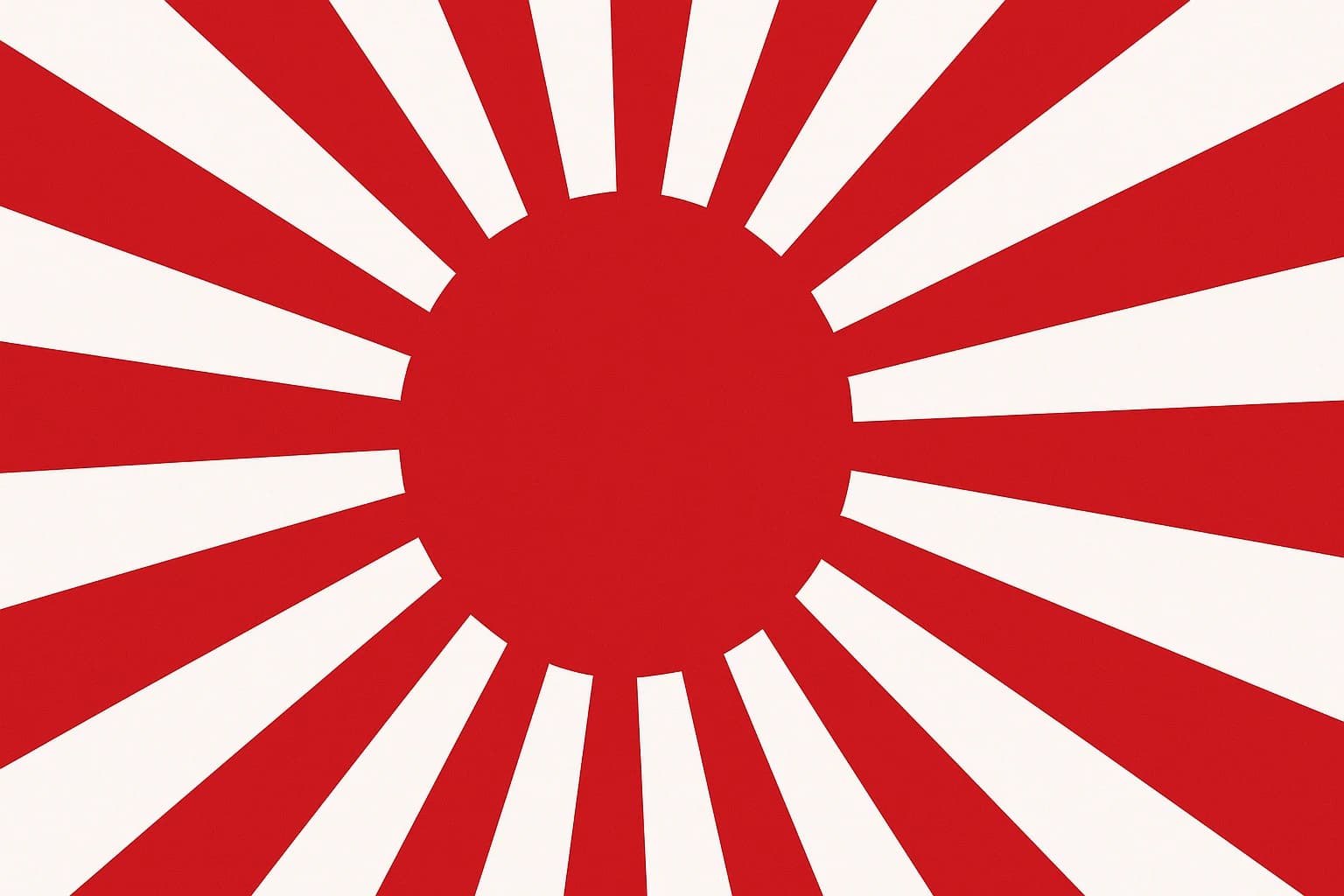
The Kyokujitsu-ki (旭日旗) is the 16-ray "Rising Sun" variant: the same red disc, now radiating sixteen red-and-white rays to the edges. The Imperial Japanese Army adopted it in 1870 and the Navy followed in 1889.
This is the flag that flew on Japanese warships and military installations across Korea, China, the Philippines and Southeast Asia during the Imperial expansion of the 1930s and 1940s. It is the flag that survivors of forced labor, sexual slavery and military occupation remember. It is also the flag that Japan's Maritime Self-Defense Force still uses.
South Korean and Chinese critics draw a direct analogy: keeping the Kyokujitsu-ki in active military service is, in their framing, roughly like Germany continuing to fly a swastika-bearing military flag. Japan's government and many legal scholars reject the comparison, arguing that the design predates the Imperial era by centuries and carries no inherently genocidal mandate. Both sides make coherent arguments and neither finds the other's convincing.
The 2018 Jeju Naval Review brought the tension to a head. South Korea asked all participating navies to fly only their national flags. Japan refused, withdrew its warship, and both governments had to state publicly what had previously been left unsaid. The gap between the two positions turned out to be unbridgeable.
The dispute has not faded. In early 2026 it resurfaced at international sporting events again, and South Korean lawmakers reintroduced a formal motion urging the International Olympic Committee to classify the Kyokujitsu-ki as a prohibited hate symbol ahead of future Games. The motion carries no legal force.
Why Japan won't let go
The Japanese government's official position is straightforward: the flag is a legitimate military ensign with centuries of continuous use, distinct from Imperial-era atrocities, and abolishing it would mean capitulating to foreign pressure rooted in grievance rather than legal principle.
Inside Japan the picture is more mixed. Younger urban Japanese tend to be indifferent, or mildly embarrassed by the flag's international reputation. Veterans' groups, nationalist organizations such as Nippon Kaigi, and parts of the Liberal Democratic Party treat criticism of the flag as an attack on Japanese identity and sovereignty.
Then there is pop culture. The 16-ray burst pattern turns up in anime, fashion brands, sports fan gear and advertising, usually stripped of military context. Critics call this aesthetic laundering, a way of normalizing a contested symbol by cutting it loose from its history. Defenders see the ordinary recycling of a traditional Japanese design element, no different from a chrysanthemum pattern or a wave motif.
The 2011 Osaka City debate is worth noting. Mayor Toru Hashimoto's attempts to regulate flag use by city employees set off a national argument about where historical accountability ends and censorship begins, and no consensus came out of it.
Japan's debate is about which version of the sun symbol is acceptable. South Korea took a different route entirely, encoding solar energy not as an image but as an abstract cosmological diagram.
South Korea's Taegukgi
There is no sun on the Taegukgi (태극기). No disc, no rays. There is a swirling red-and-blue circle at the center and four sets of black bars at the corners, and the whole thing looks like the cover of a philosophy textbook.
The central Taeguk (태극) represents the continuous dynamic balance of opposing cosmic forces, um (음, yin) and yang (양). The universe is not static; it is in perpetual motion. The idea comes from the I Ching and Neo-Confucian philosophy, which shaped Korean intellectual life for centuries.
The four trigrams (괘, gwae) at the corners encode cosmic elements. Geon (☰) is heaven, gon (☷) is earth, gam (☵) is water, and ri (☲), the fire and sun trigram, sits in the upper-left corner. The sun is present on the Taegukgi, translated into the language of cosmic philosophy instead of rendered as national iconography.
The flag's origin has its own irony. Diplomat Park Young-hyo (박영효) first adopted a version of it in 1882, during a diplomatic mission to Japan. During the Japanese colonial period from 1910 to 1945, flying it was illegal and therefore an act of resistance. The current design was finalized in 1949, after liberation.
The abstraction is a stance in itself. Korea encoded its cosmology in a universal philosophical language, producing a flag that claims alignment with the principles of the cosmos rather than with a dynasty or a bloodline.
One sun, two stories
Both flags root their symbolism in solar mythology and East Asian cosmology. Japan chose literalism, a disc. Korea chose abstraction, a diagram. The difference tracks how each nation understood sovereignty.
Japan's Amaterasu-centered mythology required the sun to be represented literally. The Emperor was the Sun Goddess's descendant, so the flag was a family crest expanded to national scale, and authority flowed from divine genealogy.
Korea's Joseon dynasty (1392-1897), which supplied the Taegukgi's philosophical vocabulary, derived legitimacy from the Mandate of Heaven, a moral and cosmic order rather than a bloodline. Any ruler who governed badly could in principle lose it. That is a more contingent claim to authority, and the flag reflects it.
The result is a bitter overlap. Korea's flag, first adopted during a diplomatic mission to Japan, had to survive as a symbol of resistance against Japanese Imperial rule. Between 1910 and 1945 the Taegukgi was a banned, underground symbol while the Nisshōki flew officially over Korean soil. Surviving documentation from the period shows several Korean independence movement figures carrying both flags at once: the Nisshōki because the law required it, the Taegukgi because they wanted it.
Why the flashpoints keep repeating
The recurring diplomatic eruptions are the predictable result of a structural problem. Japan has never formally apologized for the Kyokujitsu-ki specifically, only for the broader conduct of the Imperial era, which leaves the flag in a legal and moral gray zone that nationalists on both sides can exploit.
The pattern repeats with unusual consistency. The 2020 Tokyo Olympics dispute over flag display policies. The 2022 FIFA World Cup fan gear incidents. The 2024 Paris Olympics protest. The 2026 recurrence at another major athletic event. Each one is structurally identical and each produces the same inconclusive diplomatic exchange.
Social media changed the speed and reach of all this. What would once have been a local protest noted in a diplomatic cable now trends on Korean-language platforms within hours and reaches diaspora communities in Los Angeles, Toronto and Sydney within a day.
There is also a generational paradox that cuts against the idea that time heals wounds. Surveys consistently show younger South Koreans feel as strongly about the Kyokujitsu-ki as their parents' generation did, or more so. The internet has given them access to documentary evidence of colonial-era atrocities that was not widely taught in schools a generation ago. Distance from the events has not produced distance from the anger.
As long as Japan's Self-Defense Forces keep using the 16-ray ensign, and no international body has the mandate or the appetite to adjudicate its status, the confrontations will continue. The underlying argument is about whether a symbol carries its history with it permanently, or whether it can be emptied and refilled with new meaning. Japan says the 16-ray sun has been refilled. Korea says it cannot be.
Julio Song
Writer
Julio is a staff writer at FlagDB. He studied Mathematics at the University of Madrid and has a passion for vexillology.
More from Julio Song →Related articles
The Sun That Rises Differently: How Japan's Rising Sun Flag Became the World's Most Contested Military Symbol
The Circle That Carries a Nation: How Japan, Bangladesh, and Laos Each Loaded a Simple Disc With Completely Different Meaning