Colonial history, written into cloth
Flags carry a country's history whether or not the designers meant them to, and vexillology, the study of flags, is largely the business of reading that history back out. In former colonies the reading is often blunt: borrowed colors, a retained canton, an emblem chosen precisely because the colonizer would never have chosen it.
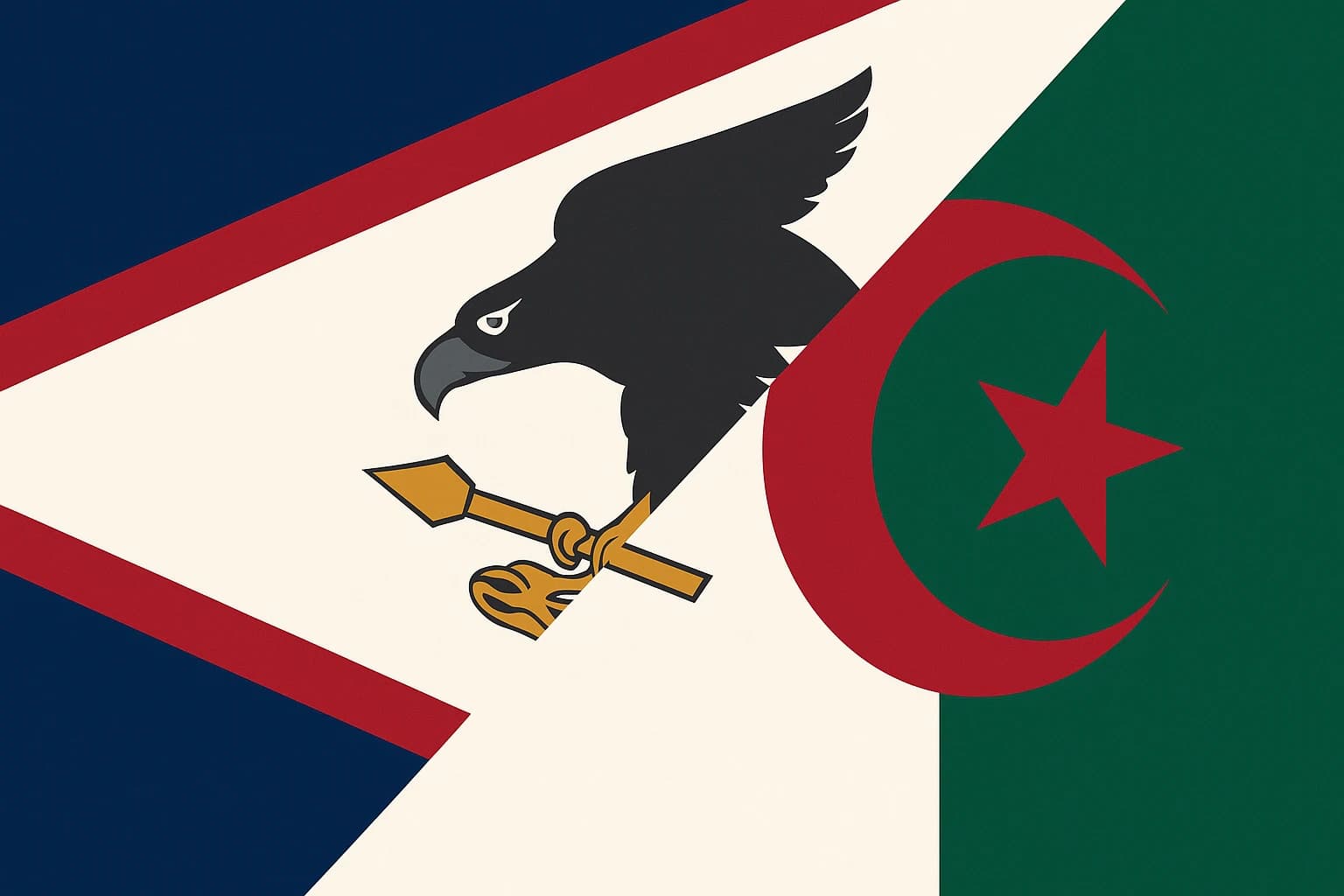
American Samoa: two traditions in one design
American Samoa's flag was made for a U.S. territory, and it shows both halves of that status.
The eagle stands for loyalty to America, and what it clutches, a war club and a fly whisk, are indigenous tools of governance and authority. The red, white, and blue come from the United States. The design is about being both things at once rather than choosing between them.
Algeria: a flag against the flag it replaced
Algeria's flag came out of the fight against French rule, and it points nowhere near France.
Green stands for Islam and white for peace, both central to how the independence movement described itself. The red crescent and star carry the other half of the story: the revolutionary spirit, the resistance.
Three other former colonies
Australia
Australia's flag states its colonial history plainly with the Union Jack in the canton. The Southern Cross places the country in the southern hemisphere.
South Africa
South Africa's post-apartheid flag brings together multiple cultural influences and moves away from colonial imprints.
India
India's flag mixes colonial and indigenous elements. The Ashoka Chakra at its center stands for eternal movement and justice, and it was a central motif of the independence struggle.
What flags do afterward
A flag keeps working long after it is adopted. It appears at sporting events, on national holidays, and at protests, and each appearance restates the argument the design was making in the first place.
When a country revisits its flag, it is usually revisiting its idea of itself. South Africa and New Zealand have both done so, aiming for something closer to their present politics and culture.
Reading a flag like American Samoa's or Algeria's is a way of seeing where a colonial past sits inside a present-day patriotism: sometimes held openly, sometimes deliberately left out.