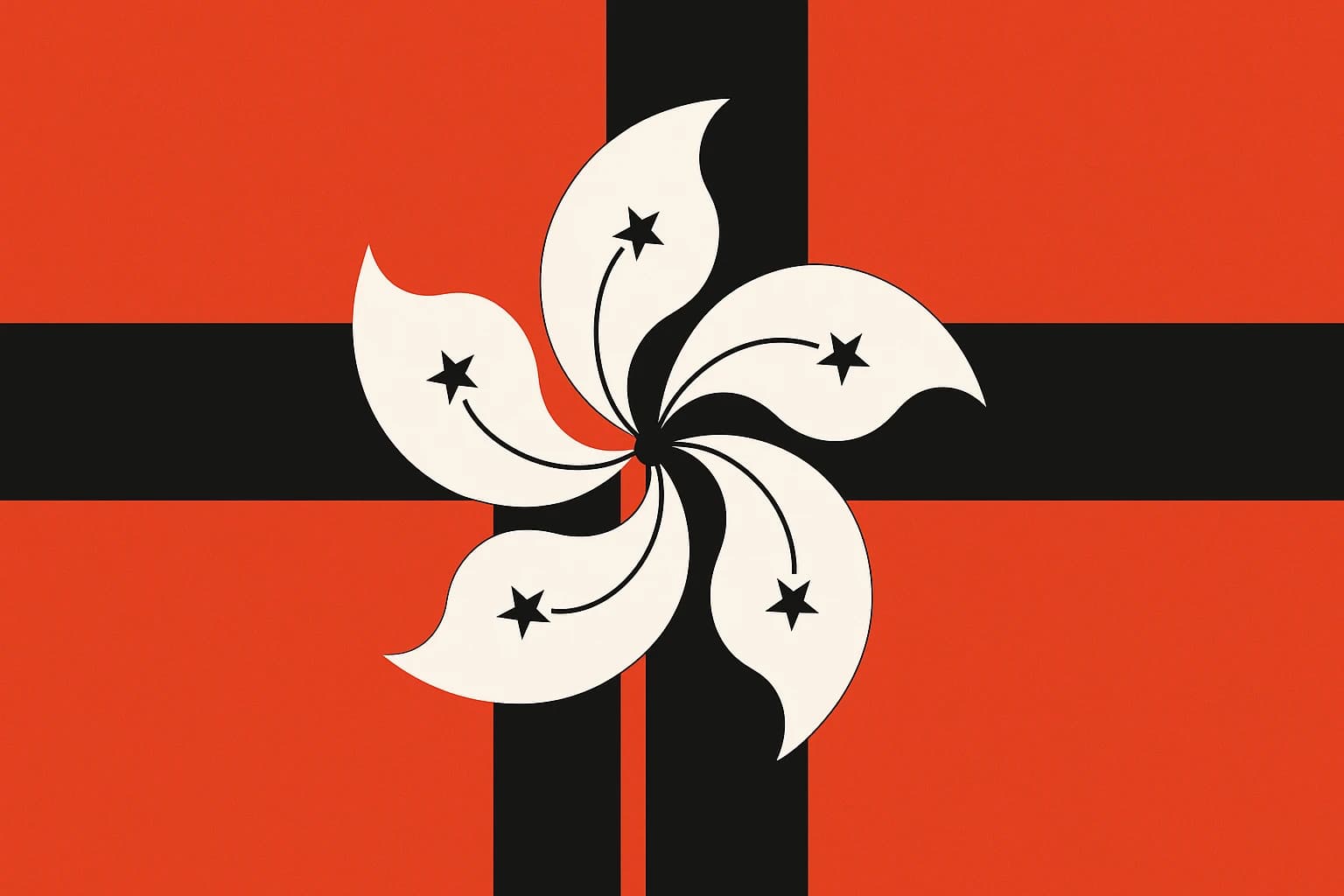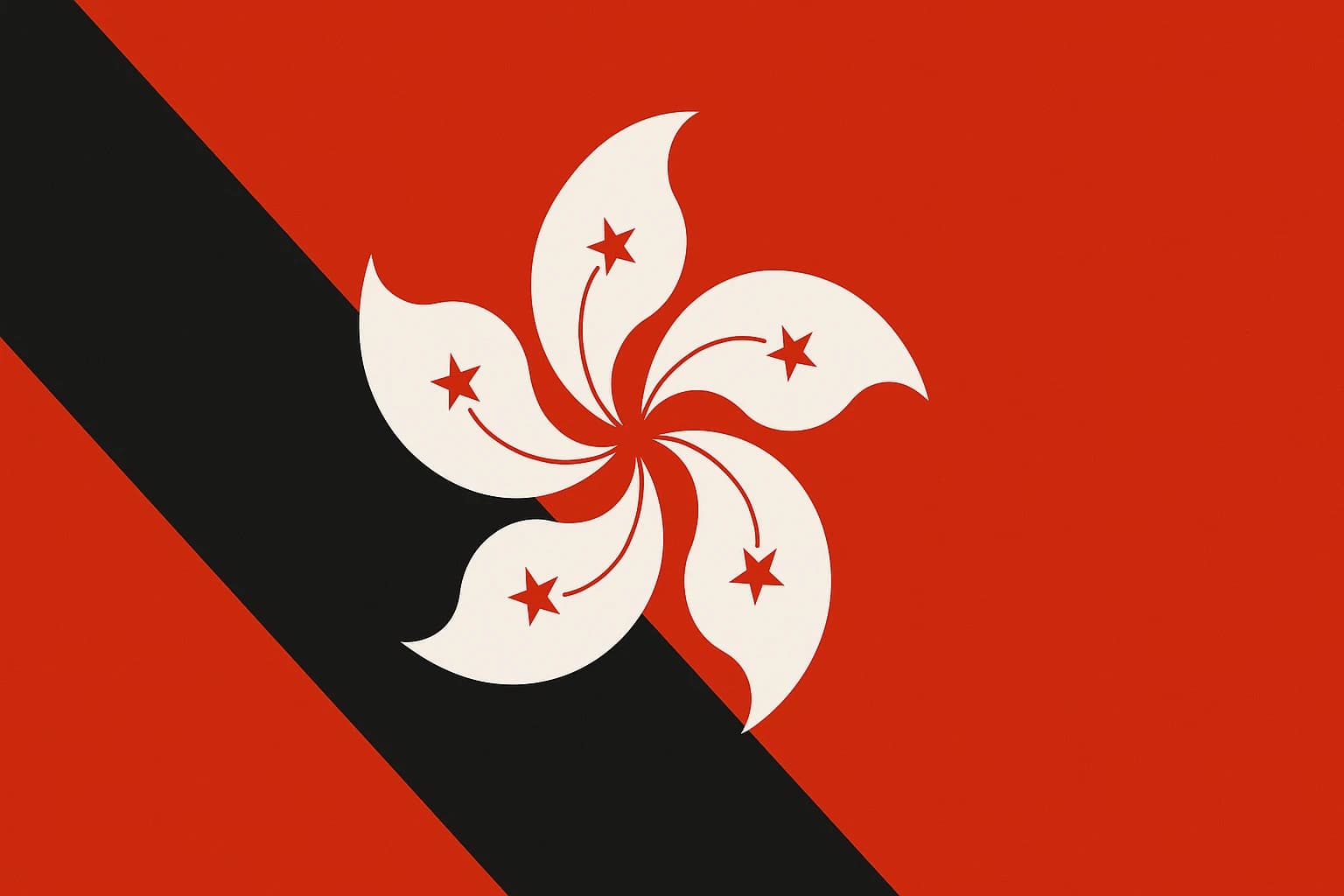
The Bauhinia blakeanae, the flower at the center of Hong Kong's flag, is a sterile hybrid. Discovered around 1880 near the ruins of a house on the shore of Tolo Harbour, it cannot produce seeds. Every specimen alive today is a clone, propagated by hand through cuttings and grafts for more than a century. When Beijing selected this flower as the emblem of the new Hong Kong Special Administrative Region in 1997, the design committee wanted a symbol of beauty and regional identity. Nearly three decades later, the Bauhinia flag is one of the most politically contested pieces of cloth in East Asia, waved in pride at Olympic ceremonies and torn apart in legislative chambers. This is the story of how a botanical specimen became a political flashpoint, and what happens when a place chooses a flower that cannot reproduce as its symbol of continuity.
A flower without a future: the strange botany of Bauhinia blakeanae
The story begins with French missionaries. Sometime around 1880, near the ruins of a house along the shore of Tolo Harbour in the New Territories, they noticed an unusual tree. It bore large, fragrant, purplish-red flowers, but it never set fruit. The specimen made its way to the Hong Kong Botanical Gardens, where the superintendent S.T. Dunn formally described it in 1908. He named it Bauhinia blakeanae after Sir Henry Blake, who had served as Governor of Hong Kong from 1898 to 1903.
The flower is a natural hybrid of Bauhinia purpurea and Bauhinia variegata, two common species across South and Southeast Asia. The cross produced something gorgeous but biologically dead-ended. B. blakeanae is triploid, so its chromosomes do not divide neatly during reproduction and it sets no viable seed. Every orchid tree (its common English name) growing in Hong Kong parks, lining Kowloon streets, or shading university campuses descends from that single original specimen through vegetative propagation.
The flower had a symbolic life well before the handover. In 1965, Hong Kong's Urban Council adopted Bauhinia blakeanae as the city's floral emblem, which made it a local icon for over three decades before Beijing touched it. That was Hong Kongers' own choice, rooted in civic pride rather than imposed from above.
The sterility was nobody's concern in 1965 or even in 1997. It was a botanical footnote. It has since become the most discussed attribute of the flower in political commentary, with protesters and pundits reading the inability to produce offspring as an allegory for Hong Kong's constrained political autonomy, a city kept alive by external decisions rather than its own generative power. Nobody designed that metaphor. It grew on its own.
Designing the transition: how the 1997 flag was made
The Sino-British Joint Declaration of 1984 set the handover date for July 1, 1997. By the late 1980s, Beijing needed new symbols for the territory it was about to reclaim. A flag design competition opened, and it drew over 7,000 entries from across Hong Kong.
The winner was Tao Ho, an architect trained at Harvard under Walter Gropius. Ho proposed a stylized five-petal Bauhinia on a red field. He wanted something that felt organically Hong Kong rather than derivative of mainland Chinese aesthetics, but the red background and the five stars embedded in the petals created deliberate visual echoes of the PRC's own five-starred red flag.
The petals rotate clockwise, suggesting motion and energy. The curved lines of each petal draw on the fluidity of Chinese calligraphic brushstrokes. Each of the five petals contains a single five-pointed star, mirroring the stars on the national flag, which places Hong Kong inside China's constellation rather than outside it.
The flag was formally adopted by the Preparatory Committee of the HKSAR on April 4, 1990. Seven years later, at the stroke of midnight on July 1, 1997, it was raised for the first time at the Hong Kong Convention and Exhibition Centre as the Union Jack came down.
What it replaced was a British Blue Ensign bearing the Hong Kong coat of arms: a naval crown, a junk, and two dragons. That design was rooted entirely in imperial heraldry, assembled in London, and reflected British maritime power rather than anything a Hong Kong resident might identify with. Against that, the Bauhinia was a genuine step toward local representation, even if the framework around it was Beijing's.
The lotus and the orchid tree: China's botanical rebranding of two colonies
Hong Kong wasn't the only former European colony that Beijing rebranded with a flower. When Portugal handed Macau back on December 20, 1999, the new flag featured a stylized white lotus above a bridge and water, set against a green field.
In both cases, Beijing approved flags centered on flowers rather than dragons, stars, or overtly political iconography. A flower signals regional distinctiveness while softening the visual assertion of sovereignty, and it avoids the kind of symbol that could imply full statehood.
The differences between the two flowers tell a subtler story. Macau's lotus is fertile, common, and carries Buddhist connotations of purity and renewal. Hong Kong's Bauhinia is sterile, rare, and named after a British governor.
This fits a broader pattern in Chinese political symbolism. China's own national flower debate has never been settled: the peony and the plum blossom both have strong advocates, and chrysanthemums appear at National Day celebrations. The tradition of investing flowers with political and moral meaning runs deep, and the "Four Gentlemen" of Chinese art (plum blossom, orchid, bamboo, chrysanthemum) have carried ethical weight for centuries. What makes a flower so useful in politics is precisely that it reads as apolitical beauty.
From emblem to battleground: the flag in the 2019 protests and beyond
The 2019 anti-extradition bill protests reshaped how the Bauhinia flag was read. On July 1, 2019, the 22nd anniversary of the handover, protesters stormed the Legislative Council building. In a scene photographed and broadcast worldwide, someone draped a colonial-era Hong Kong flag over the president's podium while others defaced the SAR emblem on the wall.
The alterations were the more inventive protest. Demonstrators created "black Bauhinia" flags, the standard design recolored entirely in black to signal mourning and resistance. Others wilted the petals, added tear gas canisters to the imagery, or dripped the design as if it were bleeding.
On the other side of the barricades, pro-Beijing demonstrators and government officials waved the standard red-and-white flag as an assertion of legitimacy and order. The same streets held dueling visual narratives, the same flower carrying opposite meanings depending on who held it.
After the implementation of the National Security Law on June 30, 2020, the black Bauhinia migrated. It became a symbol of the global Hong Kong diaspora in London, Toronto, Taipei, Vancouver, and dozens of other cities. The colonial Blue Ensign saw a strange resurgence too, reborn as a nostalgia object and protest marker.
Then came the legal response. Under the National Flag and National Emblem (Amendment) Ordinance passed in October 2021, desecrating the regional flag became punishable by up to three years in prison and a fine of HK$50,000. Altering the flag stopped being speech and became a crime.
The unintended metaphor: when symbols outgrow their designers
Tao Ho and the design committee chose the Bauhinia for its beauty and its established local resonance. Nobody was thinking about reproductive biology. The sterility of the flower has nonetheless become its defining feature in political discourse, the single fact everyone knows and everyone uses.
Flags routinely accumulate meanings their designers never anticipated. The Confederate battle flag was a military banner for a four-year conflict, and its life as a symbol of white supremacy and "heritage" debates has stretched across the following 160 years, dwarfing its original context.
The European Union's flag is another case. Its twelve stars are often misread as representing the original twelve member states. The number was chosen for its symbolic completeness, rooted in traditions of harmony and unity, and the misreading persists anyway.
The philosopher Nelson Goodman had a useful term for this: "exemplification." A symbol highlights certain properties, and those properties need not be the ones its creator considered important. Sterility, colonial naming, hybrid origins: each gets foregrounded or pushed into the background depending on who is looking and when. The gap between intended and received meaning is where most of a symbol's political life happens.
A garden of meanings: the Bauhinia in 2026
Nearly 29 years after the handover, the Bauhinia flag flies over a Hong Kong whose politics have been fundamentally reshaped. The National Security Law, the overhaul of the electoral system in March 2021, and the steady transformation of civil society have changed what the flag means in practice, even though the cloth itself has not changed at all.
The Bauhinia saturates daily life. The Golden Bauhinia Square sculpture in Wan Chai, a gift from Beijing unveiled at the handover, draws tourist photos every day. The flower appears on coins, passports, government letterheads, and the sides of police vehicles. That ubiquity both reinforces a symbol and wears it smooth.
Outside Hong Kong, the black Bauhinia keeps appearing. At overseas commemorations of the June 4 Tiananmen anniversary, at July 1 gatherings in cities with large diaspora populations, the altered flag shows up on banners, T-shirts, and social media profile pictures. Inside Hong Kong itself, those displays have been effectively suppressed.
Which raises a question that applies well beyond this one territory. Who owns a symbol? The government that commissioned it, the people who live under it, or the diaspora that carries it away? And if those people blacken it, wilt it, and reclaim it, is the redesigned version any less authentic than the original?
The clone that keeps growing
The Bauhinia blakeanae exists only because humans keep propagating it, clipping and grafting year after year. Left alone, it would vanish within a single tree's lifespan. In that respect it turns out to be a more honest symbol than its designers realized.
Hong Kong's identity also has to be actively maintained. The flag that was meant to signal a smooth transition has instead become a Rorschach test: continuity and sovereignty for Beijing, a reminder of contested promises for many Hong Kongers, and for the diaspora a flower carried far from the ground it grew in.
The Bauhinia blooms on flagpoles and protest banners, on coins and courtroom walls. It does so because other hands keep making it bloom, which is the part of the metaphor nobody planned.