The Flag of Hong Kong
Hong Kong Special Administrative Region of the People's Republic of China
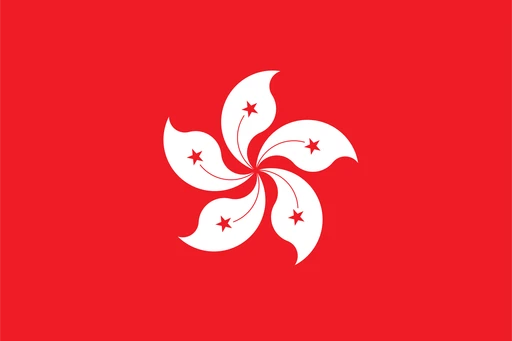
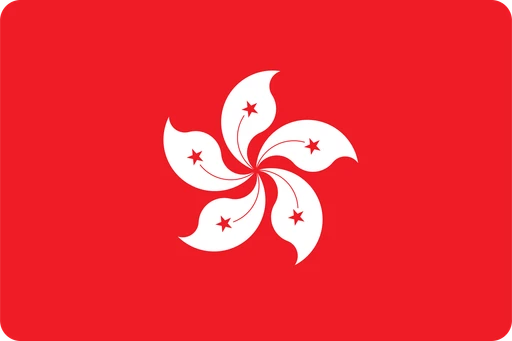
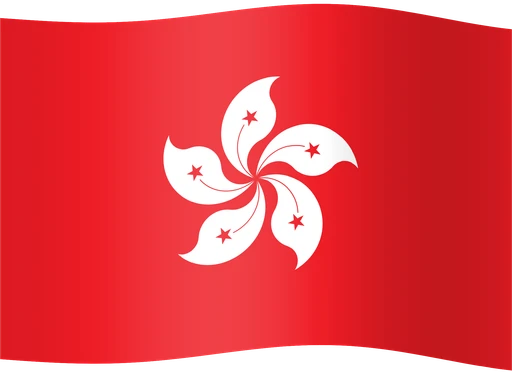
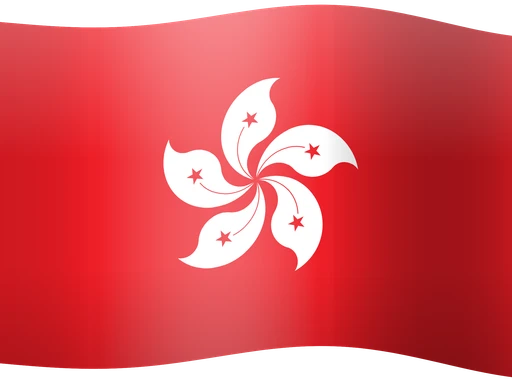
The flag of Hong Kong has a white, five-petal Bauhinia blakeana flower at the center of a red field. Each petal carries a red star, and the five stars sit in a circle. The design is meant to convey harmony and unity, and the red field ties Hong Kong to China.
The regional flag of Hong Kong puts a plant at its centre. Not a star, a crescent, or a coat of arms, but a stylised white bauhinia flower (Bauhinia blakeana), a species discovered in Hong Kong and found nowhere else on Earth in the wild. It was adopted on 1 July 1997, the day Hong Kong passed from British to Chinese sovereignty. Each of its five petals carries a red star that ties the city to the People's Republic of China, and the whole design was built to speak about Hong Kong's own identity and its place within a larger nation at the same time.
A flower found nowhere else
The Bauhinia blakeana, commonly called the Hong Kong Orchid Tree, was discovered around 1880 near the shore of Pok Fu Lam and named after Sir Henry Blake, Governor of Hong Kong from 1898 to 1903. The tree is sterile. It reproduces only through cuttings, so every Bauhinia blakeana alive today is a clone of the original specimen, which ties it to Hong Kong's soil more tightly than most floral emblems can manage.
The flower was declared Hong Kong's official floral emblem in 1965, long before anyone was thinking about flags for a post-colonial future. Its association with the city predates the handover by three decades, which gave it a legitimacy that a newly invented symbol could not have had.
On the flag the flower is stylised: five white petals, each with a red centreline, drawn boldly enough to read at a distance while staying botanically recognisable. Choosing a flower rather than a political or heraldic device was deliberate. It placed Hong Kong's identity in something local and living rather than in colonial administration, Cold War allegiance, or party ideology.
Designing for the handover
Following the 1984 Sino-British Joint Declaration, both governments agreed that Hong Kong would need its own regional flag for the post-1997 era under the "One Country, Two Systems" framework. What should go on it was another matter.
A public design competition ran from 20 May 1987 to 31 March 1988 and attracted 7,147 submissions, of which 4,489 were flag designs. That was an unusually high level of participation for a design exercise and a measure of how much the transition mattered to people.
None of the six shortlisted entries was accepted in Beijing. The design that replaced them came from architect Tao Ho (何弢), who had sat on the judging panel, and it went through several rounds of government review before it settled. A Hong Kong committee, consulting with Beijing, adapted and standardised the concept. Early drafts experimented with different background colours and petal arrangements. The final deep red was chosen to sit comfortably beside the flag of the People's Republic of China: close enough to look related, different enough not to be a copy. The National People's Congress approved the result on 4 April 1990, and the Preparatory Committee signed off on the final version on 10 August 1996.
At midnight on 1 July 1997 the flag was unveiled at one of the most televised political ceremonies of the 20th century. As the British Blue Ensign came down in the rain, the bauhinia flag went up. Prince Charles, Jiang Zemin, Chris Patten, and Tung Chee-hwa watched in person, and millions watched on television. The brief the design had to satisfy was a narrow one: the flag had to read immediately as "Hong Kong" while remaining compatible with Chinese national symbolism.
Red, white, and five stars
The background is Pantone 186 C, from the same family of red used in the PRC national flag. The choice was not accidental. It signals kinship with the mainland without matching it exactly.
Each of the five petals contains a five-pointed red star with a red centreline running through it. On the PRC flag, five stars represent the Communist Party and four social classes united under it. On Hong Kong's flag those five stars are redistributed across the five petals, restating mainland iconography through a local botanical form.
White stands for the purity and brightness associated with Hong Kong's civic character under "One Country, Two Systems." The contrast between the white flower and the red background is said to represent the relationship between Hong Kong and the motherland: distinct elements in a single composition.
The flower is also drawn with a slight clockwise rotation, a choice Tao Ho made to suggest a living, growing thing rather than a static emblem. Most viewers register the sense of motion without noticing the reason for it.
Two colours is a restrained palette for a regional flag, and that restraint is part of why the design is easy to remember.
Protocol and display
Use of the flag is governed by the Hong Kong Basic Law and the Regional Flag and Regional Emblem Ordinance (Cap. 2602), which set out dimensions, colours, and conditions of display in law rather than in guidance.
The flag must be flown alongside, and subordinate to, the national flag of the PRC on all official occasions, and may never be flown higher than it. Official dimensions specify a 3:2 ratio, and the bauhinia must occupy a diameter equal to three-quarters of the flag's width, which keeps the emblem legible at any scale.
Half-masting follows the rules for the PRC national flag. The regional government may order the flag flown at half-mast for national mourning only with central government approval.
A separate Regional Emblem (區徽) exists for official documents, seals, and government buildings. It uses the same bauhinia on a red background, encircled by the Chinese and English names of the region. The flag may not be used in commercial advertising without authorisation, and defacing or desecrating it carries legal penalties under Hong Kong law. Those provisions became far more politically visible after the 2019-2020 protests, when the flag itself became a site of contestation.
The flags Hong Kong flew before 1997
Before 1997, Hong Kong flew the British Blue Ensign defaced with the colonial coat of arms: a naval crown, a lion holding a pearl, and a junk sailing beneath. That coat of arms was granted by royal warrant in 1959, so the colonial flag itself was a late arrival. Before that year, various unofficial and interim versions circulated, which says something about how ad hoc British colonial vexillology could be.
During the Japanese occupation from 1941 to 1945, the Japanese naval ensign and Rising Sun flag flew over government buildings. That period remains a sensitive part of Hong Kong's collective memory, and the flags associated with it still carry a sharp emotional charge.
The 1997 transition was the first time Hong Kong flew a flag designed specifically for and by Hong Kong people rather than one inherited from imperial administration.
During the 2019-2020 protests, some demonstrators inverted or defaced the regional flag as a form of political expression. Others flew the old colonial Blue Ensign, a choice loaded with its own contradictions. The bauhinia flag is barely a generation old, and it remains a contested symbol rather than a settled historic artefact.
References
[1] Hong Kong Regional Flag and Regional Emblem Ordinance (Cap. 2602), Hong Kong e-Legislation (www.elegislation.gov.hk)
[2] The Basic Law of the Hong Kong Special Administrative Region of the People's Republic of China (1990), Article 10 and Annex III (www.basiclaw.gov.hk)
[3] Hong Kong Herbarium, Agriculture, Fisheries and Conservation Department, official documentation on Bauhinia blakeana (www.afcd.gov.hk)
[4] Flags of the World (FOTW), Hong Kong entry (www.crwflags.com/fotw/flags/hk.html)
[5] Carroll, John M. A Concise History of Hong Kong. Rowman & Littlefield, 2007.
[6] Welsh, Frank. A History of Hong Kong. HarperCollins, 1993.
[7] Smith, Whitney. Flags Through the Ages and Across the World. McGraw-Hill, 1975.
[8] BBC and RTHK archival footage of the 1 July 1997 handover ceremony.
Common questions
- What does the Bauhinia flower on the Hong Kong flag represent?
- The bauhinia stands for harmony and for the blend of Hong Kong and mainland Chinese culture. Each petal carries a red star, which links the flag to China's national flag, and the red background stands for Chinese nationalism.
- When is the Hong Kong flag used in official events?
- It flies at government buildings and official ceremonies, always alongside China's national flag, which takes precedence under regional protocol.
- How has the Hong Kong flag been used in protests?
- Protesters have used it to stand for democratic rights and freedoms. Its appearance at demonstrations points to the tension between Hong Kong's own identity and rule from Beijing.
Featured in these articles
- The Tree That Holds Up a Nation: Lebanon's Cedar and the Surprisingly Rare Tradition of Putting Plants on Flags
- The Bauhinia That Blooms for No One: Hong Kong's Post-Handover Flag and the Politics of Botanical Design
- The Bauhinia Flower That Blooms for No Nation: Hong Kong's Flag and the Politics of Botanical Identity
Download this flag
Free in 12 styles, from 32px icons up to 2000px, as SVG, PNG, WebP and JPG.