The Flag of Macau
Macao Special Administrative Region of the People's Republic of China
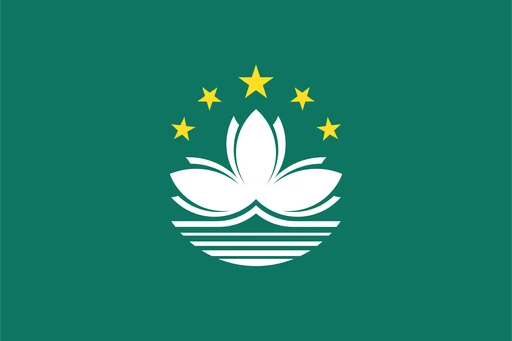
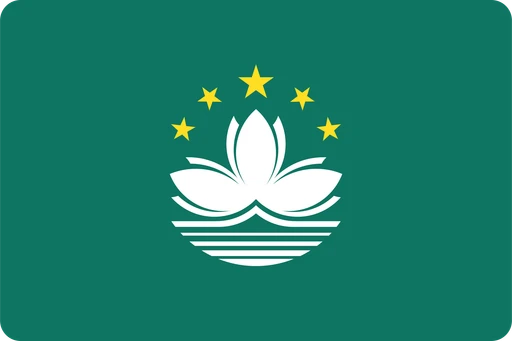
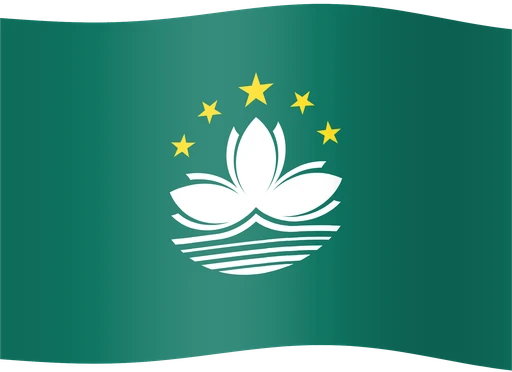
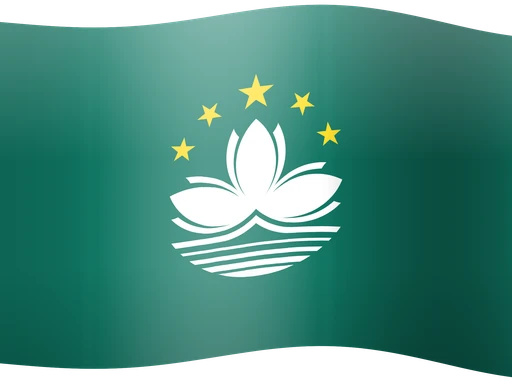
The flag of Macau is green, with a white lotus flower above a stylized bridge and water emblem, and five five-pointed stars above the lotus, one large and four small. The lotus is the floral emblem of Macau. The bridge is the Governor Nobre de Carvalho Bridge, which links the Macau Peninsula and Taipa Island, and the water beneath it marks Macau out as a coastal city. The five stars echo the flag of China and stand for Macau's relationship with the People's Republic.
Macau's flag is one of the most botanically precise in the world. At its center is a white lotus blossom rendered with enough detail to identify the species, above a stylized bridge and sea on a field of deep jade green. It was adopted in 1999, when Portugal returned Macau to Chinese sovereignty after 442 years of colonial rule, and almost every element on it is a specific reference rather than a generic one.
The 1999 handover
Macau holds a singular distinction: it was the oldest European settlement in East Asia. Portuguese traders established a permanent foothold there in 1557, decades before the British ever set foot in Hong Kong. For nearly four and a half centuries, Macau operated under Portuguese administration, its identity shaped by a unique fusion of Cantonese and Lusophone cultures. That era ended at midnight on December 20, 1999, when Portugal formally handed sovereignty to the People's Republic of China.
The flag was born from that moment. Designed specifically for the handover, it replaced the Portuguese colonial flag, which had featured the Portuguese coat of arms and colonial insignia over a plain background. The visual break was absolute and deliberate. Nothing in the new flag recalls Portugal. Where the colonial emblem spoke of European dominion, the new design speaks entirely in Chinese visual language.
Macau's handover came two years after Hong Kong's in 1997, and the gap wasn't coincidental. The two territories had entirely separate treaty histories. Hong Kong was ceded to Britain under the Treaty of Nanking in 1842 and later leased under the Convention for the Extension of Hong Kong Territory in 1898. Macau's situation was governed by the 1887 Sino-Portuguese Treaty of Peking, and negotiations for its return followed their own timeline. Those two years mattered symbolically: Macau was the last European colony in Asia, and its handover closed a chapter that stretched back to the Age of Exploration.
The political framework underpinning the flag is "One Country, Two Systems," the same model applied to Hong Kong. Under this arrangement, Macau retains its own legal system, currency, and customs territory for 50 years after the handover. The Basic Law of the Macau Special Administrative Region, effective December 20, 1999, codifies the flag's design and gives it protected legal status, which puts it on constitutional footing rather than mere convention.
The lotus, the bridge, and the sea
The white lotus at the center is Nelumbo nucifera, the sacred lotus of Chinese tradition. It's not a generic flower. In Chinese culture, the lotus carries centuries of meaning: purity, resilience, the capacity to bloom beautifully out of murky water. Buddhists and Confucians alike revere it. For Macau, it's the city's emblematic flower, and the designers rendered it with a specificity that borders on botanical illustration.
Look closely and you'll count three open petals and two closed buds. The three blooms correspond to Macau's three main land areas: the Macau Peninsula, Taipa, and Coloane. The two buds stand for future growth. The flower doubles as a map.
Below the lotus, a stylized bridge arcs across the lower portion of the emblem. This is a direct reference to the Governador Nobre de Carvalho Bridge, now commonly called the Macau-Taipa Bridge. Opened in 1974, it was the first fixed link between the Macau Peninsula and Taipa Island, a piece of infrastructure so central to Macau's modern identity that it earned a place on the flag. Beneath the bridge, gentle rippling lines evoke the waters of the Pearl River Delta and the South China Sea, Macau's geographic and economic lifeline for centuries.
The composition stacks in a deliberate order: the lotus rises above the bridge, and the bridge spans the water.
Then there's the field itself. Green in Chinese culture connotes harmony, peace, and growth. It also distinguishes Macau's flag from China's red national flag while staying within a palette that reads as Chinese rather than European.
Five stars
Above the lotus, five gold stars arc across the upper portion of the flag: one large star and four smaller ones. Anyone familiar with the flag of the People's Republic of China will recognize the echo immediately. On China's national flag, the large star represents the Communist Party of China, and the four smaller stars represent the four social classes (working class, peasantry, urban petty bourgeoisie, and national bourgeoisie) united under party leadership.
On Macau's flag, the stars are reinterpreted. They signal Macau's unity under Chinese sovereignty without carrying the same class-specific symbolism. It's a visual pledge of allegiance, rendered in gold against jade green instead of gold against red.
Hong Kong took a different approach. Its flag dropped the separate star motif and centered a white bauhinia flower with five stars embedded in the petals. Macau kept its stars distinct and prominent, which states the relationship to the mainland more plainly.
There's a subtle geometric distinction too. On China's flag the four smaller stars sit in a tight vertical arc to the right of the large star. On Macau's they follow a gentler curve above the lotus.
Comparisons, and the missing Portuguese element
When the Portuguese colonial flag came down for the last time on December 19, 1999, the visual contrast with what replaced it was startling. Gone were the European heraldic elements, the shield, the armillary sphere. In their place: a lotus, a bridge, water, stars. The shift was total.
Placing Macau's flag next to Hong Kong's reveals a fascinating design conversation. Both were created for 1990s handovers. Both feature a central white emblem on a solid colored field. Both incorporate PRC star motifs. But Hong Kong chose blood red for its field and a flower with embedded stars, while Macau chose jade green and kept its stars and lotus separate. The differences reveal distinct self-images: Hong Kong's flag feels bolder, more assertive; Macau's feels contemplative, more layered.
The lotus design draws on traditions of Chinese seal art and botanical illustration. The clean white lines against green recall woodblock printing more than they do standard flag design.
Among flags built to express partial sovereignty, like those of Åland, Greenland, or Puerto Rico, Macau's covers unusual ground: the territory's geography, its relationship to a parent state, and its cultural identity, all in one image.
The absence of any Portuguese visual reference remains politically loaded. After 442 years, not a trace of Lusophone heritage appears on the flag. Some scholars read this as deliberate erasure, others as a clean break for a territory looking forward.
Protocol and everyday use
Macau's flag is always flown alongside the national flag of the PRC, and protocol is strict: the PRC flag takes precedence in both placement and size. You'll never see Macau's flag displayed in a position of superiority over the national flag in any official context.
The flag flies most prominently on two dates. December 20, Macau Special Administrative Region Establishment Day, marks the anniversary of the handover. October 1, the National Day of the PRC, is the other major occasion. Both days feature flag-raising ceremonies, public celebrations, and official events where the jade green banner takes center stage alongside China's red.
In international sport the flag does practical work. Macau competes separately from mainland China in events like the East Asian Games and certain Olympic qualifying competitions, and its athletes march under their own flag, which is "One Country, Two Systems" playing out in public.
Then there's the casino industry. Macau is the world's largest gambling hub, ahead of Las Vegas in revenue, and the flag appears throughout that environment as a marker of official status. It hangs on government buildings, licensed casinos, and border checkpoints.
Public attitudes toward the flag vary across Macau's diverse population. The ethnic Chinese majority, the Macanese community of mixed Portuguese-Chinese heritage, and the Portuguese-speaking residents each bring different associations to the emblem. For some it represents homecoming; for others, a complex negotiation with history.
Legal protections against desecration mirror PRC national flag law. Law No. 5/1999 governs the use, display, and protection of Macau's regional flag, with penalties for misuse.
References
[1] Basic Law of the Macau Special Administrative Region of the People's Republic of China (1993, effective 1999), Article 41 and Annex I. Legally defines and protects the flag's design. (https://bo.io.gov.mo/bo/i/1999/leibasica/index_uk.asp)
[2] Government of the Macau Special Administrative Region, Official Portal. Flag specifications and ceremonial protocols. (https://www.gov.mo)
[3] Flag of the Macau Special Administrative Region Law (Law No. 5/1999). Regional legislation governing flag use and protection.
[4] Porter, Jonathan. Macau, the Imaginary City: Culture and Society, 1557 to the Present. Westview Press, 2000. Historical context for the colonial-to-handover transition.
[5] Edmonds, Richard Louis. "Macau." Encyclopedia Britannica. Verified factual baseline on geography and political status. (https://www.britannica.com/place/Macau)
[6] Smith, Whitney. Flags Through the Ages and Across the World. McGraw-Hill, 1975. Broader vexillological context on colonial and post-colonial flag transitions.
[7] South China Morning Post archival coverage of the December 20, 1999 handover ceremony. Primary journalistic record of the flag's first official raising. (https://www.scmp.com)
Common questions
- What do the symbols on the Macau flag mean?
- The Macau flag includes a lotus flower for purity and harmony, a bridge symbolizing connection and commerce, and five stars to reflect Macau's link with China. The green background stands for life and tranquility.
- When did Macau start using its flag?
- Macau's flag was adopted on December 20, 1999, the same day sovereignty was transferred from Portugal to China, establishing Macau as a Special Administrative Region.
- Why is the Macau flag green?
- The deep jade green is a nod to harmony, peace, and growth in Chinese culture. It also helps set Macau's flag apart from China's red flag, while still feeling distinctly Chinese rather than European. That was a deliberate choice that reflects Macau's place within Chinese sovereignty.
Featured in these articles
Download this flag
Free in 12 styles, from 32px icons up to 2000px, as SVG, PNG, WebP and JPG.