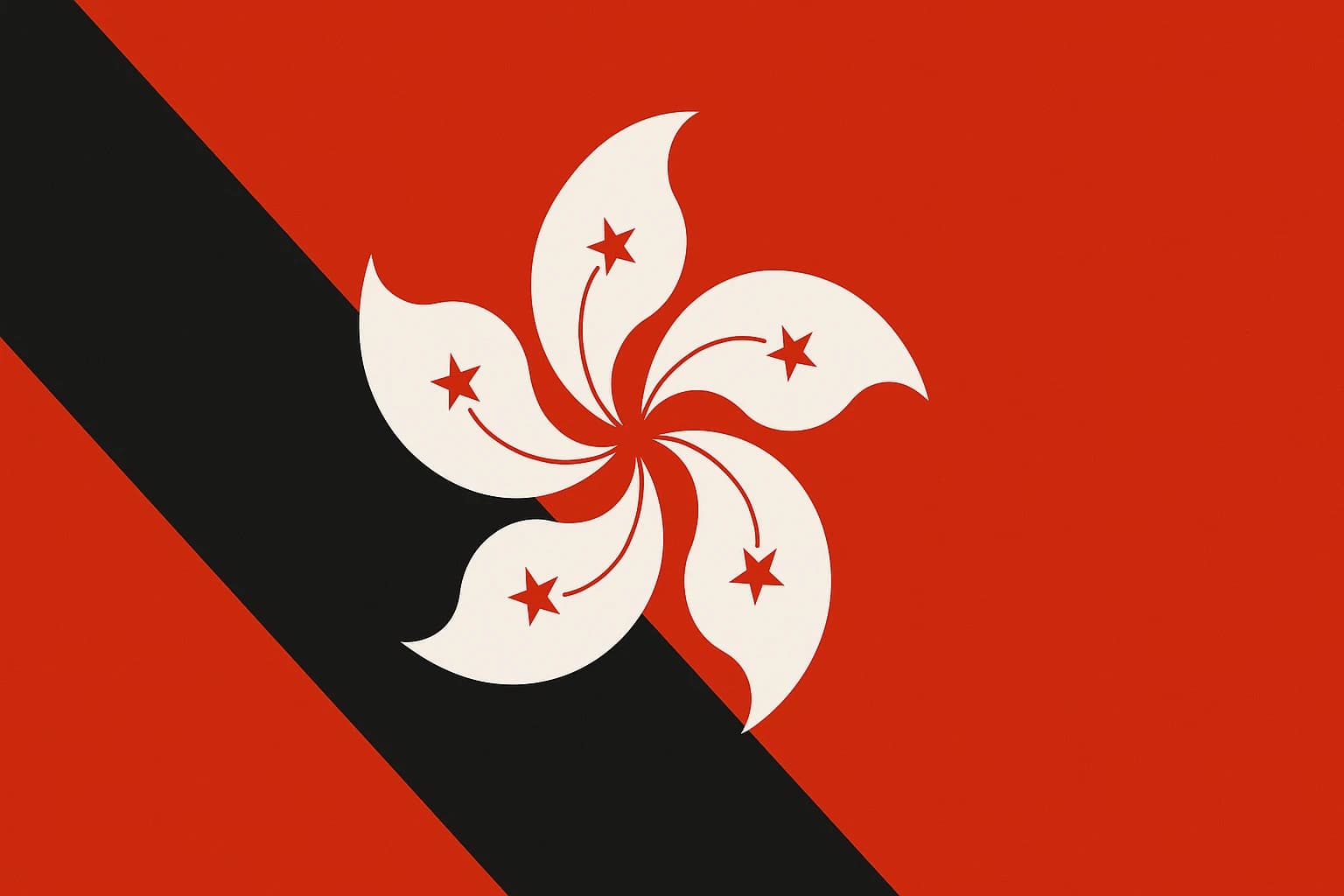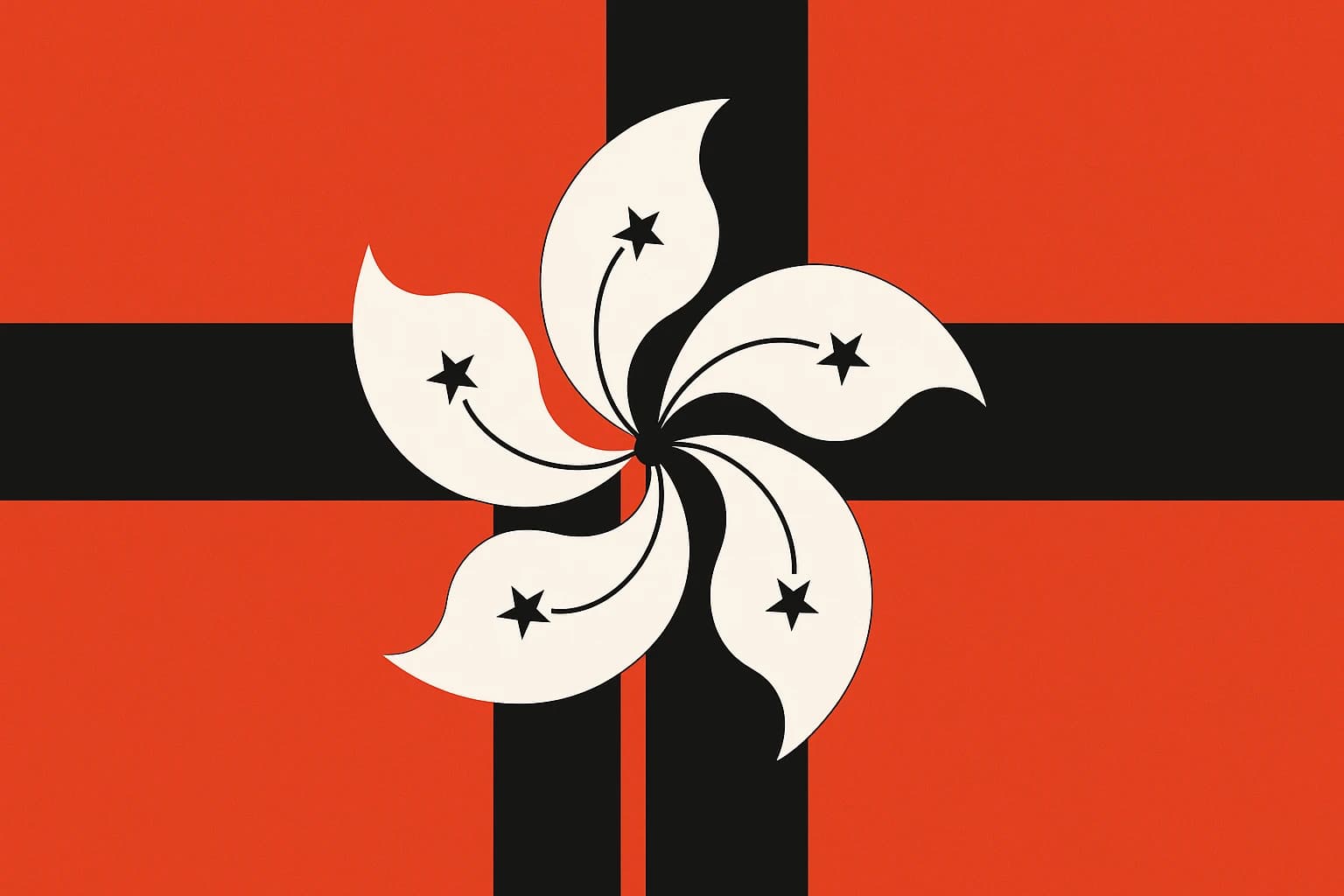
On July 1, 1997, as the Union Jack came down over Government House in Hong Kong for the last time, a new flag went up in its place: white petals on a red field, elegant and deliberately ambiguous. The flower at its center was the Bauhinia blakeana, a hybrid orchid tree first identified in Hong Kong in 1880 and named after Sir Henry Blake, a British colonial governor.
The botanical detail that turns this flag from civic branding into political metaphor is that the Bauhinia blakeana is sterile. Every tree of the species is a clone, propagated by grafting, because the flower produces no viable seeds. Hong Kong's founders chose, knowingly or not, a symbol that cannot reproduce itself. A living thing with no biological future unless tended by human hands.
Nearly three decades later, with Hong Kong's politics reshaped by the National Security Law and the 2019 protests faded into a tense quiet, the sterile flower has become one of the stranger symbols in modern vexillology. This is how a botanical quirk became a political Rorschach test, and what it says about designing identity for a place that belongs fully to no one.
The strange taxonomy of Bauhinia blakeana
The Bauhinia blakeana was first spotted around 1880 near the ruins of a house on the shore of Tolo Harbour, by French missionaries from a nearby Catholic mission. It was not formally described until 1908, when Stephen Troyte Dunn, superintendent of the Hong Kong Botanical Gardens, gave it a Latin name honoring Sir Henry Blake, the colony's 12th governor, who served from 1898 to 1903.
The tree is a natural hybrid, most likely a cross between Bauhinia variegata and Bauhinia purpurea, and it is completely sterile. No viable seeds, ever. Every Bauhinia blakeana in existence is a clone of the original specimen, kept alive through cuttings and grafts. The flower on Hong Kong's flag exists because humans keep copying and replanting the same genetic individual, decade after decade.
Hong Kong adopted the Bauhinia blakeana as its official flower in 1965, under British colonial rule, more than three decades before the handover. The flower's symbolic identity predates both the current flag and the political framework it represents. It was a colonial-era choice that survived decolonization, which says something about how deeply it was already woven into Hong Kong's self-image.
Then there is the naming. A French missionary's discovery, a British governor's name, Latin taxonomic conventions: layers of European possession inscribed onto a plant that is, genetically speaking, uniquely and only Hong Kong's.
Designing ambiguity: the 1997 flag
The flag design process began in 1987, a full ten years before the handover, when the Basic Law Consultative Committee solicited proposals from the public. Architect Tao Ho chaired the selection panel and is credited with the final design: a five-petal Bauhinia rendered in white lines on a red background, with each petal containing a small star that echoes the five stars of the PRC flag.
The result was diplomatic vexillology at its most careful. The red background signalled alignment with China, matching the PRC flag's red field. The white flower avoided the hammer-and-sickle, communist iconography, and any overt party symbolism. The stars within the petals were a compromise, visible enough to satisfy Beijing and subtle enough not to dominate the composition.
The design also avoided any reference to British colonial heritage. No Union Jack canton, no colonial coat of arms, no lion-and-dragon motifs. The colonial flag, used from 1959 to 1997, had featured a blue ensign with the colonial badge, and the new design severed that visual lineage entirely.
Choosing a botanical emblem over a political one put Hong Kong in a specific tradition: using nature to sidestep allegiance. The flower is local without being nationalistic, beautiful without being ideological. That was the intent, anyway.
One detail is worth noting. The flag was officially adopted on April 4, 1990, by the National People's Congress in Beijing. Hong Kong's own symbol of identity was authorized by the sovereign power it was designed to feel independent from.
How other territories use flora to dodge the flag question
Hong Kong is not alone in reaching for a plant when the politics get complicated. Macau's flag, adopted in 1999, mirrors the strategy almost exactly: a stylized lotus flower on a green field, with a bridge, water, and five stars.
The lotus, associated with purity in Chinese culture, is even more explicitly aligned with the PRC than the Bauhinia is. Macau's designers either had less ambiguity to work with or less desire to create it.
Martinique is the sharper counterexample. Its historical flag had a blue field with a white cross and four fer-de-lance snakes, a colonial-era design associated with slavery and plantation rule. In 2023 the Collectivité Territoriale de Martinique adopted a new flag with a red, green, and black color scheme and a stylized conch shell. The conch was used to call enslaved people to revolt. That was not a neutral botanical image but a deliberate rupture from colonial symbolism, chosen with full awareness of what it replaced.
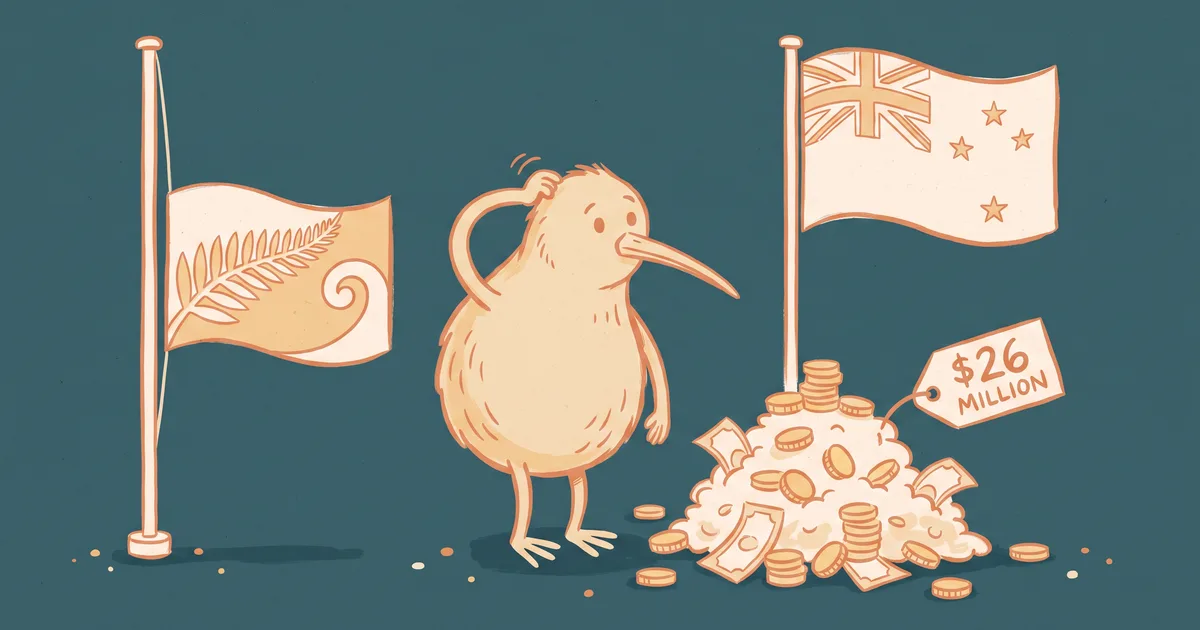
New Zealand's silver fern, never officially adopted as a flag, shows the same impulse from another angle. During the 2015-2016 flag referendums, the silver fern designs were pitched as a way to move beyond the Union Jack canton, using an indigenous plant to assert post-colonial identity. The effort failed, but the botanical logic was identical to Hong Kong's.
Then there is Canada in 1965, where the maple leaf flag replaced the Red Ensign with its Union Jack canton. It remains the benchmark for botanical decolonization: a permanent shift from imperial allegiance to natural symbol.
The key difference is that Canada was a sovereign nation making a sovereign choice, while Hong Kong was a territory being transferred. What unites these cases is the implicit argument that nature is politically neutral, that a flower or leaf can represent a people without representing a state. The Bauhinia tests that proposition harder than any of them.
Sterility as metaphor
During the 2014 Umbrella Movement, the Bauhinia appeared on protest art in altered forms: wilting, blackened, dripping. Artists and demonstrators reimagined it as a symbol of Hong Kong's fading autonomy. The flower's biological sterility became an explicit metaphor for a city that cannot reproduce its own political identity and depends on the decisions of others for its continuation.
By the 2019 anti-extradition bill protests, the Bauhinia was deeply contested. Protesters in some cases defaced the Golden Bauhinia sculpture in Golden Bauhinia Square, a gift from Beijing unveiled in 1997, spray-painting it black. The act targeted not the flower itself but its co-optation as a symbol of harmonious reunification.
The Hong Kong government, meanwhile, doubled down on the Bauhinia as a symbol of stability and prosperity under One Country, Two Systems. The flower appears on coins, passports, and government documents, and its ubiquity is a form of soft assertion that the system is working as designed.
The contrast exposes the Bauhinia's instability. It was designed to be apolitical, but its neutrality created a vacuum that both sides rushed to fill. A flower chosen because it belonged to no ideology now belongs to all of them at once. Since 2020 and the implementation of the National Security Law, public displays of altered or protest-associated Bauhinia imagery have become legally fraught. The Bauhinia's meaning has not settled. It has been frozen by law.
The clone garden
The fact that every Bauhinia blakeana is a clone raises questions that map eerily onto Hong Kong's political situation. The tree cannot adapt through sexual reproduction. It cannot evolve. It is preserved exactly as it was when first discovered, maintained by deliberate human intervention. The parallel to One Country, Two Systems, a framework designed to preserve Hong Kong's character unchanged for 50 years until 2047, is almost too neat.
Botanists have debated the Bauhinia's taxonomic status for decades. A 2005 molecular study published in Biochemical Systematics and Ecology suggested the tree might not be a simple hybrid at all but could involve more complex parentage. Its identity, like Hong Kong's, resists simple categorization.
The Bauhinia blakeana has been planted across subtropical cities worldwide, in Guangzhou, Taipei, and parts of Southern California, yet it remains symbolically tethered to Hong Kong alone. It is a species without a natural range, a flag flower without a homeland in the ecological sense.
Which raises the question at the heart of botanical nationalism. Can a sterile clone represent a living culture? Or does the symbol accidentally encode a pessimistic message, that Hong Kong's identity, like its flower, is beautiful but frozen, incapable of generating something new on its own terms?
2047 and the flower that cannot seed
The Basic Law's 50-year guarantee of Hong Kong's separate system expires in 2047, now just 21 years away, and no official framework has been articulated for what comes after. The flag, the flower, and the political structure they represent exist in a state of constitutional uncertainty unprecedented in modern governance.
Some scholars and commentators argue that the 2020 National Security Law effectively accelerated the convergence timeline, making 2047 less a cliff edge than a formalization of changes already underway. In that reading, the Bauhinia flag may outlast the system it was designed to represent.
Flags of absorbed or dissolved political entities often persist in diaspora communities. The South Vietnamese flag. The pre-1959 Tibetan flag. The Republic of China flag in overseas Taiwanese communities.
Whether the Hong Kong Bauhinia flag will one day serve a similar role depends on political developments nobody can predict.
The Bauhinia blakeana itself continues to bloom every November through March across Hong Kong's parks and hillsides, indifferent to the politics inscribed on it, propagated by gardeners who ensure its survival one graft at a time.
A symbol too perfect for its own good
The designers of Hong Kong's flag in 1990 believed they were choosing something safe: a local flower, pretty and inoffensive, a symbol that could paper over the ideological gap between British liberalism and Chinese socialism. They succeeded more thoroughly than they could have known.
The Bauhinia blakeana turned out not to be a neutral symbol but an uncannily precise one. A sterile hybrid, unable to reproduce, beautiful but dependent on external intervention for its survival, claimed by multiple powers yet native to a single place.
In the decades since 1997 the flower has been gilded, spray-painted, printed on passports, burned in effigy, and planted in diplomatic gardens around the world. It has meant reunification and resistance, stability and stagnation, pride and grief, sometimes all at once. As 2047 approaches and Hong Kong's political future remains unwritten, the Bauhinia keeps doing what it has always done: blooming for no nation, seeding nothing, and surviving anyway.