The Horizontal Stripe That Started a Revolution: How Haiti's Flag Was Born from a Torn Tricolor
Julio Song · · 9 min read
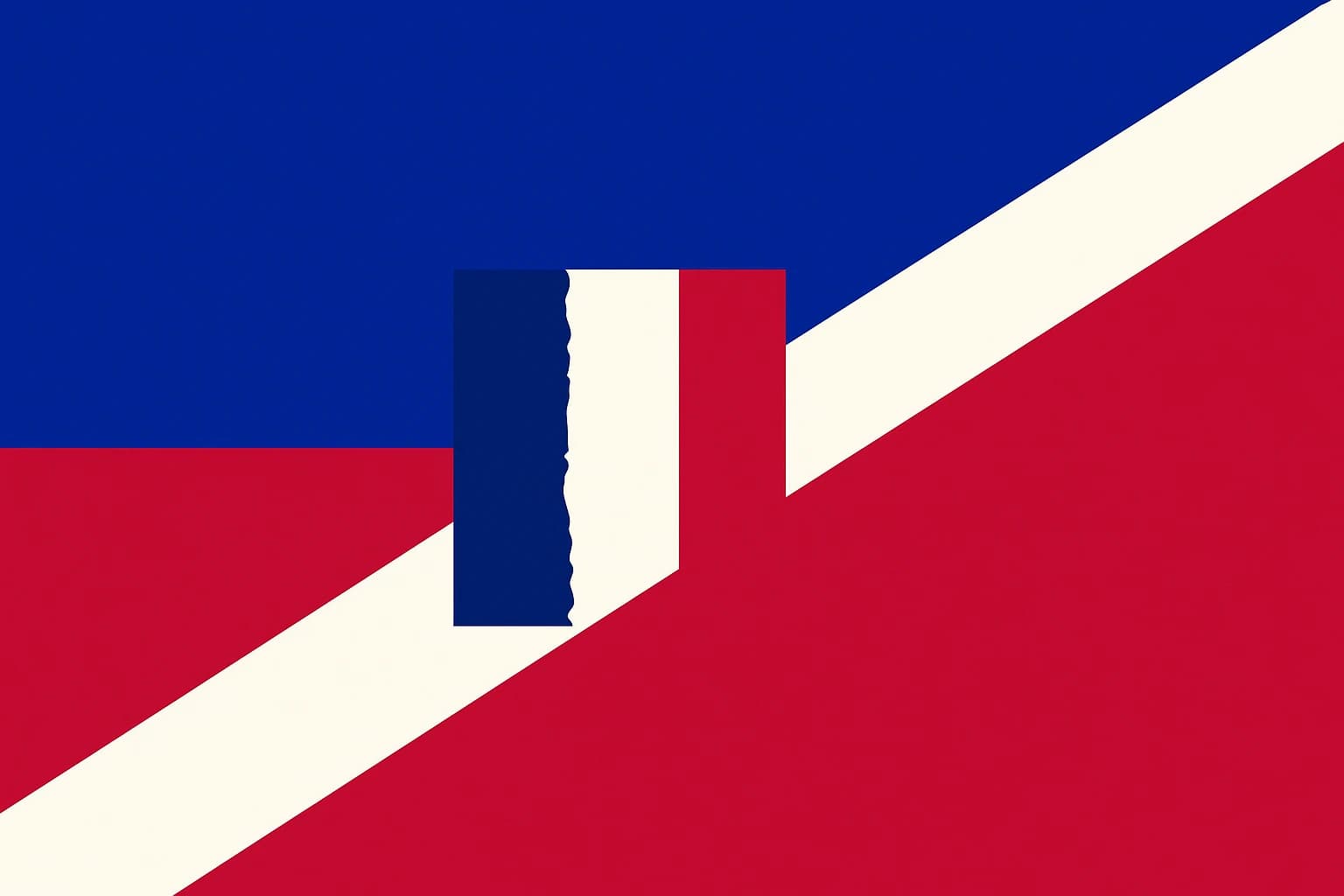
May 18, 1803, at Arcahaie on the western coast of Saint-Domingue. According to the legend every Haitian schoolchild knows, a young woman named Catherine Flon takes a French tricolor, rips out its white center band, and stitches the remaining blue and red panels together. What emerges is not a flag designed by committee. It is a flag born from destruction.
This is not a story about sewing. It is a political declaration written in torn fabric, a nation's identity defined as much by what it destroys as by what it builds. And it raises a question worth sitting with: what does it mean to found a country on an act of deliberate erasure?
We are now 220 years past Haiti's formal independence, declared on January 1, 1804, and the founding myth of the torn tricolor has not faded. The birth of Haiti's flag set a template for how revolutionary moments get stitched into cloth, and for how the absence of a color can speak louder than any symbol you could add.
The white must go
To the revolutionaries gathered at the Congress of Arcahaie, the white stripe in the French tricolor did not represent neutrality or peace. It represented whiteness: the white planter class, the Code Noir that reduced human beings to property, the entire architecture of enslaved subjugation on Saint-Domingue.
Conventional flag-making is almost always additive. Nations pile on symbols, colors, and emblems to signal what they stand for. Haiti's founding act ran the opposite way. It was subtractive, and that is what made it radical. Call it chromatic erasure: the deliberate removal of a color as a manifesto. There is a parallel in the religious tradition of iconoclasm, the smashing of idols to assert new spiritual and political authority, where the destruction itself becomes the sacred act.
An honest note is due here. The Catherine Flon story is widely regarded as legend, or at least an embellished retelling, and historians debate whether it happened as the popular version describes. Its cultural persistence is historically significant regardless. Nations choose the founding stories they need. The documented anchor is the Congress of Arcahaie on May 18, 1803, where the new bicolor flag was formally adopted, and the legend wraps around that fact like thread around a needle.
The argument still holds: the act of tearing, not designing, made Haiti's flag philosophically unusual among national flags, and that philosophy rippled outward into post-colonial flag-making for the next two centuries.
From tricolor to two colors
The flag adopted at Arcahaie was blue over red in horizontal stripes. The bicolor symbolized the unity of two groups that French colonial policy had deliberately pitted against each other: the formerly enslaved population, represented by blue, or black in the earliest versions, and the affranchis, the free people of color, represented by red.
The early flag changed more than once. The original 1803 design under Jean-Jacques Dessalines used black and red rather than blue and red. The shift to blue came later, formalized under Alexandre Pétion after 1806, when Haiti split into a northern kingdom and a southern republic. The color palette became a political battlefield of its own.
Then came the coat of arms at the center: a palm tree, cannons, flags, and the motto "L'Union Fait La Force," Unity Makes Strength. That was the second layer. After the erasure came the construction of a new national grammar, a set of symbols that belonged to nobody's colonial past.
The orientation is easy to miss. The French tricolor is vertical. Haiti's stripes run horizontal. The colors were not only changed, they were rotated, a quiet act of formal rejection that says this flag shares no axis with the one it came from.
This was not a peacetime emblem unveiled at a ribbon-cutting. It was a battle standard, carried into the final campaigns of the Haitian Revolution, including the decisive Battle of Vertières on November 18, 1803.
A flag becomes a weapon at Vertières
Vertières was the end of the line. On November 18, 1803, Dessalines's forces met Napoleon's army, commanded by General Rochambeau, just outside Cap-Français, now Cap-Haïtien. The French had been losing ground for months, ravaged by yellow fever and relentless guerrilla resistance. Vertières broke them.
The bicolor flying over that battlefield carried a message French troops could read: this is your flag, unmade. It was visually derived from the tricolor but violently altered. Every French soldier looking across the field at those blue and red horizontal bands saw his own national colors rearranged and stripped of a component.
The charge of François Capois, known as Capois-la-Mort, Capois the Death, became one of the revolution's defining images. His horse was shot from under him. He got up and kept charging. When a second bullet struck his hat, he kept going. The story goes that even Rochambeau's officers paused to salute his bravery.
On January 1, 1804, Haiti declared formal independence, becoming the first Black republic in the world and the first nation in the Western Hemisphere founded by formerly enslaved people. The flag was inseparable from that declaration. It did not accompany the moment, it was the moment, materialized in fabric.
Together, Vertières and the torn tricolor created a template that echoes across centuries. Revolutionary identity is not declared in constitutions alone. It is embodied in objects, especially objects forged from the destruction of the oppressor's symbols.
Haiti's flag logic travels
Haiti's act of chromatic erasure established an implicit grammar for post-colonial nations: the colonizer's flag must be visibly repudiated, not quietly replaced.
Consider Rwanda. After the 1994 genocide, Rwanda's original tricolor, with its red-yellow-green bands and a distinguishing "R" in the center, carried unbearable associations. In 2001, Rwanda adopted an entirely new flag, a field of blue, yellow, and green with a sun in the upper right corner. The goal was explicit: erase the visual link to genocide-era identity and build something new. Subtraction followed by reconstruction, the same sequence that played out at Arcahaie nearly two hundred years earlier.
Or look at Togo, which gained independence from France in 1960. Its flag, with red, yellow, and green stripes and a white star, took up the Pan-African palette. That choice was its own form of erasure, replacing French colonial visual identity with a chromatic vocabulary rooted in Ethiopia's resistance flag and the broader Pan-African movement.
Ethiopia matters here because it was the African nation that most successfully resisted European colonization, and Haiti's revolution had helped inspire that spirit of defiance across the Black Atlantic world. The green, yellow, and red became a shared language of liberation.
Marcus Garvey's 1920 red, black, and green Pan-African flag owed an ideological debt to the same tradition. The idea that color itself carries the weight of liberation, that a stripe or a hue is never neutral, traces a line back through Ethiopia to Haiti.
There is an argument in this for anyone who cares about flags now. The modern instinct to design flags through committees and graphic design principles, as promoted by organizations like the North American Vexillological Association, misunderstands how the most enduring flags were born. They did not come from design briefs. They came from acts of rupture.
France's tricolor in the mirror
To understand why Haiti's reversal was so devastating, you need to understand what the French tricolor represented and how France betrayed its own banner.
The tricolor was adopted during the French Revolution of 1789 and stood for liberty, equality, and fraternity, radical ideals for the age. France proclaimed those ideals and simultaneously failed to extend them to its enslaved colonial subjects in Saint-Domingue, Guadeloupe, and Martinique.
The specific betrayal was this. In 1794, during the revolutionary fever, the French National Convention abolished slavery across its colonies, a genuine if fragile step. Then Napoleon Bonaparte came to power and, in 1802, reinstated it. He sent an army of tens of thousands to Saint-Domingue to crush the revolution and re-shackle the population.
That reversal made the tricolor, by 1803, a symbol of betrayal rather than liberation, which is what gave Haiti's tearing of it such force. The revolutionaries at Arcahaie did not reject the tricolor's stated ideals. They held France accountable to them. The torn flag said: you have abandoned your own colors' meaning, and we are keeping what matters.
Compare that with the American flag. The Stars and Stripes was also born from revolution against a colonial power, but it retained visual continuity with British colonial symbols. The canton's design echoed the British East India Company flag, and the red, white, and blue palette stayed. Haiti's break was far cleaner.
220 years later
In 2026, 220 years after independence, Haiti faces ongoing political instability, security crises, and the displacement of large parts of its population. The founding mythology of the torn tricolor carries renewed weight, perhaps because of the crises rather than despite them.
The Catherine Flon legend has become increasingly central to Haitian cultural memory: a woman as the literal creator of the nation's symbol. In conversations about gender, agency, and who gets credited in national founding narratives, her figure resonates in ways that feel sharper now than a generation ago. Historical fact or collective myth, the story insists that national birth passes through women's hands.
In Haitian diaspora communities across Miami, Montreal, Paris, and New York, the flag works as both identity marker and portable mythology. People carry it at protests, hang it in barbershops, drape it over car mirrors. The story of the tear travels with the cloth. You do not need to explain Haiti's entire revolutionary history to someone when the flag encodes the narrative of rupture and rebuilding.
The born-from-destruction narrative resonates well beyond nationalism, too. It carries the conviction that the most meaningful things are made not from abundance but from loss, and from the decision to build anyway.
In an era when nations commission branding agencies to redesign their flags, when Kyrgyzstan tweaked its sun emblem in 2023 and New Zealand held a national referendum on its flag design in 2016, Haiti's story is a useful corrective. The flags that endure across centuries are not the ones with the best typography or the cleanest aspect ratio. They are the ones that carry the weight of an irreversible act.
Return for a moment to the image of Catherine Flon's hands. Legendary or not, those hands tearing white from blue and red encode a radical political idea: that nationhood begins not with what you claim but with what you refuse. France, Rwanda, Togo, and the wider Pan-African chromatic tradition all carry traces of the logic first expressed in a torn flag at Arcahaie. The white stripe is still gone, 220 years later, and its absence still speaks.
Julio Song
Writer
Julio is a staff writer at FlagDB. He studied Mathematics at the University of Madrid and has a passion for vexillology.
More from Julio Song →