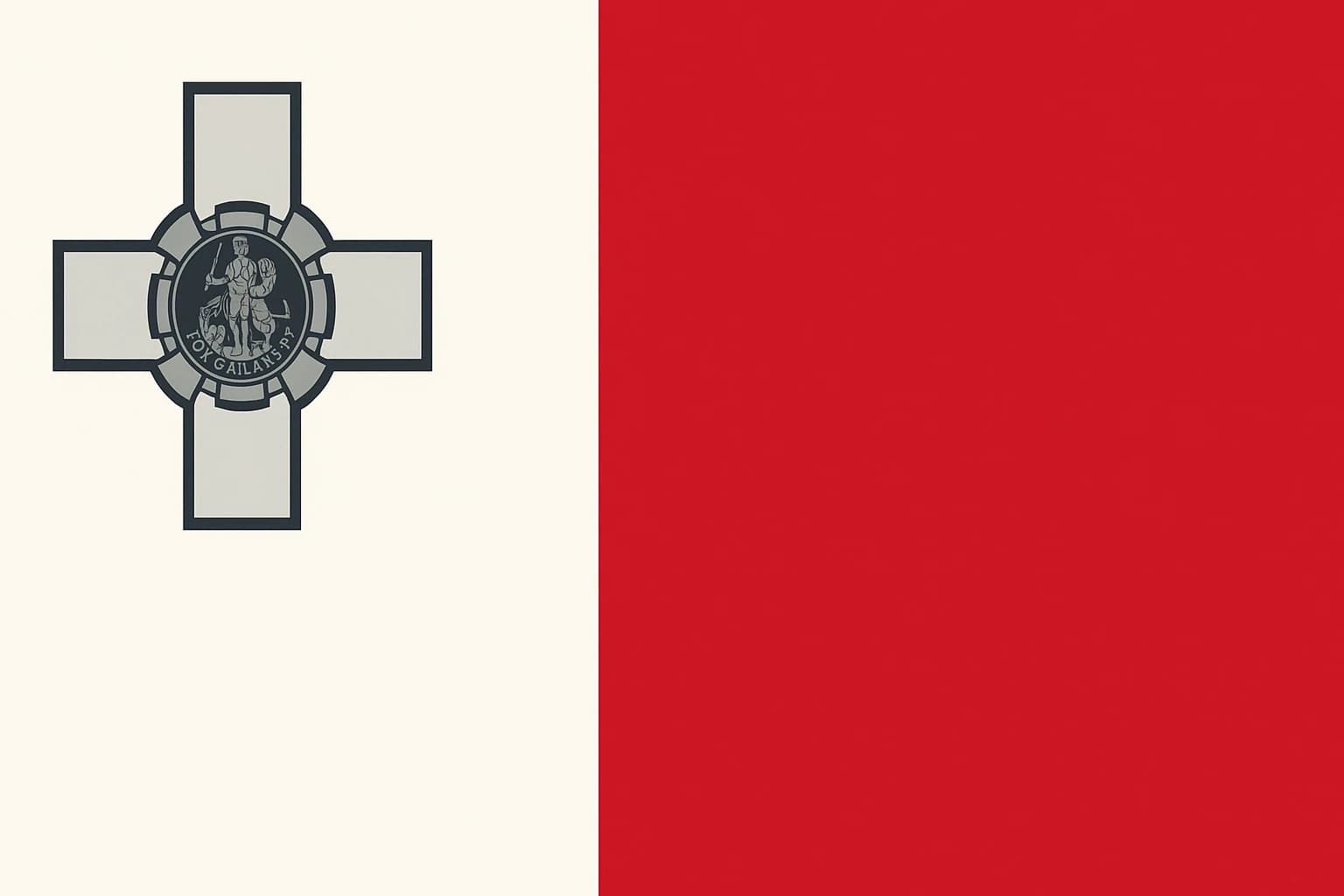
If you examine the flags of the world's 193 sovereign nations, only one displays a foreign military decoration. In the upper-left canton of Malta's flag, a simple bicolor of white and red, sits a small blue-bordered representation of the George Cross. It's a British award for civilian gallantry. By any measure, it's one of the strangest design elements on any national flag in existence.
How did a medal designed by a British king end up permanently embedded in the sovereignty symbol of a postcolonial republic? The answer runs through one of the most devastating sieges of the Second World War and through a fiercely contested independence movement, and it is not settled yet. Malta is still working out what it means to define yourself by an honor your colonizer handed you, and more than 80 years on the country has shown no interest in giving it back.
The siege that earned a medal: Malta 1940-1942
Malta sits in the dead center of the Mediterranean, roughly 60 miles south of Sicily. In 1940, that geography made it the most strategically important island on the planet. The British used it as a base to disrupt Axis supply lines to North Africa. The Axis powers responded by trying to bomb it into submission.
Between June 1940 and November 1942, Axis forces flew approximately 3,000 bombing raids and dropped over 6,700 tons of bombs on an island smaller than Philadelphia. For context, that's a staggering concentration of destruction on a landmass of just 122 square miles. Malta became, by tonnage per square mile, the most bombed place on Earth during the war.
Daily life collapsed into a rhythm of sirens, shelters, and rationing. By mid-1942, civilians were near starvation. British military planners had calculated a "Target Date" of August 1942, the estimated point at which Malta would have had to surrender because it had run out of food and ammunition. Operation Pedestal, the convoy that broke through in August 1942, became the stuff of legend. The tanker SS Ohio, lashed between two destroyers, limped into Grand Harbour with fuel that kept the island alive. It was that close.
On April 15, 1942, King George VI made an unprecedented decision. He awarded the George Cross, Britain's highest civilian gallantry decoration (created only two years earlier, in 1940), to the entire island of Malta collectively. His letter read: "To honour her brave people, I award the George Cross to the Island Fortress of Malta to bear witness to a heroism and devotion that will long be famous in history."
This was extraordinary on multiple levels. The Cross was awarded to a place and its people, not an individual. No colony, territory, or nation had received such an honor before. None has since. It was a morale gesture, yes, but also a legal and symbolic act with consequences nobody fully anticipated. The George Cross was immediately incorporated into the colonial flag of Malta. A 1943 colonial warrant authorized the change: the Cross appeared in a blue canton in the upper-left corner of the existing colonial ensign.
A British medal was now part of a flag, which was unusual enough. Keeping it after the British left was stranger still.
"For Gallantry": what the medal actually says
The words are worth pausing on, because they are on the flag. The George Cross is a plain silver cross whose central medallion shows St George on horseback slaying the dragon, ringed by the inscription "For Gallantry." King George VI created the decoration in September 1940, at the height of the Blitz, specifically to honor civilian courage: acts of the greatest heroism performed away from the battlefield. In stature it is the civilian equal of the Victoria Cross, which it ranks immediately behind in the official order of wear.
So the "for gallantry flag," as search engines know it, is Malta's. Anyone who looks closely at the canton of the Maltese flag is looking at a two-word citation, a formal commendation for bravery issued to a nation of roughly a quarter of a million people. Official renderings of the flag reproduce the inscription faithfully, making Malta the only country with an English commendation, addressed to its entire population, written on its flag.
From colonial ensign to national flag: the independence debates of 1962-1964
Malta's path to independence was messy. A 1956 referendum on integration with the United Kingdom failed due to low turnout and a Labour Party boycott. By the early 1960s, independence was the consensus goal, but the question of national symbols provoked fierce argument.
The Constitutional Convention of 1962-1963 debated the flag at length. The Nationalist Party (Partit Nazzjonalista), led by Prime Minister Giorgio Borg Olivier, pushed to keep the George Cross on the new flag. The Malta Labour Party, led by Dom Mintoff, initially favored a clean break, a completely new design that owed nothing to colonial symbolism.
Borg Olivier's argument was both strategic and emotional. The George Cross, he insisted, was not a symbol of British rule. It was a symbol of Maltese suffering and courage. Retaining it reframed the decoration entirely. It was no longer something Britain gave Malta. It was something Malta earned and owned. This rhetorical inversion was the key move.
The compromise reached at independence on September 21, 1964, was elegant. The new flag was a simple white-and-red bicolor (colors with roots in Malta's Norman-era history, predating British rule by centuries) with the George Cross outlined in red in the upper canton of the white stripe. The colonial blue ensign was abandoned entirely. Only the Cross survived the transition.
The telling detail comes later. When Mintoff's Labour Party came to power in 1974 and Malta became a republic, removing the Queen as head of state, the flag didn't change. The Cross stayed. Even the most anti-colonial faction in Maltese politics decided the George Cross had earned its place.
The rhetorical inversion: rewriting the meaning of a colonial award
What Malta did with the George Cross was to refuse the obvious reading of it. Instead of a mark of subjugation or patronage, the decoration was absorbed into Maltese national identity as proof of exceptionalism. The narrative became: "We were so brave that even the British Empire had to acknowledge it."
Postcolonial scholars have a term for this. Taking the colonizer's language, symbols, or institutions and repurposing them to serve the colonized nation's self-image is a well-documented phenomenon. India retained British parliamentary structures. Dozens of former colonies kept English as an official language. Malta kept a medal.
But the George Cross on Malta's flag functions differently from, say, the Union Jack on Australia's or New Zealand's flag.
Those flags display the colonizer's symbol as a mark of ongoing relationship or heritage. Malta's flag displays an award, an acknowledgment of Maltese agency and sacrifice, embedded in the colonizer's own symbolic vocabulary. The difference is significant. One says "we belong to them." The other says "they recognized us."
The 1975 redesign reinforced this distinction. The George Cross was given a thin red border, integrating it more fully into Malta's red-and-white color scheme and visually distancing it from its British origins. It became less "a British medal on a flag" and more "a Maltese design element that happens to be cross-shaped."
This reframing has been remarkably successful. Many Maltese citizens today, especially younger generations, identify the George Cross primarily as a Maltese national symbol rather than a British decoration. The WWII narrative is taught extensively in schools and commemorated annually on September 8 (Victory Day/Our Lady of Victories). The siege story is woven so deeply into Maltese identity that the Cross feels indigenous.
Comparative vexillology: how other nations handled colonial symbols
Fiji provides the closest parallel. Upon independence in 1970, Fiji retained the Union Jack in the canton of its flag and kept its colonial coat of arms on the fly side.
In 2013, Prime Minister Frank Bainimarama announced plans for a new flag without the Union Jack. A design competition followed. Public debate raged. The change was shelved in 2016. Fijians, like Maltese, were divided between those who saw the colonial symbol as heritage and those who saw it as subjugation.
Contrast that with nations that made clean breaks. Kenya (1963), Tanzania (1964), and Ghana (1957) all adopted entirely new flag designs at independence that owed nothing to British heraldry.
The Pan-African colors (red, black, green, sometimes with gold) became a deliberate counter-narrative to European colonial symbols.
Serbia's post-2006 flag offers another angle. It features a royal crown from the Obrenović/Karađorđević dynasty atop its coat of arms, a symbol from a previous regime rehabilitated for modern national identity.
Like Malta's George Cross, Serbia's crown is an artifact from an earlier political order deemed too symbolically potent to discard.
The distinction that matters is this. Malta is the only sovereign nation whose flag displays a foreign military decoration. Australia and New Zealand display the Union Jack (a foreign flag). Fiji does too. Several Pacific nations display elements of colonial heraldry. The George Cross is categorically different. It is an award, not a flag or coat of arms. It implies a narrative (bravery under siege) rather than a relationship (colonial subject to metropole).
The ongoing flag-change debates elsewhere confirm how difficult these decisions are. New Zealand's 2015-2016 flag referendum failed to produce a change. Australia's republican movement continues to discuss flag redesign as of 2026. Removing colonial symbols is never straightforward, even decades after independence.
The George Cross in Maltese life today: more than a flag element
The original George Cross medal awarded in 1942 is displayed in the National War Museum at Fort St. Elmo in Valletta. It is one of Malta's most visited artifacts. It functions almost as a secular relic, a physical object that connects a modern European republic to its wartime mythology.
The Cross appears across Maltese public life: on the coat of arms, on euro coins (Malta's 2-euro coin features the George Cross prominently, minted since the country joined the eurozone in 2008), on official documents, military insignia, and public monuments. It's everywhere. You cannot spend a day in Malta without encountering it.
Every September 8, Malta celebrates Victory Day, which commemorates the end of the Great Siege of 1565, the French blockade of 1800, and the Italian armistice of 1943. Three sieges, three victories, one holiday. The George Cross narrative is layered onto centuries of siege-and-survival mythology, which makes it feel less like a British imposition and more like the latest chapter in a much older story. Malta has been besieged by the Ottomans, the French, and the Axis powers. Each time, the island survived. The Cross is simply the most recent proof.
There have been periodic calls, mostly from small academic or activist circles, to remove the George Cross from the flag. The argument: it's anachronistic and colonial. These calls have never gained mainstream political traction. As of 2026, no major Maltese political party advocates for a flag change. The Cross is safe.
And perhaps that's the most remarkable outcome. The George Cross has become, paradoxically, a symbol of Maltese independence from Britain rather than dependence on it. A British king's medal, designed in London, awarded to a colonial possession, now flies on the sovereign flag of a European republic 84 years later.
Malta's retention of the George Cross is not an act of deference. It is an act of narrative seizure. By keeping the Cross, Malta insists on a particular reading of its history: not as a passive colony that received a pat on the head from its ruler, but as an island of extraordinary resilience whose courage was so undeniable that even the empire had to formally recognize it.
Postcolonial nations are still arguing over what to do with inherited symbols, whether to pull them down, contextualize them, or reclaim them. Malta took the third route and made it hold, which is why the Cross is read in Valletta as evidence of what the island did rather than of what was done to it.