Vexillology, the study of flags, spends a lot of its time on questions of lineage: who copied whom, and when. A less tidy question is how much of a flag comes from the ground the country stands on. Mountains, rivers and forests do turn up in national designs, sometimes as an explicit picture and more often as a color choice nobody bothers to explain.
Bhutan and the mountains behind it
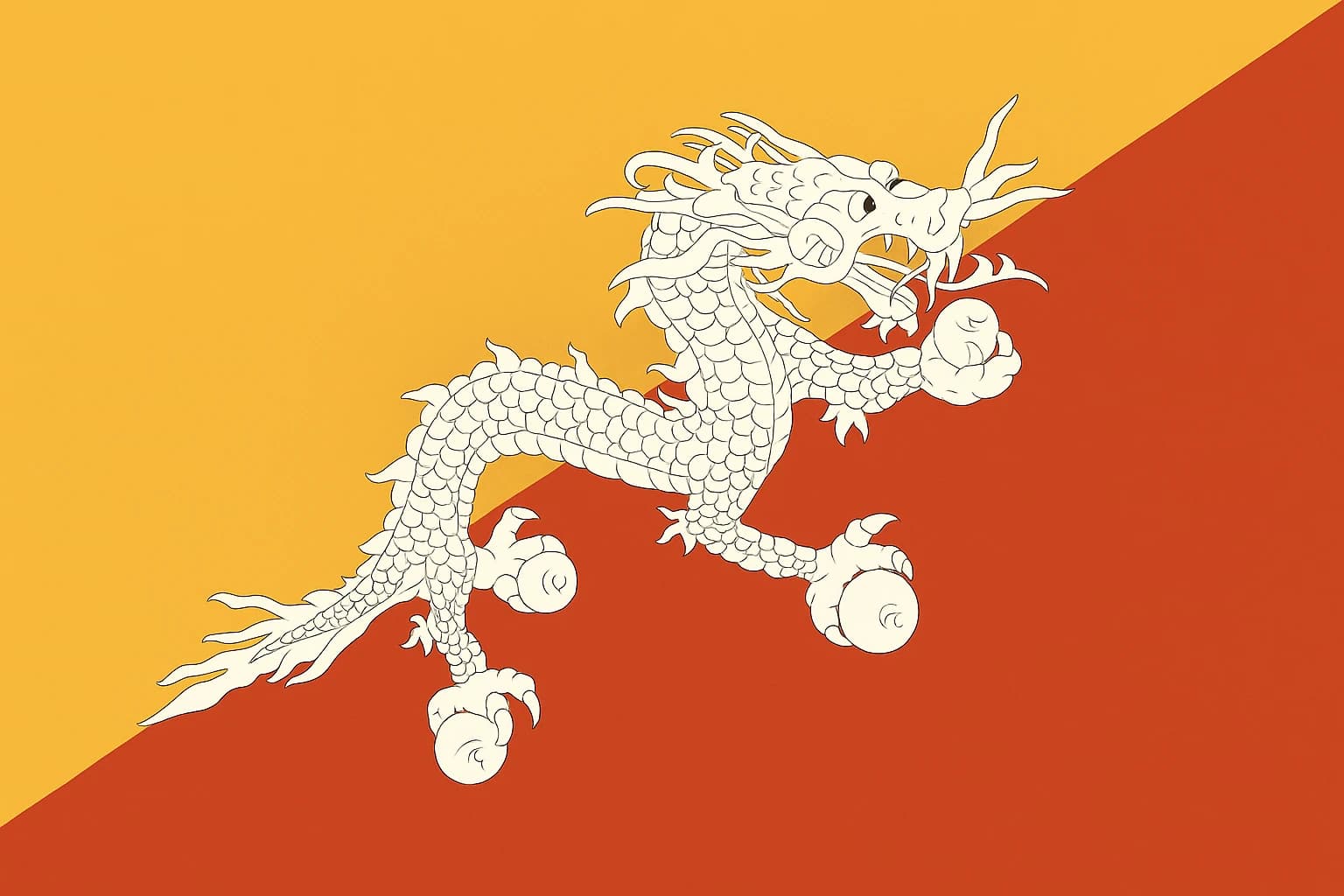
Bhutan's flag carries a dragon, and the dragon carries thunder, which is not a subtle way of pointing at the Himalayas the country sits inside.
The yellow and orange split the flag between secular and spiritual authority, so the geography and the politics are stacked on the same rectangle.
Brazil's night sky
Green and yellow are usually explained by the rainforest and by the country's gold.
The globe in the middle is the more specific claim. Its stars are arranged as the night sky appeared over Rio de Janeiro at the moment Brazil became a republic, which makes the flag less a picture of the land than a timestamp taken from above it.
Landscape by implication
Not every geographic reading is that deliberate. Nepal is the only country whose flag is not a rectangle, and the shape gets tied back to the country's topography often enough that the explanation has stuck.
Scotland's blue and white gets read as weather and hillside.
Canada's maple leaf is the least ambiguous of the group, since the tree really is everywhere in the country.
Italy's green gets folded into the same argument, standing in for fields.
Whether the designers had any of this in mind is another matter. Landscape readings tend to get attached to flags afterwards, by citizens rather than by committees, and they stick because they are easier to remember than the political compromise that produced the colors.
When the landscape stops explaining things
Flags change, and the reasons are rarely geographic. Colonization, war and independence movements have redrawn far more flags than rivers or mountains ever have. South Africa is the clearest case: a design replaced outright because the country it stood for had changed, with the land underneath it exactly where it had always been.