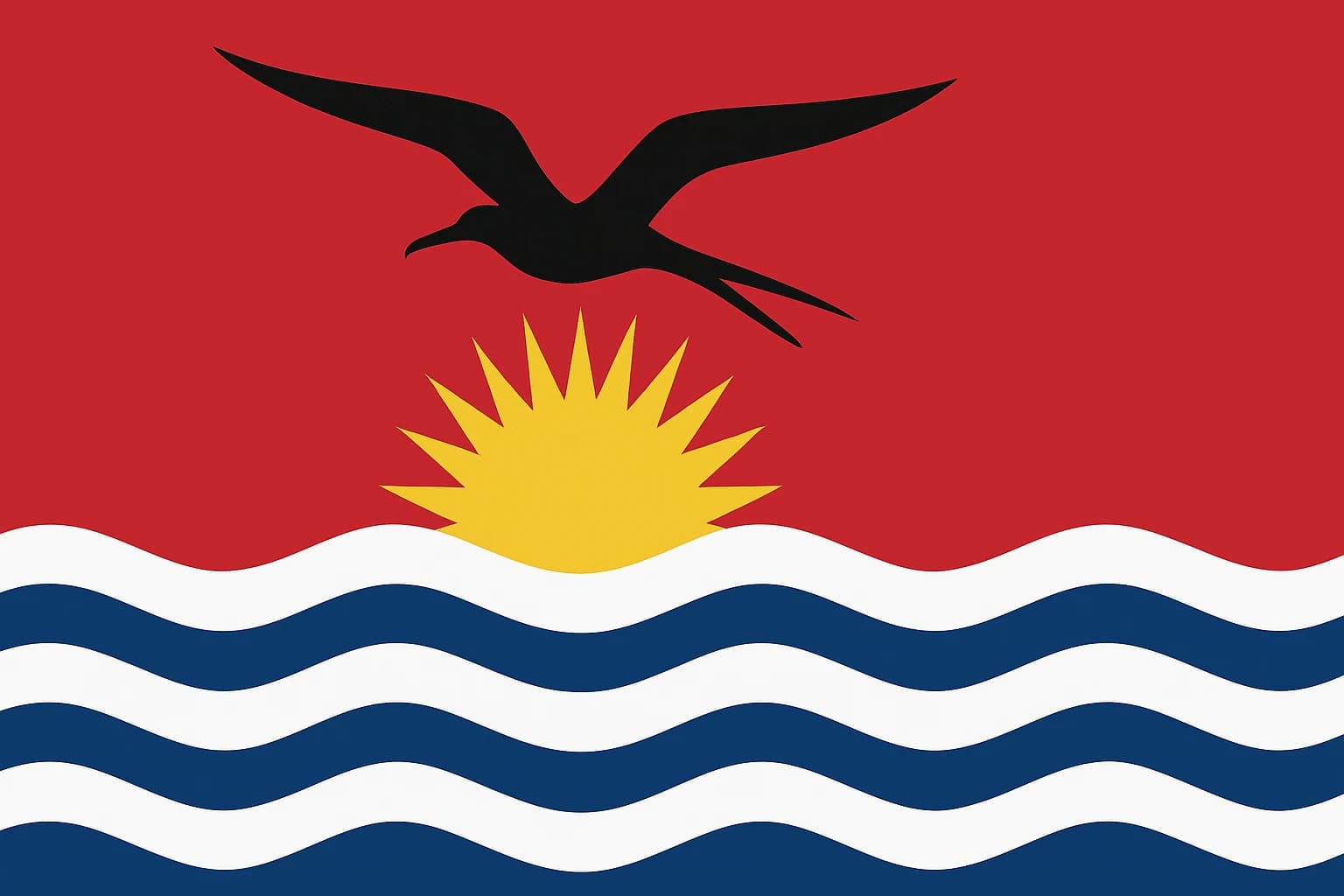
Somewhere in the central Pacific, straddling the equator and the International Date Line, lies a nation of 33 coral atolls where the highest point barely reaches three meters above sea level. Its flag features a golden frigatebird soaring over a half-risen sun and six blue-and-white ocean waves. Designed as a triumphant declaration of independence in 1979, that same image now reads like a prophecy. The bird flies over rising waters, and the nation beneath it is running out of time.
One flag ended up doing three jobs at once. It is a navigator's compass, a creation myth, and a climate emergency.
Most people glance at a national flag and see colors and shapes. Kiribati's flag is something rarer: an artifact whose meaning has been fundamentally transformed, not by revolution or redesign, but by the slowly rising ocean around it.
A flag born from independence: replacing the colonial shield
Kiribati, then known as the Gilbert Islands, gained independence from Britain on July 12, 1979, after nearly a century as part of the Gilbert and Ellice Islands Colony. The colonial flag followed a familiar template: the standard British Blue Ensign with a colonial badge. That badge depicted a frigatebird over a rising sun and waves, designed by Sir Arthur Grimble in 1937 and formalized by the College of Arms in London.
The newly independent nation held a flag design competition, and the winning entry came out strikingly close to the colonial coat of arms. That looks like an irony until you ask the I-Kiribati about it, because they read the result as reclamation rather than inheritance. The frigatebird, the ocean, the sun: these were theirs long before any British administrator put them on a shield.
The flag's specific elements tell a layered story. A golden frigatebird (Fregata minor, the great frigatebird) soars in flight. Below it, a half-risen golden sun sends out 17 rays, representing the 16 Gilbert Islands and Banaba (Ocean Island). Six alternating blue and white wavy bands represent the Pacific Ocean. The red upper field symbolizes the sky, or more precisely, the equatorial horizon.
Compare this with other Pacific nations navigating decolonization. Fiji retained elements of the Union Jack and debated removing it as recently as 2015.
Papua New Guinea, independent since 1975, chose a completely indigenous design featuring a bird of paradise and the Southern Cross.
Kiribati charted a fascinating middle course: colonial imagery re-read through indigenous eyes. The form stayed. The meaning shifted entirely.
The navigator's bird: frigatebirds in Gilbertese seafaring tradition
Why the frigatebird, of all creatures? The answer lies in centuries of open-ocean voyaging. In traditional Gilbertese navigation, frigatebirds were living compasses. Polynesian and Micronesian navigators tracked frigatebirds returning to land at dusk to determine the direction of islands beyond the horizon. With wingspans up to 2.3 meters and the ability to stay aloft for weeks, frigatebirds ranged farther from shore than any other seabird.
The practice of te borau, traditional ocean voyaging, depended on reading wave patterns, star paths, and bird behavior to cross hundreds of miles of open ocean without instruments. So the bird was useful, and it also came to stand for freedom, for command of the sky, and for the link between sea and land.
Other Pacific cultures developed parallel traditions. Hawaiian wayfinders tracked the kōlea (Pacific golden plover) for similar purposes. Marshallese navigators built stick charts to map wave refraction patterns.
But Kiribati's choice to place the frigatebird at the center of its sovereign banner was unique. No other Pacific nation gave a navigational animal such prominence on its flag.
The bird also appears in Kiribati's national emblem and figures in traditional dances and oral poetry. It represents skill, resilience, and the ability to find home across vast distances. These are qualities the I-Kiribati have prized for centuries, and qualities they need now more than ever.
Te Bakoa and Te Man: the frigatebird in Gilbertese mythology
The frigatebird's significance runs deeper than navigation. In Gilbertese cosmology, Nareau the Spider created the world from primordial darkness, known as Te Bo ma Te Maki. Some versions of the creation myth hold that birds, including the frigatebird, were among the first creatures to separate the sky from the sea. They were agents of creation itself.
On some atolls, particularly Tabuaeran and Kiritimati, a striking cultural practice developed: frigatebird rearing and training. Young frigatebirds were caught, raised, and trained to return to their keepers. The practice blended utility (message-carrying between atolls) with deep spiritual significance. Annual frigatebird-calling ceremonies persist in cultural memory even today.
The composition follows from that. The bird occupies the space between sky (red field) and sea (blue and white waves), with the sun mediating between them. The flag is a cosmogram, a compressed model of the Gilbertese universe.
This approach to flag design runs throughout the Pacific. The Marshall Islands' flag uses diagonal bands and a star to represent the equator, the two island chains, and the sunrise. Palau's golden circle represents the full moon, central to Palauan agricultural and ceremonial cycles.
These are flags designed to be read as stories, not merely as insignia. And Kiribati's story is one of the most layered of them all.
Rising waters, shifting meaning: the flag as climate prophecy
As of 2026, Kiribati faces an existential threat from sea-level rise. The IPCC's Sixth Assessment Report and subsequent updates project that many of Kiribati's atolls could become uninhabitable by 2050 to 2060 due to saltwater intrusion, storm surges, and freshwater lens contamination. Full submersion isn't even required. The land becomes unlivable well before it disappears.
The flag's imagery has been reinterpreted by climate activists, I-Kiribati diaspora communities, and international media. The frigatebird no longer soars in triumph alone. It flies over waters that are literally rising. The six blue-and-white waves evoke not the timeless Pacific but an encroaching threat. Former President Anote Tong (2003 to 2016) used the flag's imagery explicitly in climate diplomacy, calling the I-Kiribati a people "whose flag may one day fly over no land at all."
Concrete policy responses have followed. In 2014, Kiribati purchased 20 square kilometers of land on Vanua Levu, Fiji, as potential relocation territory. Tong championed a "Migration with Dignity" policy. Current President Taneti Maamau has taken a more complicated stance, oscillating between climate urgency and Chinese-funded infrastructure development. As of 2026, the tension between adaptation and relocation remains unresolved.
And then there's the philosophical question that no one has a good answer for: what happens to a flag when its nation loses its territory? International law has no clear framework for statehood without land. Kiribati's flag could become the first national flag to represent a people without a country, a symbol of identity unmoored from geography, much like the frigatebird itself, which never lands on water and must always find land.
At the 2025 Pacific Islands Forum discussions in Tonga, Kiribati and Tuvalu jointly pushed for a "climate refugee" legal framework and the recognition of permanent sovereignty over maritime zones even if land territory is lost. The symbolism of national flags was explicitly invoked in those debates.
Flags of the vulnerable: Pacific and Caribbean parallels
Kiribati is not alone in this predicament. Tuvalu's flag features a map of its nine atolls, eight of which are projected to be submerged. The Marshall Islands' flag evokes an ocean that threatens to reclaim the land it once celebrated.
The pattern extends beyond the Pacific. Belize's flag features a mahogany tree flanked by two loggers, commemorating the timber trade that built the colony. But Belize's mahogany forests have been severely depleted by logging and hurricane damage, making the flag a record of ecological loss.
Grenada's flag features a nutmeg, the island's "black gold." But Hurricane Ivan in 2004 destroyed 90% of Grenada's nutmeg trees, and recovery has been slow. The flag preserves what the land has lost.
There's a vexillological argument worth making here. Flags that center natural imagery are uniquely vulnerable to environmental reinterpretation. A flag with abstract stripes or geometric shapes can't be "read against" its environment in the same way. Kiribati's flag, like Grenada's and Belize's, becomes a living document. Its meaning shifts as the landscape it represents is altered.
The phenomenon is largely absent from the flags of major industrialized nations, whose symbols tend to be abstract or historical: stripes, crosses, crescents. There is a quiet injustice in that. The nations most responsible for climate change have flags that will never be reread by rising seas or dying forests.
Identity aloft: what the frigatebird means now
Return to the bird itself. Fregata minor is under pressure from climate change. Shifting fish populations, nesting habitat loss, and increased storm frequency threaten breeding colonies across the Pacific. The symbol on the flag faces the same existential threat as the nation it represents.
For the I-Kiribati diaspora, communities now established in New Zealand, Fiji, and Australia, the flag functions as a marker of identity for people who may never return to their home atolls. The flag appears at cultural festivals, church gatherings, and climate marches. Its meaning has shifted from national pride to something closer to diasporic memory.
Some I-Kiribati voices have suggested that the flag should be updated, perhaps to reflect the climate crisis more explicitly or to symbolize resilience and adaptation. Others argue fiercely that changing the flag would be a concession, an admission that the nation is already lost. This tension mirrors the broader debate between adaptation and mourning in climate-vulnerable communities. Do you plan for survival, or do you grieve what's already gone? The answer, for most I-Kiribati, is both.
One final detail about the frigatebird's actual behavior. It is a kleptoparasite, harassing other seabirds until they drop their catch. And it is the only seabird that cannot land on water without drowning because its feathers are not waterproof. It must always stay aloft. It must always find land.
The parallel to Kiribati's situation, a nation that must find somewhere to land, is almost unbearably precise.
A golden bird over rising waters
Kiribati's flag was designed in 1979 to celebrate independence, navigational heritage, and a cosmology that put the frigatebird at the boundary between sky and sea. Nearly five decades later that boundary is moving in ways its designers could not have planned for. The flag itself has not changed. The ocean underneath it has, and that alone has rewritten what the image says.
Whether the frigatebird ends up as the emblem of a country or of a people living somewhere else is a question the next few decades will answer, and the I-Kiribati are the ones who will have to live inside the answer.