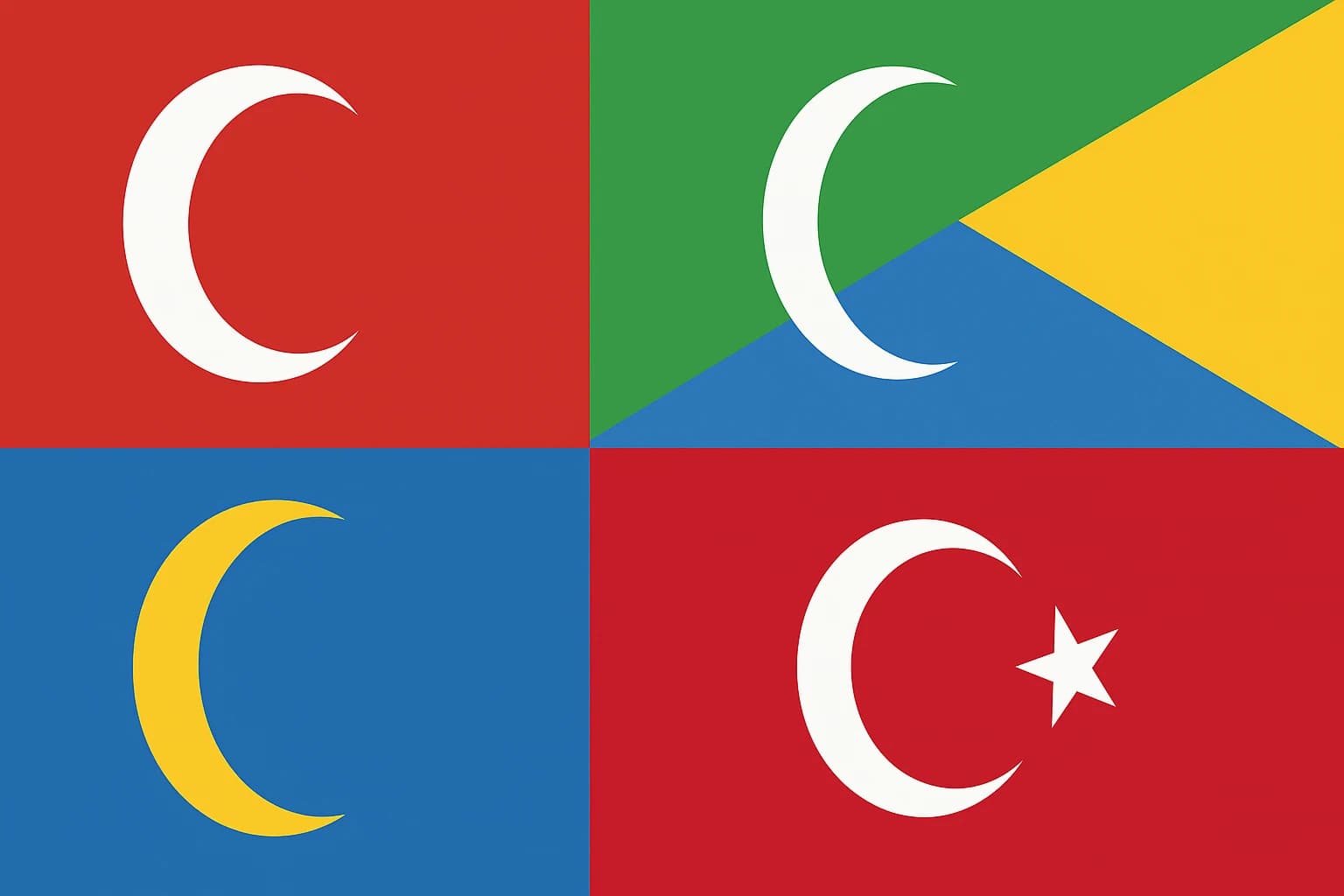
Try this thought experiment. Take Turkey's flag and flip it horizontally so the crescent faces right instead of left. Nothing else changes. Same red, same star, same proportions. Yet the flag looks wrong to almost anyone who has seen the original, even people who couldn't point to Turkey on a map.
That gut reaction is worth pulling on. We internalize the direction a crescent faces without being able to say why it matters. From Ottoman battlefield standards to post-colonial constitutions drafted in the 1960s, the direction a crescent points has been a quiet carrier of meaning. Whether that meaning was always intended, or whether we project it after the fact, is one of vexillology's more interesting open questions.
The Turkish template: how a left-facing crescent became the default
Turkey's flag, codified in its current form by law in 1936 but rooted in late Ottoman military banners from the 18th century, features a crescent that opens toward the fly (the free edge, opposite the pole). When the flag hangs on a pole to the viewer's left, this makes the crescent appear to "face left" in the most common mental image people hold.
Because the Ottoman Empire was the most powerful Muslim-majority state for centuries, its crescent orientation became the unconscious prototype. When people sketch "a crescent moon flag" from memory, informal polls and online surveys consistently show they default to the Turkish orientation. It's the mental wallpaper of crescent symbolism.
A terminology note, because this trips up even experienced flag nerds. Vexillologists describe orientation relative to the hoist (pole) side, while casual viewers describe it relative to their own perspective. The two frames of reference often produce opposite descriptions of the same flag. For the rest of this article I use "opening toward the fly" (Turkish style) versus "opening toward the hoist" as anchoring terms, with plain-language descriptions where things get confusing.
One more thing worth knowing: the Ottoman crescent was not originally religious. It likely derived from Turkic sky-god symbolism and the civic emblem of Byzantine Constantinople. But its association with Islam solidified during the 17th through 19th centuries as European mapmakers and diplomats needed a visual shorthand for "the Muslim world." The crescent became that shorthand, and the Ottoman orientation became the default crescent.
Mirror images: Algeria, Tunisia, and the politics of flipping
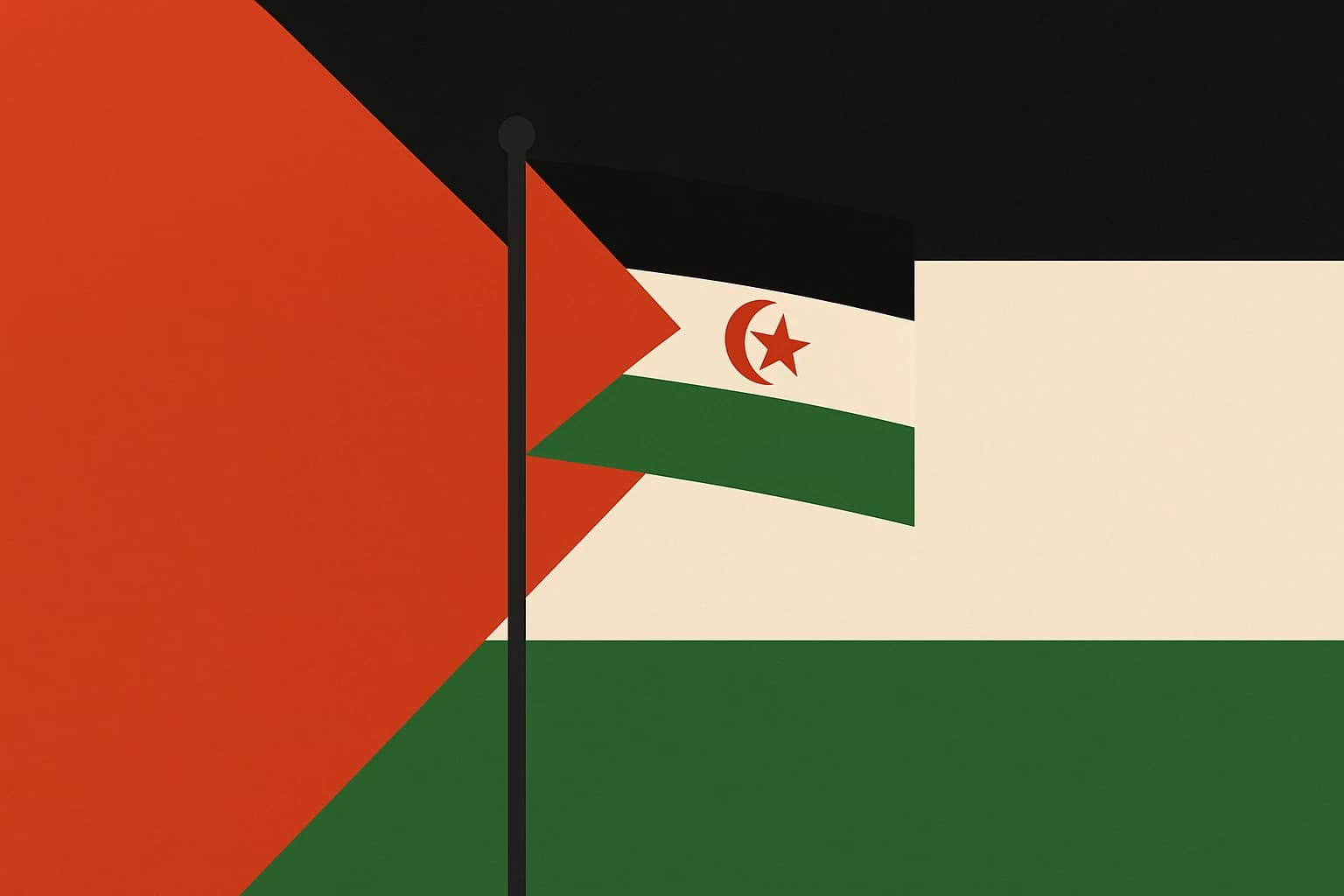
Algeria's flag, adopted in 1962 upon independence, features a crescent that opens toward the hoist. That's the mirror image of Turkey's. This was a deliberate design choice by the FLN (Front de Libération Nationale), which wanted to signal Islamic identity without implying Ottoman lineage. Given Algeria's complex history as an Ottoman regency for 300 years followed by 132 years of French colonization, the distinction mattered enormously.
The French colonial administration had banned the crescent from public display in Algeria for much of the colonial period. That prohibition charged the symbol's eventual orientation on the independence flag with extra defiance. The direction wasn't aesthetic. It was a statement about whose Islam this was.
Now compare Tunisia. Its flag, adopted in 1827, is one of the oldest national flags still in use. People often mistake it for a close copy of Turkey's: red field, white crescent and star. But Tunisia's crescent is enclosed within a red circle, and its orientation subtly differs in historical renditions. The 1999 legal standardization clarified precise geometry. The enclosed crescent served to distinguish Tunisian Husainid dynasty identity from direct Ottoman suzerainty.
Set the two side by side and the contrast is clear enough. Algeria's green-and-white bicolor with a hoist-opening crescent reads as "Arab-Islamic, post-colonial, revolutionary." Tunisia's red field with a fly-opening crescent-in-circle reads as "continuous dynastic heritage, reform from within." The same symbol pointed the other way.
Pakistan's crescent: facing the future, literally
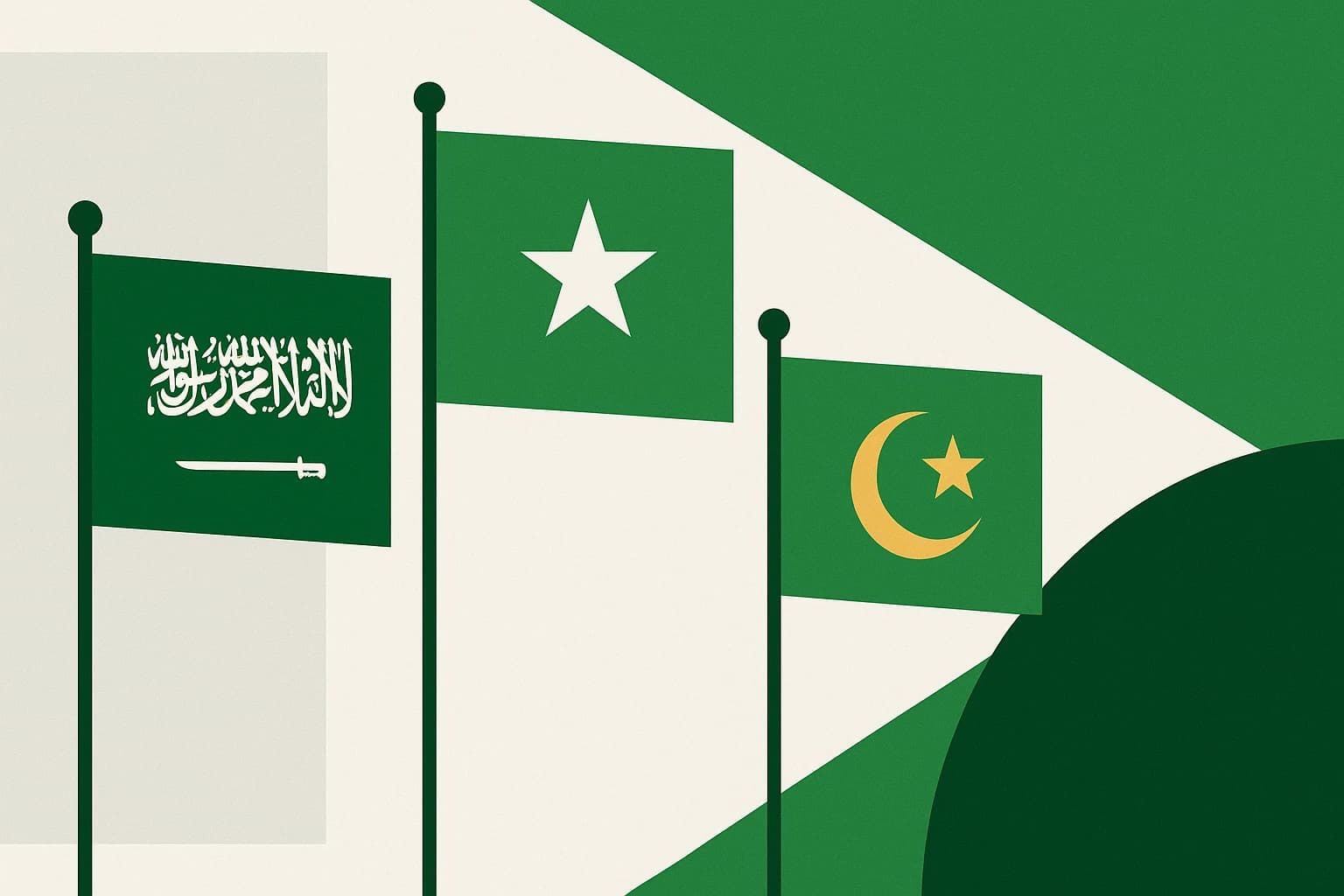
Pakistan's flag, adopted August 11, 1947, three days before independence, features a dark green field with a white vertical stripe at the hoist, a white crescent, and a star. The crescent opens toward the fly, similar in orientation to Turkey's but placed in a completely different compositional context.
The flag's designer, Syed Amir-uddin Kedwaii, described the crescent as representing progress and the star as representing light and knowledge. The "facing toward the fly" orientation was framed as "facing forward," a future-directed metaphor that aligned with Pakistan's self-image as a modern Muslim state, not a revival of Mughal or Ottoman glory.
The white stripe at the hoist represents religious minorities. The crescent's orientation away from that stripe has been read by some commentators as "the Muslim majority moving forward while keeping minorities at its foundation." Whether Kedwaii intended this spatial reading is debated. But it illustrates how orientation generates meaning even when the designer's notes are ambiguous.
Pakistan's flag is one of the few where we have detailed contemporaneous documentation of the design rationale, including resolutions from the Constituent Assembly and Kedwaii's own writings. This makes it a valuable test case for the intention-versus-projection debate we'll return to shortly.
Contrast this with Bangladesh, which abandoned the crescent entirely upon secession from Pakistan in 1971. The new nation chose a red circle on green, a conscious rejection of the crescent symbol and its directional politics.
When a symbol carries that much weight, dropping it altogether is sometimes the strongest statement available.
The Maldives exception: a crescent that faces the pole
The Maldives' flag, in its current design since 1965, places a white crescent on a dark green rectangle, centered on a red field. The crescent opens toward the hoist, toward the flagpole, which is the opposite of the "forward-facing progress" reading that Pakistan's designers articulated.
Some vexillological commentators have read the hoist-facing orientation as symbolizing adherence to tradition and Islamic orthodoxy, consistent with the Maldives' status as a constitutionally 100% Sunni Muslim nation. Others argue this is a post-hoc rationalization with no basis in the design record.
The chronology complicates both readings. The Maldives adopted Islam in 1153 CE by traditional dating, and the crescent appeared on Maldivian royal standards centuries before Ottoman influence reached the Indian Ocean. The orientation likely reflects a local design tradition unrelated to the Ottoman template.
The Maldives case is the strongest argument against reading crescent orientation as a universal code. If orientation always "meant" something consistent, if left equals tradition and right equals progress (or vice versa), the Maldives would need to fit the pattern. It doesn't. Or at least, making it fit requires interpretive gymnastics that tell us more about the interpreter than the flag.
The vexillological debate: meaning built in or bolted on?
This brings us to the core scholarly tension. On one side stand scholars like Whitney Smith, founder of the Flag Research Center, who argued that every design element on a flag carries encoded intentional meaning, even if the documentation has been lost. On the other: a growing camp in 2020s vexillology that treats flags more like memes, symbols that accumulate meaning through circulation, not through original design intent.
The crescent sits right at the fault line of this debate.
Consider the waxing-versus-waning reading. In Western heraldry and astrology, a crescent's orientation signals whether the moon is waxing (growth, youth, beginning) or waning (decline, ending). Some Western commentators have applied this framework to Muslim-majority flags. But in Islamic artistic tradition, the crescent is almost always a generic lunar symbol without phase-specific meaning. Imposing the waxing/waning framework onto these flags is arguably a form of interpretive colonialism, reading someone else's symbol through your own cultural grammar.
At the 2019 FIAV (Fédération internationale des associations vexillologiques) congress, a panel on "Symbolic Overcoding" addressed crescent orientation directly. Panelists noted that no Muslim-majority country's official flag documentation mentions waxing or waning as a design consideration.
There's a useful analogy in another micro-detail: the direction an eagle faces on flags and coats of arms. The U.S. Great Seal eagle was turned to face the olive branch in 1945, a deliberate reorientation. Orientation debates exist across symbols. But the crescent case is charged differently because it sits at the intersection of religious identity and post-colonial politics.
What viewers see vs. what designers meant
Back to the flipped Turkish flag. When it looks "wrong" to us, we are revealing our own trained expectations rather than detecting a disruption in the flag's intended meaning. This is the projection problem in miniature.
Digital technology has made this problem worse, or at least more visible. Flag-identification apps, emoji rendering, and digital reproductions have flattened crescent orientation. The Unicode crescent emoji (☪️) opens to the right in most fonts, reinforcing the Turkish default. As recently as 2025, Algerian and Maldivian users raised this as a representational concern in online vexillology forums. When the dominant emoji doesn't match your flag's crescent, your orientation becomes invisible.
So flags are not static texts with fixed meanings. Their smallest details, a few degrees of rotation or a curve opening left instead of right, become screens onto which history and ideology get projected by one generation after another.
Consider the counterfactual. If we discovered tomorrow that Turkey's crescent points the way it does because an 18th-century tailor happened to cut the textile that way, would it change how anyone feels about the flag? Almost certainly not, which suggests the meaning lives in the viewer rather than the cloth.
A single variable, an enormous range
The crescent's orientation is a single variable. Left or right. Hoist or fly. Yet it refracts an enormous range of historical relationships: Ottoman inheritance, colonial resistance, modernist aspiration, theological identity.
The five flags examined here, Turkey, Algeria, Tunisia, Pakistan, and the Maldives, demonstrate that there is no universal code. Orientation matters, but not because it carries inherent meaning. It matters because it creates a space small enough for nations to claim as uniquely theirs.
In flag design the tiniest details often do the heaviest lifting, precisely because they are subtle enough to bear the weight of projection without breaking. A curve bending a few degrees one way or the other can carry three centuries of post-colonial memory, and that is how symbols are supposed to work.
For crescent symbolism from a different angle, see our companion piece on divergent crescent meanings across Azerbaijan, Comoros, Palau, and Turkey.