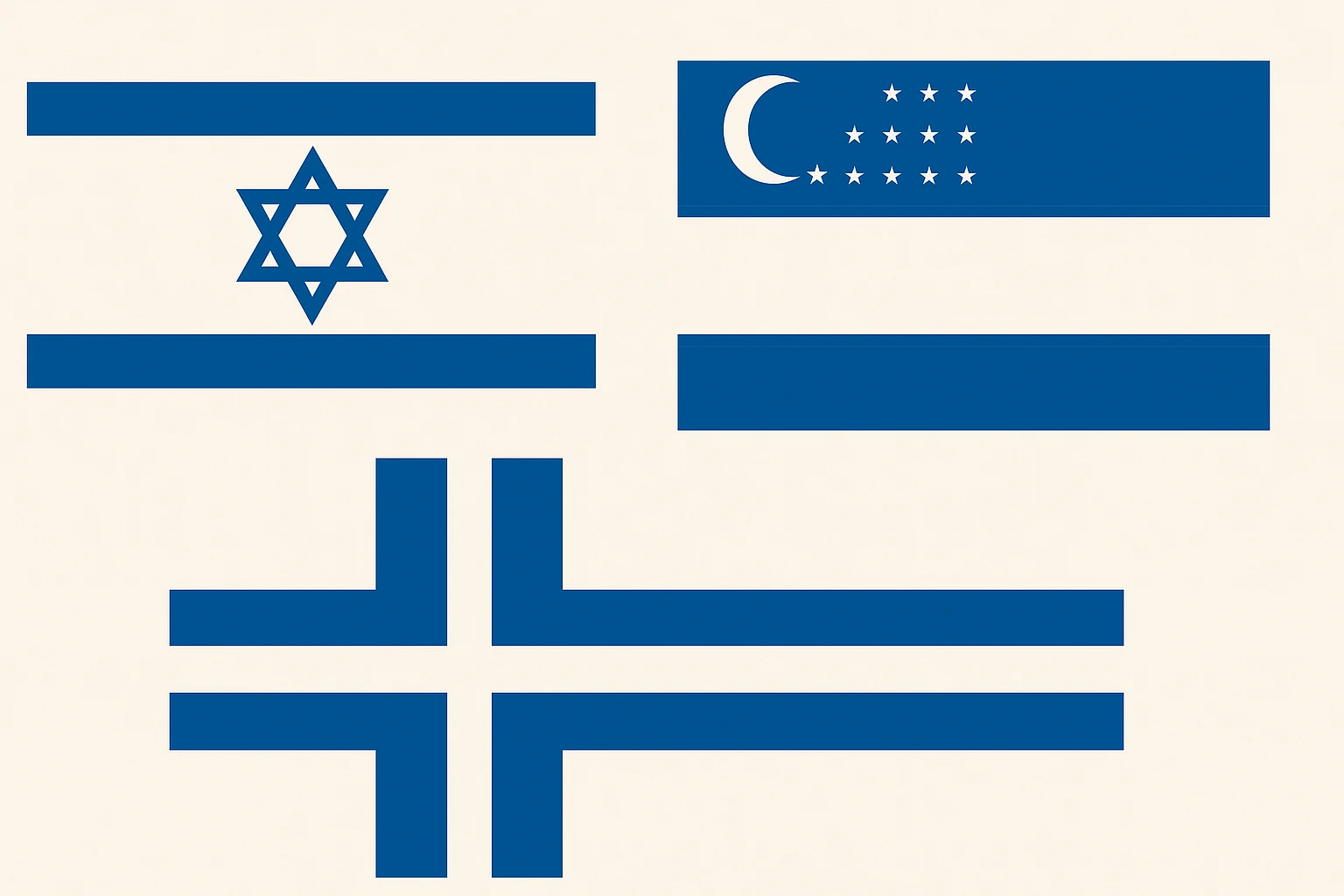
Place the flags of Israel, Uzbekistan, the Åland Islands, Curaçao, and Djibouti side by side and they look like a family. Blue and white, clean and cool, apparently all saying the same thing.
They are not.
In linguistics, a "false cognate" is a word that looks identical across two languages but means something different in each. The Spanish word embarazada means pregnant, not embarrassed. Blue-and-white on flags works the same way: universally recognized, locally specific every single time. This article traces the histories behind blue-and-white on flags from the Åland Islands, Uzbekistan, Israel, Curaçao, and Djibouti, and finds no common thread at all.
The false cognate problem: why blue-and-white isn't one tradition
Blue-and-white appears on roughly 30 or more national and territorial flags worldwide. There is no shared origin myth uniting them. Compare the Pan-African green-yellow-red triad, rooted in the Ethiopian flag, or the Pan-Arab red-white-green-black palette, traceable to the 1916 Arab Revolt. Those color families have genealogies. Blue-and-white does not.
Red-and-white is also common, but it usually traces back to identifiable heraldic or revolutionary traditions: the Red Cross lineage, Austro-Hungarian influence across Central Europe, the Scandinavian cross family. See a red-and-white flag and you have a reasonable chance of guessing its cultural neighborhood. Blue-and-white gives you no such foothold.
The reason is that blue is semantically overloaded. It can mean the sea, the sky, loyalty, freedom, a specific ethnic group, a historical dynasty, or an aesthetic choice someone made in a committee room. White is similarly flexible: peace, purity, snow, clouds, surrender, divinity. Stack the two together and you get a pairing that means almost anything, which is another way of saying it means nothing in particular.
The Åland Islands: blue as the sea between two nations
The Åland Islands form an autonomous, demilitarized archipelago of 6,700 islands between Sweden and Finland. About 30,000 people live there. Swedish is the sole official language, despite Finnish sovereignty, a status settled by the League of Nations in 1921. It's one of Europe's stranger geopolitical arrangements, and the flag reflects every bit of that strangeness.
The flag has a red Nordic cross outlined in gold on a blue background. Finland officially recognized it in 1954. The blue field explicitly represents the surrounding Baltic Sea, which makes it one of the rare cases where a flag's blue is literally cartographic. The color of the water on the map became the color of the flag.
There is a second layer. The blue also nods to Sweden's blue-and-yellow flag, signaling the islands' Swedish-speaking allegiance, while the red cross distinguishes Åland from Sweden proper. The flag says, in effect: we are culturally Swedish, politically Finnish, and geographically defined by the sea between the two.
It was controversial at first. Finland worried about separatist symbolism. The blue field worked as a compromise: it referenced Swedish heritage without reproducing the Swedish flag, and the sea reading gave Helsinki something politically neutral to point at.
Here, blue means a specific geographic and linguistic borderland. It is the actual water that shapes Ålanders' daily life. When an Ålander looks at the blue on that flag, they see the Baltic.
Uzbekistan: blue as the banner of Timur and the Central Asian sky
Now the opposite geography. From an archipelago surrounded by water to a doubly landlocked country with almost no sea at all. Blue still dominates.
Uzbekistan adopted its flag on November 18, 1991, months after independence from the Soviet Union. Three horizontal stripes of blue, white, and green sit separated by thin red fimbriations, with a white crescent moon and twelve stars in the upper-left canton. The blue stripe is the most prominent element.
The official symbolism of that blue is twofold. It represents the Central Asian sky, a defining feature of the steppe landscape. It also pays tribute to the banner of Timur (Tamerlane), the 14th-century Turco-Mongol conqueror who ruled from Samarkand and whose empire is central to modern Uzbek national identity. Timur's kök bayroq (blue banner) has been a touchstone of Turkic identity for centuries.
The dual meaning was deliberate. Post-Soviet Uzbekistan chose blue partly to break from the red-dominated Soviet palette, so the color was both a reclamation of pre-colonial identity and a rejection of communist symbolism. The white stripe represents peace and purity, but also cotton, Uzbekistan's fraught "white gold" economy that has generated both wealth and well-documented labor controversies.
Compare that with Åland. Uzbekistan's blue is historical and dynastic rather than geographic. The sky metaphor is poetic, not literal the way Åland's sea is literal. Nobody designed the Uzbek flag by looking at a map and matching colors to terrain. They looked backward in time, to Timur's banner over Samarkand six centuries ago.
Israel: blue as sacred text and modern reinvention
If Åland's blue is cartographic and Uzbekistan's blue is dynastic, Israel's blue is liturgical.
The Israeli flag was adopted on October 28, 1948, five months after independence, though its design dates to the Zionist movement of the 1890s. It is arguably the world's most recognizable blue-and-white flag: two horizontal blue stripes on a white field, with a blue Star of David centered between them.
The origin story runs straight through scripture. The flag was inspired by the tallit (Jewish prayer shawl), traditionally white with blue or black stripes. The blue dye historically associated with the tallit is tekhelet, derived from a marine snail (the Murex trunculus) and prescribed in the Torah for use in ritual fringes (tzitzit).
David Wolffsohn is traditionally credited with proposing the flag at the First Zionist Congress in 1897 in Basel. "We already have a flag," he reportedly said, "white and blue." That simplicity belied decades of argument about shade, proportion, and whether the Star of David should be filled or outlined. The specific shade of blue shifted over time and was only standardized in 2007 by the Israeli Standards Institution, and the blue has been read as the sky over Eretz Israel, the Mediterranean, and divine commandment, all within a single national context.
This is the sharpest version of the false cognate argument. Israel's blue is liturgical, diasporic, and textual. It carries religious law and centuries of exile. It could hardly be more different from Åland's cartographic blue or Uzbekistan's dynastic blue, yet all three flags look alike to the untrained eye.
Curaçao, Djibouti, and other blue-and-white dialects
The pattern holds well beyond these three.
Curaçao adopted its flag in 1984: a blue field with a horizontal yellow stripe and two white stars. The blue represents the Caribbean sea and sky as separate elements, the upper portion standing for sky and the lower for sea. Few flags make blue do double geographic duty in a single design.
Djibouti's flag, adopted in 1977, has a light blue upper triangle and a green lower triangle with a white star. The light blue represents both the sky and the Issa Somali people, one of the country's two major ethnic groups. Blue as an ethnic signifier is rare, and almost entirely absent from European or American flag traditions.
Broaden the lens further:
- Finland's blue represents its lakes and sky.
- Greece's nine stripes represent the syllables of the national motto, with blue standing for sea and sky.
- Argentina's blue evokes the sky, with the Sun of May at center.
- Nicaragua and other Central American flags use blue for the Pacific and Atlantic oceans flanking the isthmus.
The more examples you collect, the less coherent any universal theory of flag blue becomes.
Why blue resists a single story
Why does blue resist universal symbolism more than other colors? Red almost always involves blood, revolution, or sacrifice. Green reliably signals Islam, fertility, or land. Blue refuses to stay put.
The answer is in nature. Blue is the only color that dominates both the sky and the sea, the two largest visual fields in human experience. Every culture on Earth has a local blue to claim. A landlocked Central Asian nation sees its endless sky. An island territory sees its surrounding water. A diasporic religious community sees the dye prescribed in ancient text. Red and green require a metaphorical leap; blue is already there, overhead and on the horizon.
That has practical consequences for flag design. Because blue means almost anything, it is the safest and most politically neutral color to adopt, which is part of why newly independent nations reach for it: Uzbekistan in 1991, Djibouti in 1977, Curaçao in 1984.
Blue's dominance on flags is also historically recent. Michel Pastoureau, in his 2001 book Blue: The History of a Color, argues that blue became the West's favorite color only in the 12th and 13th centuries. Before that Europeans considered it barbaric or insignificant. The Romans had no positive associations with blue, and the ancient Greeks barely distinguished it from gray or green in their vocabulary. Blue's current prestige, on flags and elsewhere, is a contingent development rather than an inevitability.
Five flags, five meanings
Go back to those five flags side by side. After tracing the histories, the resemblance dissolves.
The Åland Islands' blue is the Baltic Sea lapping at a Swedish-speaking shore. Uzbekistan's blue is the memory of Timur's banner over Samarkand. Israel's blue is a thread of tekhelet dye prescribed in scripture thousands of years ago. Curaçao's blue is the Caribbean horizon split into sea and sky. Djibouti's blue is a people.
The color is shared, and the reasoning behind it almost never is.