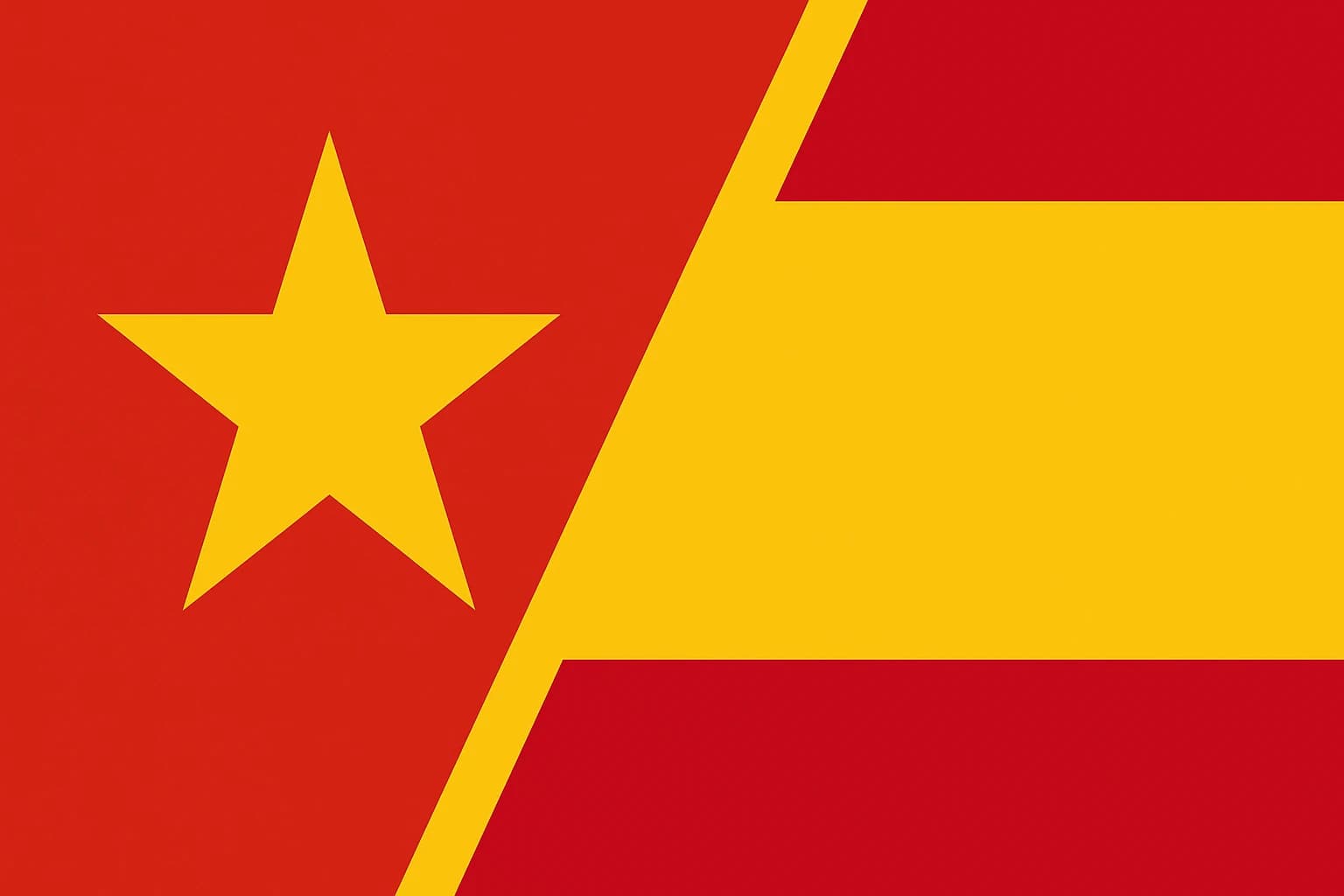
In November 1975, three rival governments declared independence from Portugal on the same day. Each flew a different flag. Each claimed to represent the "real" Angola. Only one of those flags survived.
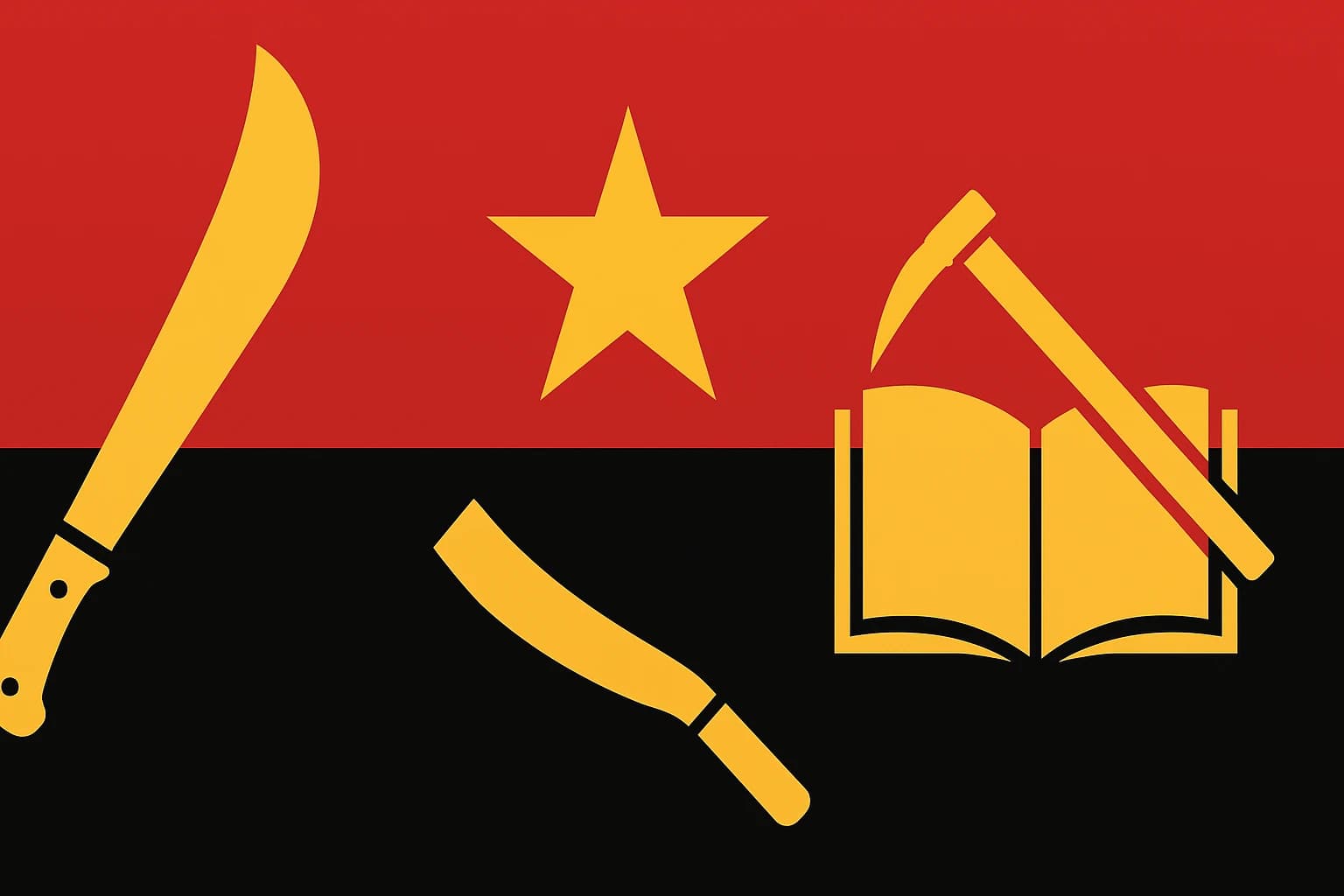
Today, Angola's national flag features a machete crossed with a half cogwheel, arranged in an unmistakable echo of the Soviet hammer and sickle.
Most people who notice this assume it is a copy-paste from Moscow, a Cold War client state slapping communist iconography onto a new banner. That reading skips over a real design argument. Choosing a machete rather than a rifle, a hoe, or a book carried ideological weight, and the competing liberation movements were proposing very different versions of Angolan identity through the symbols they picked. The flag that won was the flag of the faction that won, and it has been sitting there since 1975 like a preserved specimen of the moment it was made.
Three movements, three flags, one day
November 11, 1975. Portugal formally withdraws from Angola after the Alvor Agreement collapses. Three rival governments simultaneously declare independence. The MPLA (People's Movement for the Liberation of Angola) sets up in Luanda. UNITA (National Union for the Total Independence of Angola) declares from Huambo. The FNLA (National Front for the Liberation of Angola) raises its banner in Ambriz.
Each movement had spent years developing its own flag and national symbols during the independence war that ran from 1961 to 1975. These were propaganda tools and ideological manifestos compressed into cloth, not afterthoughts.
The MPLA's flag, red and black horizontal stripes with the machete-and-cogwheel emblem in gold, won out militarily with crucial Cuban and Soviet backing. By early 1976, the MPLA controlled Luanda and most major cities. Their flag became the Angolan flag.
UNITA's proposed flag imagery leaned on agrarian and pan-African symbolism. It featured a cockerel (rooster) symbolizing vigilance and the rural peasant base Jonas Savimbi claimed to represent. The FNLA's flag used a similar red-black-green palette but emphasized pan-Africanist unity over Marxist revolution, reflecting leader Holden Roberto's close ties to Mobutu's Zaire.
Angola's flag was not chosen by consensus or by a post-independence design committee. It was chosen by military victory, and the symbols on it are the ideology of the faction that won the war rather than a negotiated national identity.
How the MPLA designed its symbols
The MPLA was founded in 1956 in Luanda, drawing its core leadership from Marxist-influenced intellectuals like Agostinho Neto, a poet and physician educated in Portugal, and Viriato da Cruz. From its earliest years the movement paid attention to visual symbolism. Neto understood that a liberation movement needed a language of images as well as words.
The machete-and-cogwheel emblem was developed during the 1960s as the MPLA's party symbol, well before it became the state flag. The design directly references the Soviet hammer and sickle: the machete replaces the hammer (representing agricultural labor and the peasant class), and the half cogwheel replaces the sickle (representing industrial workers and modernization). A gold star sits above the emblem, echoing socialist star motifs found on flags from China to Vietnam.
But the choice of a machete rather than a hammer was deliberate and locally meaningful. Angola in the 1960s had virtually no industrial proletariat. The country's economy under Portuguese colonialism was built on forced agricultural labor, coffee plantations, and diamond extraction. A hammer would have been absurd. The machete was the universal tool of Angolan rural life, used for clearing land, harvesting crops, and, crucially, as an improvised weapon in early anti-colonial uprisings.
The cogwheel stood for what the MPLA intended to build: Angola would become an industrialized socialist state. It was a symbol of the future rather than the present, and the gap between the machete (the agrarian reality) and the cogwheel (the industrial plan) is more or less the whole MPLA project in two objects.
The red and black carried a double meaning. Red was for the blood of the anti-colonial struggle and black for Africa, but the palette also echoed the colors used by other Marxist-aligned liberation movements across the Portuguese-speaking world. None of it was accidental.
Why a machete and not a rifle
The most revealing contrast is with Mozambique, Angola's sibling in the Portuguese colonial empire. Mozambique's flag, adopted in 1983 and refined from FRELIMO's party flag, features an AK-47 crossed with a hoe over an open book. It remains the only current national flag in the world to depict a modern firearm.
Both flags come out of the same moment, with Marxist-Leninist liberation movements fighting Portuguese colonialism on Soviet and Cuban support. The two movements were allied and drew on the same symbolic vocabulary, yet they made very different choices about how to depict armed struggle.
FRELIMO chose the AK-47 to honor armed resistance: independence was won through the barrel of a gun rather than at a negotiating table. The hoe stood for the peasantry and the open book for education as a revolutionary tool. Mozambique's flag is a complete program in three objects, telling citizens to fight, farm, and learn.
The MPLA chose the machete, which is ambiguous in a way the AK-47 is not. A machete is simultaneously a farming tool and a weapon. It collapses the distinction between peaceful labor and revolutionary violence, suggesting that the peasant's daily work is the revolution. This ambiguity may have been strategic. The machete made the MPLA's flag less overtly militant than FRELIMO's while still gesturing toward armed struggle.
This distinction matters because it shaped how these flags have aged. Mozambique has debated removing the AK-47 from its flag for decades, most recently in a 2005 flag redesign competition that failed to produce a replacement. Angola's machete, because it reads as a simple agricultural tool, has faced far less pressure for removal, even after the MPLA officially abandoned Marxism-Leninism in 1990.
The Guinea-Bissau connection
Angola's flag belongs to a visual family of flags from former Portuguese colonies that declared independence in the 1970s. Guinea-Bissau's flag (adopted 1973) is perhaps the closest sibling: a vertical red stripe with a black star on the hoist side, and horizontal yellow and green stripes on the fly.
The black star, drawn from pan-African symbolism and specifically from Ghana's flag, became a shared motif across Lusophone African liberation aesthetics.
The connection is not coincidental. The PAIGC (African Party for the Independence of Guinea and Cape Verde), led by Amílcar Cabral, was in direct contact and solidarity with the MPLA throughout the 1960s and 1970s. These movements shared training camps, Soviet and Cuban advisors, ideological frameworks, and design influences.
Cabral, assassinated in 1973 just months before Guinea-Bissau's independence, was arguably the most sophisticated theorist of cultural decolonization among the Lusophone liberation leaders. He explicitly argued that national symbols had to be rooted in African realities, not imported wholesale from European socialist traditions. That principle influenced the MPLA's decision to localize the hammer-and-sickle template rather than simply adopting it.
The result is a recognizable Lusophone liberation look: bold red, black, yellow and green palettes, stars, and emblems built from farm and factory tools. The coherence was intentional. It signaled solidarity among the Portuguese colonies fighting for independence, something close to a shared revolutionary brand across the two coasts of the continent.
The flags that lost
Jonas Savimbi's UNITA proposed a very different symbolic vocabulary for Angola. UNITA's flag, a green, red, and black tricolor with a cockerel at its center, drew on rural Ovimbundu cultural symbolism. The cockerel represented the dawn of a new era, vigilance, and was associated with traditional authority in the central highlands where Savimbi's base was concentrated.
UNITA's symbolism was explicitly anti-communist in its later evolution. Savimbi, initially Maoist in orientation, pivoted to Western alignment during the Cold War and received CIA and South African apartheid government support. His flag's rejection of Soviet-style iconography was a political statement: Angola's identity should be rooted in indigenous African traditions, not European ideologies, whether colonial Portuguese or Soviet Marxist.
The FNLA, led by Holden Roberto, used pan-Africanist imagery. Its flag's colors and design drew more on the Congolese/Zairian aesthetic of Mobutu's sphere of influence, reflecting Roberto's close ties to Kinshasa and his Bakongo ethnic base in northern Angola.
Had UNITA or the FNLA won the civil war, Angola's flag would tell a different story about who Angolans are. The cockerel flag would have put the weight on ethnic tradition and rural continuity, the FNLA's on pan-African unity rather than socialist internationalism. The machete and cogwheel endured because of Cuban troops, Soviet weapons, and Cold War patronage, not because it was the better design.
The losing flags have not disappeared. UNITA's cockerel is still its party symbol and still carries weight in Angolan opposition politics in 2026, which keeps the point visible: the national flag stands for one faction's version of the country.
Why the flag outlived its ideology
In 1990, the MPLA formally abandoned Marxism-Leninism, renaming itself the MPLA-Social Democratic Party and embracing market economics. The Soviet Union collapsed a year later. Cuba withdrew its troops. The ideological framework that produced the machete-and-cogwheel flag evaporated. But the flag remained.
Angola has considered flag changes multiple times. A 2003 constitutional debate included proposals to replace the flag with a design more "inclusive" of all Angolans, not just MPLA supporters. The proposals went nowhere. In 2010, a new constitution was adopted under President José Eduardo dos Santos, and the flag was retained without modification.
The flag persists for several reasons. The MPLA has held power continuously since 1975, making Angola effectively a one-party state for most of its history. Changing the flag would mean the ruling party symbolically disowning its own origin story. Beyond politics, the machete-and-cogwheel has accumulated decades of national association. Generations of Angolans have grown up with no other flag. It has become a symbol of Angola itself rather than of Marxism-Leninism specifically.
That is what happens to ideologically loaded flags given enough time. The ideology fades and the flag becomes simply ours. The machete now reads as Angola rather than as peasant revolution, and the cogwheel reads as national aspiration in the abstract rather than industrial socialism. Sheer persistence has washed the symbols of most of their original meaning.
Compare this to the flags of former Soviet bloc nations. East Germany's flag was immediately retired upon reunification in 1990, while China and Vietnam's communist-era flags persist because the parties that designed them still rule. Angola fits the latter pattern: the flag survives because the party survives.
Reading the machete in 2026
Angola's flag is one of roughly a dozen current national flags that carry overt socialist or Marxist-derived iconography, alongside Mozambique, China, Vietnam, Laos, and North Korea.
Angola is the odd one out in that group, because it no longer claims to be a socialist state. The flag is an ideological fossil.
Flags like this one complicate the assumption that a national flag represents a national consensus. Angola's represents the MPLA's version of Angola circa 1975, contested then and contested now. UNITA still operates as an opposition party, and ethnic and regional divisions have not gone away.
The Soviet designers who worked out the hammer-and-sickle template could hardly have pictured their idea still flying over Luanda in 2026, reinterpreted as a post-ideological national emblem on the pennants of oil executives' SUVs and on luxury apartment blocks in a thoroughly capitalist economy. Symbols outlast the intentions of the people who made them.
The open question applies well beyond Angola: at what point does a liberation movement's flag stop being a party symbol and start being a national one, and can a flag born in factional war represent an entire country?
Calling the flag derivative, a tropical hammer and sickle, misses how local the argument behind it was. Angolan intellectuals and revolutionaries spent years working out which symbols could stand for a country that did not yet exist, and the machete crossed with the cogwheel beat the cockerel and the pan-Africanist star because the movement carrying it won a brutal civil war with superpower backing. Half a century on, and three decades after the MPLA dropped the ideology that produced it, the machete no longer means what it meant in 1975. It still means something, and the distance between those two readings is the part worth looking at.