In most countries, a national flag is designed to represent everyone, a unifying canvas of shared identity. But what happens when the flag of the winning side in a civil war simply becomes the national flag?
In 1975, Angola hoisted a banner virtually identical to the flag of the MPLA, the Marxist guerrilla movement that seized Luanda at the moment of independence. Two decades later, Eritrea adopted a flag derived from the emblem of the Eritrean People's Liberation Front, the rebel faction that outlasted all rivals in a brutal 30-year war against Ethiopia. In both cases, a party symbol was promoted to national symbol almost overnight. Machetes, stars, and revolutionary triangles were recast as emblems of statehood.
The design is the least of it. What both cases raise is a question about legitimacy that neither country has settled: can a flag born from one faction's victory ever belong to everyone?
When guerrilla banners become state flags
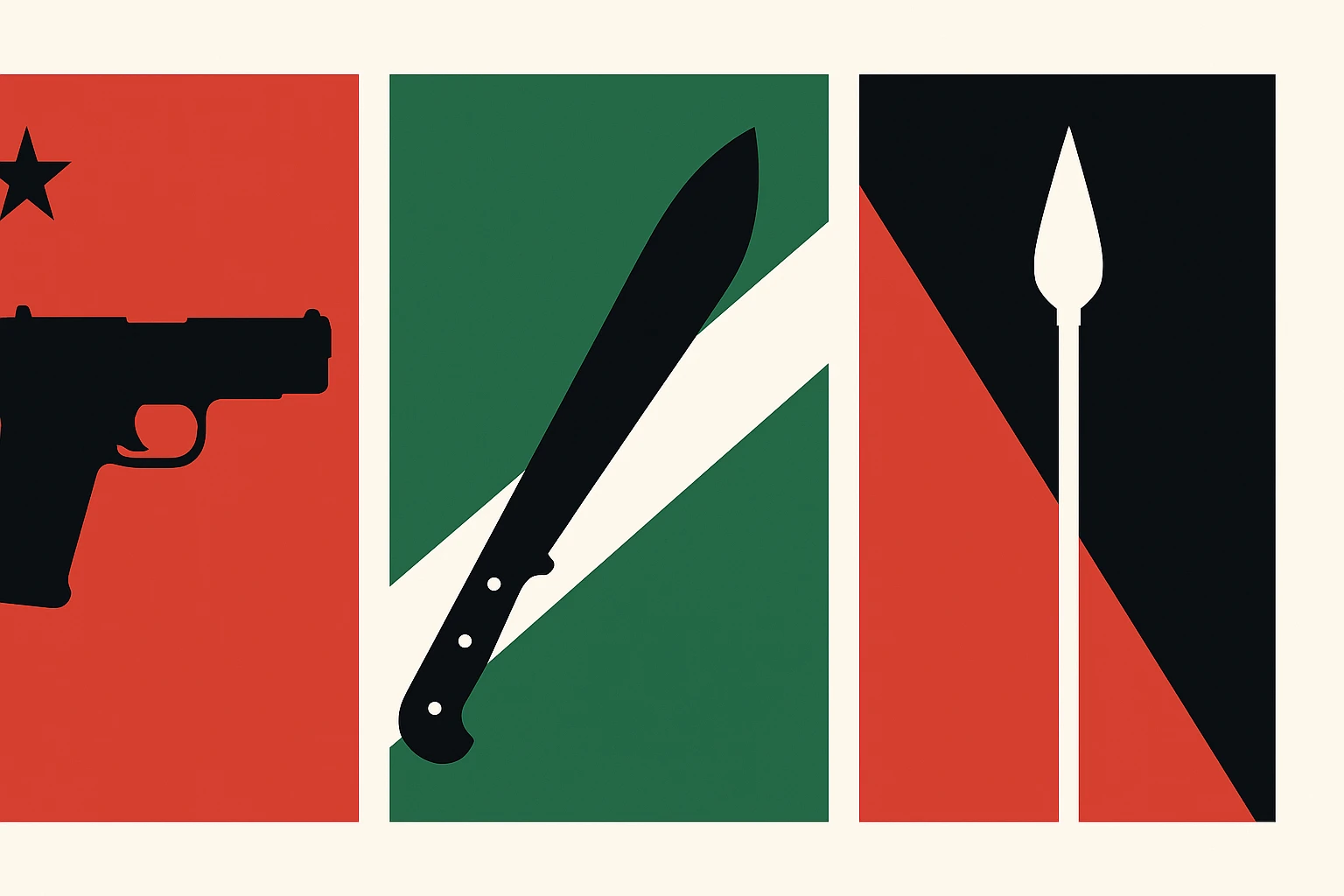
The pattern shows up across post-colonial Africa. Mozambique's flag features an AK-47 borrowed from FRELIMO's party imagery.
Zimbabwe's design carries the visual DNA of ZANU's liberation-era symbolism.
But Angola and Eritrea executed the transfer most directly. In both countries, the winning movement's flag became the national flag with minimal redesign.
This is worth distinguishing from the more common approach, where a committee or constituent assembly designs something new. Think of South Africa's 1994 flag, commissioned by Frederick Brownell to merge multiple traditions into a fresh symbol of reconciliation. That flag was deliberately built to transcend factional lines.
The Angola and Eritrea pattern makes a different political claim. When a liberation movement puts its own flag on the state flagpole, it is saying that the party and the nation are the same thing, and that the party's struggle is the national story. Everyone else's version becomes secondary, or disappears.
The two make a sharp comparative pair. Both emerged from prolonged armed struggles involving multiple competing factions, both adopted flags barely modified from the winning movement's, and both are still governed by the successor organizations of those movements decades later. These are not relics of a settled argument.
Angola's flag: the MPLA's banner over Luanda
November 11, 1975. Portugal's withdrawal from Angola is chaotic, rushed, and violent. Three rival liberation movements, the MPLA, the FNLA, and UNITA, are already fighting a civil war before independence is even formally declared. The MPLA, led by Agostinho Neto and backed by Cuban troops and Soviet arms, controls the capital. It declares independence first, raising its own flag as the national flag.
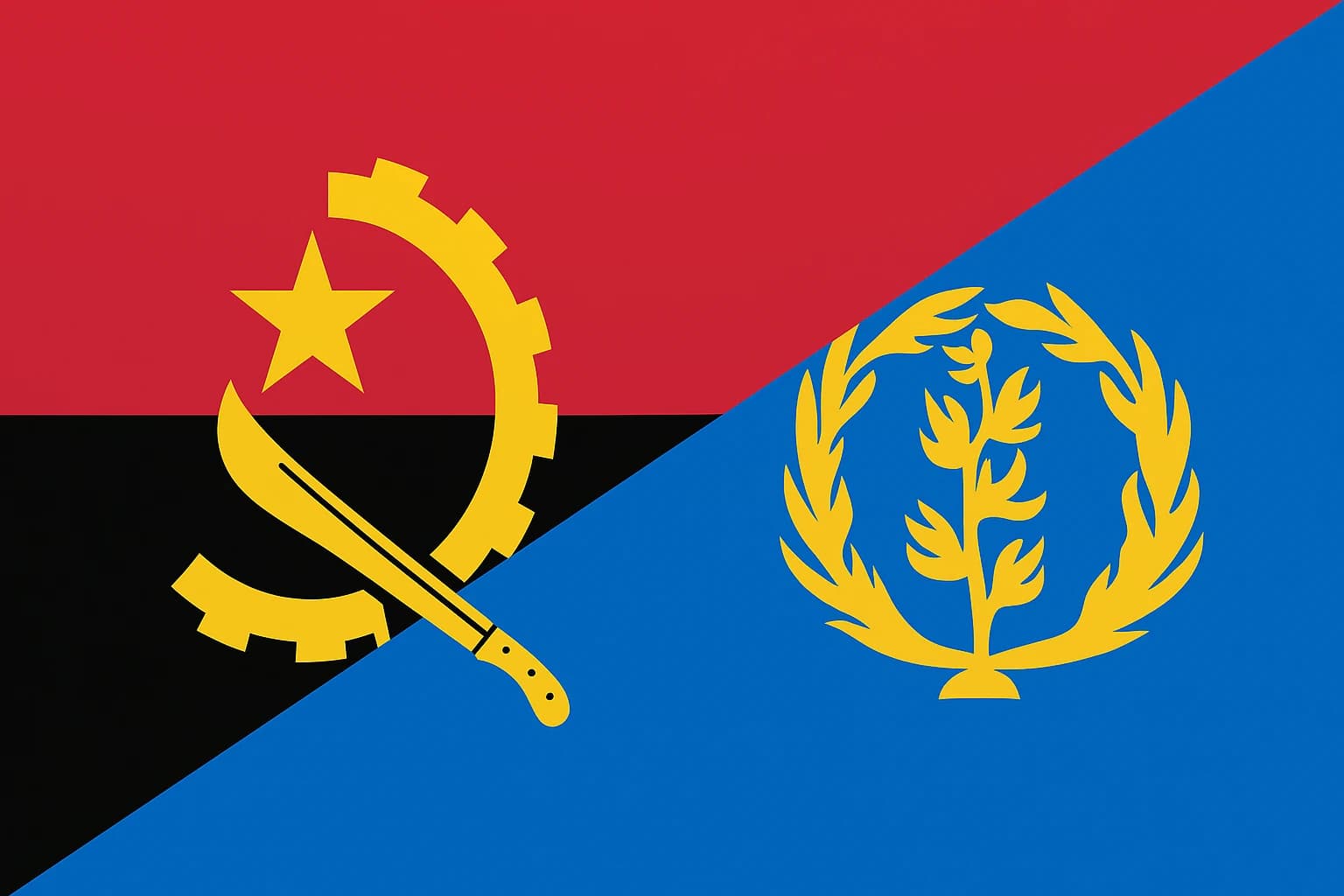
The iconography is unambiguous. Two horizontal bands: red for the blood shed in the struggle, black for the African continent. At the center sits an emblem featuring a machete (representing peasant struggle and agricultural labor), a cogwheel or gear (industrial workers and progress), and a yellow star (internationalism and socialist solidarity). Every element is drawn straight from the Marxist-Leninist visual playbook. The machete and gear echo the hammer-and-sickle tradition. The star mirrors the stars on the flags of the Soviet Union, China, and Cuba.
What the flag leaves out is just as deliberate. Angola's other liberation movements appear nowhere on it: nothing for the FNLA's northern Bakongo constituency, nothing for UNITA's Ovimbundu base in the central highlands. At the moment of its adoption the flag represented roughly one of the country's three political factions, and the other two were at war with it.
The MPLA's party flag and the national flag are nearly identical. The party version uses a slightly different arrangement, but the same colors and core symbols. This was not an adaptation. It was a promotion of party insignia to state status.
In 1990 the MPLA formally abandoned Marxism-Leninism. A constitutional revision followed in 1992, along with proposals to redesign the flag, and the machete and gear emblem was debated. It was kept anyway, even as the country moved, at least nominally, to multiparty politics. The symbols outlived the ideology that had justified them.
Eritrea's flag: a rebel triangle becomes a nation
Eritrea's path to independence was one of Africa's longest and most punishing conflicts: a 30-year war against Ethiopia stretching from 1961 to 1991. Two major liberation fronts fought both Ethiopia and each other. The Eritrean Liberation Front (ELF) launched the armed struggle in 1961. The Eritrean People's Liberation Front (EPLF) split off later and, by the early 1980s, had defeated and expelled the ELF. The EPLF became the sole liberation movement standing.
The EPLF's flag featured a red triangle on the hoist side with a gold star, set against a blue and green field. When Eritrea gained formal independence in 1993 after a UN-supervised referendum, the new national flag was a clear derivative. The same red triangle, now extended across the full height of the flag. The blue and green were retained. But one change stood out: an olive wreath replaced the gold star.
The wreath was borrowed from the 1952 Eritrean Federation emblem, the flag that represented Eritrea during its brief federal union with Ethiopia before annexation. By reaching back to a pre-war symbol, the EPLF claimed a lineage older than its own founding: the new Eritrea was not simply what the EPLF had made, but the restoration of a state that had existed before. It is a subtler piece of legitimation than Angola's direct party-to-state transfer.
The subtlety had limits. The ELF, which had initiated the armed struggle and represented a significant portion of Eritrean society, particularly lowland Muslim communities, found no trace of its own symbolism in the new national flag. ELF veterans and their descendants have raised this as a grievance, arguing that the flag tells only half the story of Eritrean liberation.
The political context makes this erasure sharper. The EPLF reconstituted itself as the People's Front for Democracy and Justice (PFDJ) in 1994. Eritrea has been a one-party state ever since. President Isaias Afwerki, the former EPLF leader, has ruled without elections. The flag's origins in a single faction mirror the country's continued single-faction governance.
Side by side: what the two flags reveal
The ideological content of the two flags is quite different. Angola's is explicitly Marxist-Leninist: the machete and gear are proletarian symbols and the star signals socialist internationalism. Eritrea's is nationalist rather than ideological, with a triangle, a wreath, and colors that point at geography and peace rather than class struggle.
This reflects the different characters of the two movements. The MPLA was deeply embedded in Cold War geopolitics, a Soviet-aligned party fighting a proxy war. The EPLF, though leftist, defined itself primarily through national self-determination. The MPLA's flag says "workers of the world." Eritrea's flag says "this land is ours."
The degree of modification matters too. Angola kept essentially the same flag, while Eritrea made a deliberate effort to soften the partisan origin with the pre-war olive wreath. The EPLF was more conscious of the legitimacy problem, even though the practical outcome, one-party rule, turned out identical.
Both flags were presented as symbols of national liberation and unity, and both were compromised by the fact that they came out of a factional victory. Neither could be fully neutral. For UNITA supporters in Angola's Ovimbundu heartland, saluting the MPLA's flag was, and in some ways remains, an act of submission rather than belonging. For ELF veterans scattered across Eritrean exile communities, the flag is a reminder of their movement's destruction.
Contrast this with post-liberation flags that attempted inclusivity. South Africa's 1994 flag was designed from scratch to merge multiple traditions. Mozambique has held periodic discussions about removing the AK-47 from its flag. East Timor's flag adoption process involved broad consensus-building.
Other paths were available, which means the route Angola and Eritrea took was a choice rather than an inevitability.
Living under the revolution's flag
Angola shows what a couple of generations can do to a symbol. The MPLA has governed continuously since 1975, the civil war ended in 2002 with the death of the UNITA leader Jonas Savimbi, and despite nominal multiparty elections the flag has never been seriously redesigned. Younger Angolans, born after the war, increasingly read it as the Angolan flag rather than the MPLA's. Opposition politicians still call for a new one from time to time as part of wider democratization demands, so the argument has not gone away.
During the anti-government protests of 2020 and 2021, demonstrators carried the national flag as an act of reclamation, turning the MPLA's own symbol against it. Even a flag with party origins can be taken over by the people carrying it, and put to meanings the party never intended.
Eritrea's situation is bleaker. The PFDJ's total grip on power means the flag remains uncontested domestically. There is no legal opposition to challenge it. But in the vast Eritrean diaspora, hundreds of thousands who have fled the country's indefinite military conscription, the flag is bitterly contested. Some diaspora communities fly it with pride as a symbol of hard-won independence. Others reject it as the emblem of a dictatorship. A few ELF-aligned groups use alternative flags entirely.
Which raises the question of whether a flag can earn legitimacy through time and habit alone, whatever its origins. The American flag, after all, was the banner of revolutionary rebels.
The French tricolor was a factional symbol before it became a national one.
The difference, arguably, is that those flags ended up in the hands of governments that allowed dissent. Citizens could argue about what the flag meant, protest under it, burn it, wave it ironically, take it back. In Angola and Eritrea the flags stay frozen in their original factional meaning partly because the political systems stay closed.
The flag as historical document
Both flags are historical documents. They record the moment a guerrilla movement declared itself a nation, and in each case promoting a party banner to national status was a claim of total political ownership. The movement had not only won the war, it had become the state.
Decades on, both are still flying, normalized for some citizens and contested by others. That is the tension running through post-colonial nation building: a country needs a unifying symbol, and independence was usually won by one faction among several. Whether these two flags are eventually redesigned or simply outlast the memory of where they came from depends on politics rather than design, and on whether Angola and Eritrea ever open up enough for their citizens to argue the question in public.