The Flag of Yemen
Republic of Yemen
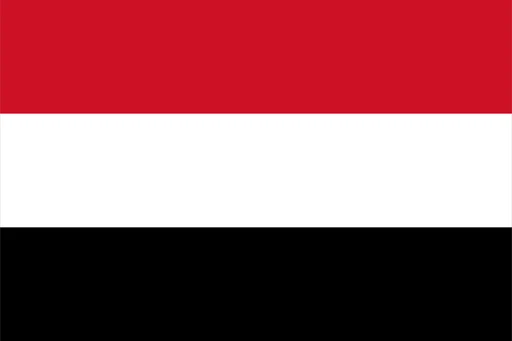
The flag of Yemen is three horizontal stripes of equal size, red at the top, then white, then black. These are the Pan-Arab colors. Red is the blood shed for independence, white a bright future and black the dark past.
The flag of Yemen, adopted on May 22, 1990, is a plain red, white and black tricolor, and the plainness is the point.
A flag for a merger
The flag was adopted on the day North Yemen, the Yemen Arab Republic, and South Yemen, the People's Democratic Republic of Yemen, became one country. That ended decades of division between two states with very different politics.
Both predecessors had used the same three colors. The Yemen Arab Republic flew horizontal stripes with a green star. The People's Democratic Republic added a blue chevron and a red star. Both emblems were dropped for unification, leaving a bare tricolor that gave neither side's symbol precedence over the other's.
Pan-Arabism, the movement to unite Arab peoples around shared traditions, shaped that choice and put Yemen visually alongside other Arab states.
Design and symbolism
Three horizontal stripes, red over white over black. Red is Arab liberation and the sacrifices made for independence. White is hope and peace. Black is the struggle for freedom.
The same palette appears on the flags of Egypt, Iraq and Syria, and the family resemblance is deliberate. Yemen's version is the simplest of them, since it carries nothing but the stripes.
Where it flies
The flag hangs at government buildings, including the presidential palace and the houses of parliament, and is used at official ceremonies and on National Unity Day. It flies at forts and army camps. Yemeni delegations use it at United Nations assemblies and at diplomatic missions abroad.
Through the war
Through years of conflict and political unrest, the flag has gone on standing for a unified Yemen and for the aspiration to sovereignty. It appears at cultural events and celebrations and throughout Yemeni media.
References
[1] CIA World Factbook on Yemen: CIA Factbook
[2] Vexilla Mundi - Yemen Flags: Vexilla Mundi
[3] Historical Records on Yemen Unification - United Nations Archives: UN Archives
Common questions
- What do the colors on Yemen's flag stand for?
- Red is Arab liberation, white is hope and peace, and black is the struggle for freedom. Together they are the Pan-Arab colors, which tie Yemen to a wider Arab inheritance.
- Why does Yemen's flag use Pan-Arab colors?
- Red, white and black mark shared cultural and political goals with other Arab countries. They connect Yemen to Pan-Arabism, the movement for Arab unity.
Download this flag
Free in 12 styles, from 32px icons up to 2000px, as SVG, PNG, WebP and JPG.