The Flag of Portland
City of Portland
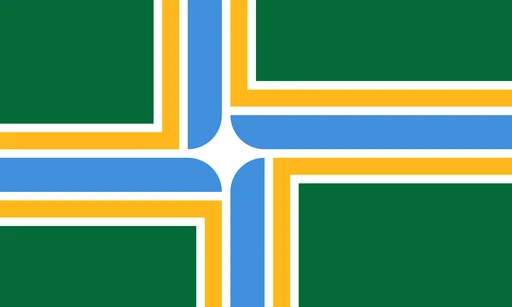
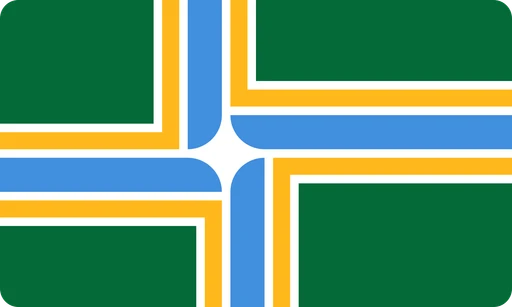
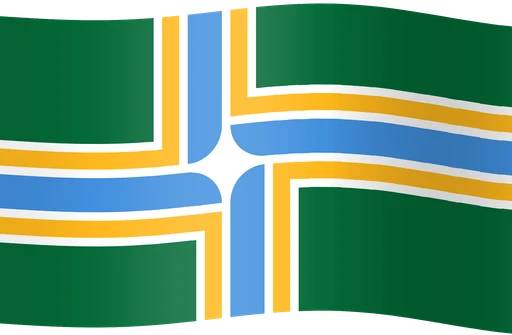
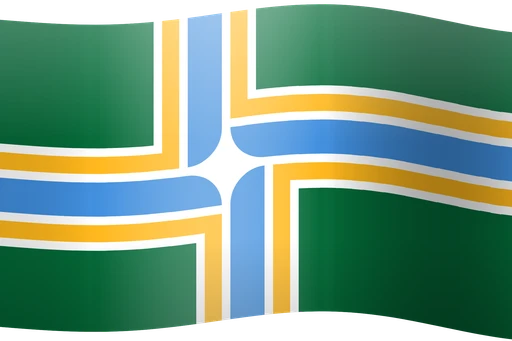
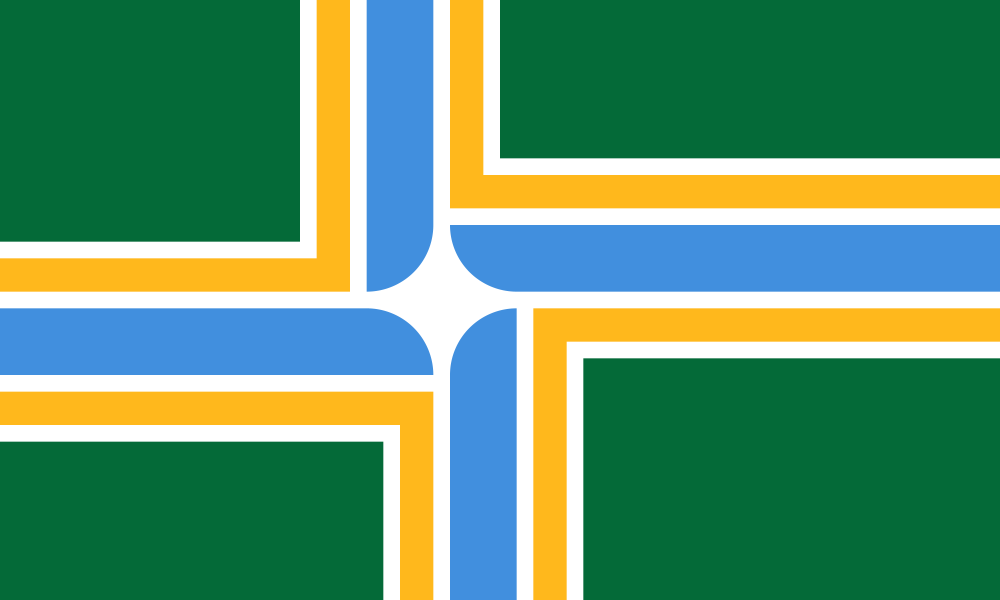
The flag of Portland, Oregon, is a green field crossed by light blue stripes that meet left of center in a white four-pointed star. The arms are offset like a pinwheel. Each blue stripe has a yellow stripe beside it, and thin white lines separate the yellow from the blue and the green. The city code says the green stands for the forests and "our green City," the blue for the rivers, and the yellow for agriculture and commerce. Designer Douglas Lynch said the star marks Portland, where the Willamette River meets the Columbia. The proportions are 3:5.
Portland's flag looks like a map drawn by a designer who refused to draw a map. Two light blue stripes cross a green field and meet in a white four-pointed star, set a little toward the hoist. The arms don't line up. Each one is shifted sideways, so the cross spins like a pinwheel. Yellow stripes run beside the blue, with thin white lines between every color. It has no seal, no rose, no mountain and no lettering, and that took 33 years to achieve.
Four tries before a flag stuck
Portland spent half a century failing to adopt a flag. In November 1916 Mayor Harry R. Albee appointed a committee to decide whether the city needed one. A contest followed in 1917, and H. W. Frederick won $25 for a white, blue-green and white tribar with a red circle for the city. The committee then decided the design missed the contest rules, and with the country newly at war the council named the Stars and Stripes as the municipal flag instead.
In June 1950 Mayor Dorothy McCullough Lee wanted a city flag for the Rose Festival Parade. Harry Matheson, the shop teacher at Benson Polytechnic High School, put the city seal on a white field with "City of Roses" above it. The mayor promised to adopt it. The council never acted.
In 1958 the Lang Syne Society ran a contest among high school students. Phil Shaffer of Franklin High School won a $200 savings bond for a design that packed in Mt. Hood, Bonneville Dam, a covered wagon, a log cabin and a downtown street scene. It hung in the council chambers for more than ten years. It was never adopted either, which the Commercial Club of Portland pointed out in April 1969 when it proposed a design of its own.
The questionnaire and the seal
Mayor Terry Schrunk sent the Commercial Club's proposal to the Portland Art Commission, which planned to hire a designer for $500. Its chair, Libby Solomon, asked her predecessor Douglas Lynch. Lynch was a graphic designer who had painted murals and carved linoleum panels for Timberline Lodge in the 1930s and later worked as art director at Jantzen. He first said no, calling a city flag "a project where even angels fear to tread."
He agreed on one condition. Every member of the city council and the art commission had to fill in a questionnaire on five subjects, including abstraction, lettering, color and the city seal. The answers split along the lines you'd expect. All four council members polled disliked an abstract design and wanted the seal. Seven of the nine art commissioners wanted abstraction, and all but one rejected the seal.
Lynch finished in August 1969. His starting point, he said, was that Portland exists because the Willamette River meets the Columbia there. So two blue stripes crossed on green, with a small white star at the junction.
The council then amended it. The upper hoist corner turned dark blue and gained the city seal. The Portland Rose Festival Association objected that any symbol on the flag ought to be a rose. When the council took it up in December 1969, one protester called the design "too abstract, and similar to Socialist countries," and warned that the star stood for a metropolitan government "which will take us all over eventually." The council approved the amended flag anyway.
Production stalled for lack of money. In August 1973 Solomon offered $1,000 toward the $3,500 cost of 100 flags, and donors covered the rest. Schrunk received the first one in January 1974 as he left office.
Lynch gets his second draft
In 2002 Lynch joined the Portland Flag Association and gave a talk on the flag. He told the group that the gold and white edging overwhelmed the blue river stripes, and that he wished he had the chance to do it over. The members urged him to try.
He made four major changes. The seal came off. The canton went green. The blue stripes doubled in width. The star grew to nine times its former size. Association members worked with Sam Adams, the mayor's chief of staff, to draft an ordinance, and they testified at city council. One of them, Mason Kaye, was a high school student who presented the history of the city's flags.
The council passed Ordinance 176874 on September 4, 2002. Mayor Vera Katz oversaw the raising of the new flag in the council chamber. Elmer's Flag & Banner made it on one week's notice and donated it. The 1969 version stayed valid until December 31, 2004. Lynch was 89 when the city adopted the flag he had first drawn in 1969.
A flag written in inches
Portland City Code 1.06.010 describes the flag in one-inch units on a standard size of 5 feet by 3 feet. Each arm of the cross is 12 units wide: a 4-unit blue band, flanked by 1-unit white lines, 2-unit yellow bands, and 1-unit white lines again. The star is 9 units high and wide, with concave sides cut by quarter circles of 4-unit radius.
The four green sections are all different sizes. The canton is 18 by 14½ units, the upper fly 30 by 9½, the lower fly 25 by 14½ and the lower hoist 23 by 9½. That mismatch is what offsets the arms and gives the flag its spin.
The code names the colors twice. Cloth flags use Kelly or Irish Green, U.N. Blue, Golden Yellow and White. Printed flags match Pantone 349, 279 and 1235. It also states the meaning: green for the forests and "our green City," blue for the rivers, yellow for agriculture and commerce. The council amended the section in 2014 and again in a 2024 ordinance that took effect on January 3, 2025.
From council chamber to the North End
Kaye wrote that after 1974 the old flag flew in a few public places and stayed unknown to most residents. The revised one had better luck. In the North American Vexillological Association's 2004 survey of 150 American city flags, Portland ranked seventh. In 2003 the association gave Lynch its Vexillonnaire Award.
You'll see the flag most often at Providence Park, where the Timbers Army waves it during Portland Timbers matches. By 2014 it was so common in the stands that one supporter told the club's website, "The City of Portland flags are cool, but everyone's seen them."
Lynch's own summary of the job was shorter. "It is important that flags look like flags," he said.
References
[1] "Chapter 1.06 Official Flag," Portland City Code, City of Portland, Oregon. https://www.portland.gov/code/1/06
[2] Ordinance 191988, City of Portland, Oregon, passed December 4, 2024. https://www.portland.gov/council/documents/ordinance/passed/191988
[3] Mason Kaye, "The Flags of Portland, Oregon (1916-2002)," Proceedings of the XX International Congress of Vexillology, Nordic Flag Society (2004). https://fiav.org/wp-content/uploads/2021/06/ICV20-21-Kaye-M.pdf
[4] "History," Portland Flag Association. https://portlandflag.org/history/
[5] "Portland, Oregon (U.S.)," Flags of the World. https://www.crwflags.com/fotw/flags/us-orpor.html
[6] "Flag of Portland, Oregon," Wikipedia. https://en.wikipedia.org/wiki/Flag_of_Portland,_Oregon
[7] "Doug Lynch," Portland Design History. https://www.portlanddesignhistory.com/post/doug-lynch
[8] Dane Carbaugh, "From The Stands: New flags in the North End provide color, history to matches," Portland Timbers (2014). https://www.timbers.com/post/2014/06/02/stands-new-flags-north-end-provide-color-history-matches
[9] "Vexillonaire," 99% Invisible, episode 140 (2014). https://99percentinvisible.org/episode/vexillonaire/
Common questions
- What does the flag of Portland, Oregon, mean?
- Portland City Code gives three meanings. The green background stands for the forests and "our green City." The light blue stripes stand for the rivers. The yellow stripes stand for agriculture and commerce. Designer Douglas Lynch added that the blue stripes are the Columbia and Willamette, and the white star where they cross is Portland at the rivers' confluence. The thin white lines carry no meaning. They separate the colors.
- Who designed the Portland flag?
- Douglas Lynch, a Portland graphic designer and a former chair of the Portland Art Commission. He drew the first version in 1969 after polling the city council and the art commission on what they wanted. In 2002, aged 89, he revised his own design with members of the Portland Flag Association. Lynch died in 2009 at 96.
- When was the Portland flag adopted?
- The current design became official on September 4, 2002, when the city council passed Ordinance 176874. An earlier version of the same flag, with the city seal on a dark blue canton, was approved by the council in December 1969. The 1969 flag stayed valid alongside the new one until December 31, 2004, so existing flags were allowed to wear out.
- Why did Portland remove the city seal from its flag?
- The seal was never part of the designer's plan. The city council added it in 1969 over Douglas Lynch's objection. In 2002 Lynch told the Portland Flag Association he wished he had the chance to do the flag over. The members backed him, helped draft an ordinance with the mayor's chief of staff, and testified at city council. The council voted unanimously for the version without the seal.
- What are the official colors of the Portland flag?
- Green, light blue, yellow and white. For cloth flags the city code names Kelly or Irish Green, U.N. Blue, Golden Yellow and White. For printed or painted flags it specifies Pantone 349 for green, Pantone 279 for blue and Pantone 1235 for yellow. White has no Pantone number in the code.
- What is the star on the Portland flag?
- The city code calls it a four-pointed directional star. It is white, 9 units high and wide on a flag 36 units tall, with four concave sides formed by quarter circles at the ends of the blue stripes. Lynch meant it as the city itself, set where the two river stripes meet. The 2002 revision made it nine times larger than the star on the 1969 flag.
Download this flag
Free in 12 styles, from 32px icons up to 2000px, as SVG, PNG, WebP and JPG.