The Old Flag of South Africa
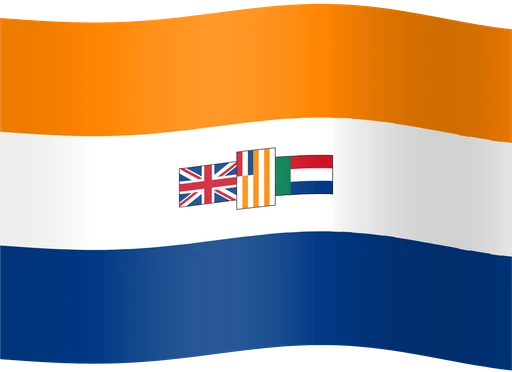
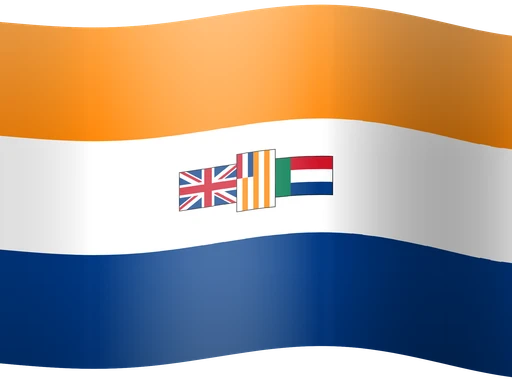
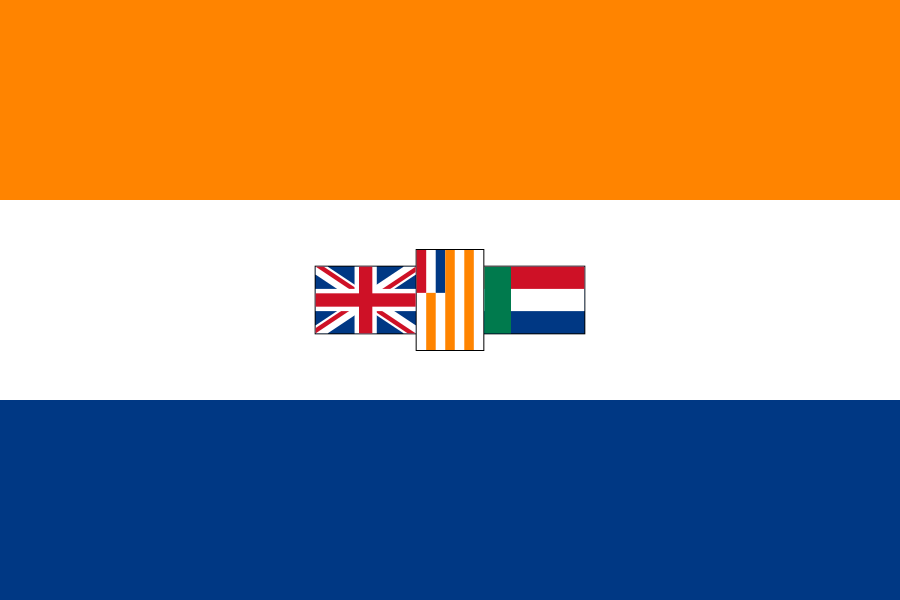
National flag of the Union and Republic of South Africa, 1928 to 1994
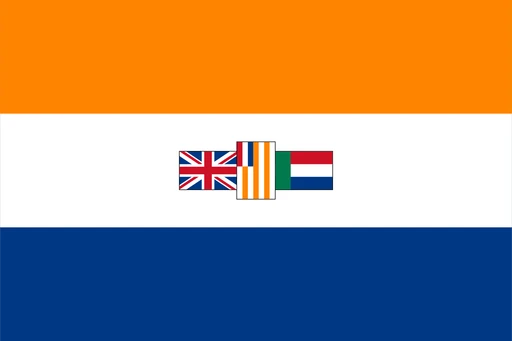
The old flag of South Africa was the national flag from 1928 to 1994. It has three equal horizontal stripes of orange, white and blue, with three small flags in the middle of the white stripe. The Union Jack sits toward the hoist, the vertical flag of the Orange Free State stands in the center, and the Vierkleur of the Transvaal Republic sits toward the fly. The stripes come from the Dutch Prinsenvlag. The design was a political compromise between English-speaking and Afrikaans-speaking South Africans. Today it is widely called the apartheid flag, and its public display is restricted by South African courts.
For sixty-six years the orange, white and blue flag with three tiny flags in the middle stood for South Africa. It was the work of a quarrel, not a designer. English speakers wanted the Union Jack and Afrikaners wanted it out, and the flag that ended the argument in 1928 put the Union Jack on the cloth anyway, shrunk and set beside two Boer republic flags. Politicians on both sides called it a settlement. Not all of them liked it.
Its later life is heavier than its birth. The flag flew through the apartheid years and became a symbol of that system. This page explains how it came about, what it looked like and how it is treated now.
A country with no flag of its own
South Africa was formed as the Union of South Africa in 1910, eight years after the South African War of 1899 to 1902 ended. It had no national flag, and the Union Jack filled the gap. That suited many English speakers. Many Afrikaners, whose republics had been defeated in the war, found it unacceptable.
Talk of a national flag came and went. In 1925 D. F. Malan introduced a bill to create one, and the debate became a long political crisis. Natal threatened to secede if the Union Jack was removed. The Balfour Declaration of 1926, which gave the dominions control of their own affairs, made the question harder to avoid.
Design No. 2 and the revolt
The government's bill came to the House of Assembly in May 1927. Speakers described the flag it offered as "Design No. 2," a green flag with a red cross, with the Union Jack flown on only four days a year. Mr. Nieuwenhuize of Lydenburg called it "deadly neutral." Mr. Anderson of Natal asked the government to build a solution "on the basis of inclusion, not exclusion." Mr. O'Brien warned that the bill, if passed, would "prove a source of bitterness and sorrow."
Feeling ran high outside Parliament. On 21 June 1927 Afrikaner nationalists rebelled against plans to put the Union Jack at the center of the national flag.
Peace with honour
The break came on 26 October 1927. The Prime Minister told the House of Assembly he had reached a settlement with the Leader of the Opposition. The shield would be dropped. The national flag would carry the Union Jack and the two old republican flags, with the Free State flag hanging "vertically in the centre." The Union Jack would also fly from Parliament, the provincial capitals and seaports.
General Smuts called it "peace with honour." He said, "We have now two flags," one for national sentiment and one for imperial ties. The Minister of the Interior said that "victory does not rest with the one side nor with the other." The Union Nationality and Flags Act came into force on 31 May 1928, and the two flags went up together at Parliament in Cape Town and the Union Buildings in Pretoria.
Three flags on a stripe
The base was the Prinsenvlag, a Dutch orange, white and blue tricolor and the first flag raised in what became South Africa. The three stripes are equal, and the flag is 2:3. Three smaller flags sit in the middle of the white stripe. The Union Jack lies toward the hoist, the Orange Free State flag stands upright in the center and the Transvaal Vierkleur lies toward the fly.
The blue gave trouble. Flags made in Britain used a dark shade, and in 1982 the government specified a lighter blue called Solway blue. The master image on this page shows the original dark shade.
Not everyone liked the result. Nationalists called the cluster of small flags a scab, and said it would one day fall off.
Flying through the apartheid years
The Union Jack stopped flying as a second national flag on 6 April 1957, when the Flags Amendment Act left the orange, white and blue as the only national flag. It stayed in use after South Africa became a republic in 1961. Pupils at Afrikaans schools saluted it every day, and it appeared in the corner of military, prison and police flags until 1994. C. J. Langenhoven wrote a flag song for it, the "Vlaglied."
Because it was the flag of the apartheid state, black South Africans came to associate it with the system. When negotiations to end apartheid began, the ANC asked that its use fade and that a new flag be made. The Transitional Executive Council approved a replacement designed by Fred Brownell on 15 March 1994. The new flag was raised on 27 April 1994 and the old flag came down for the last time at Parliament in Cape Town.
What the old flag means now
Some white South Africans still fly it as a symbol of Afrikaner heritage. White supremacists in South Africa and abroad have used it too, and Dylann Roof was pictured wearing patches of it before the 2015 Charleston shooting. In 2012 the flag was taken down from the Castle of Good Hope in Cape Town and moved into the museum.
The courts have now drawn a line. In August 2019 the Equality Court declared its gratuitous public display to be hate speech, with exceptions for academic, journalistic, artistic and museum uses. In 2023 the Supreme Court of Appeal partly upheld that ruling, finding gratuitous display unlawful without deciding the question for private display.
References
[1] "Flag of South Africa (1928-1994)," Wikipedia. https://en.wikipedia.org/wiki/Flag_of_South_Africa_(1928–1994)
[2] "South Africa: Old National Flag 1928-1994," Flags of the World. https://www.crwflags.com/fotw/flags/za_old.html
[3] Parliament of South Africa, House of Assembly debates, 30 May 1927, on the South Africa Nationality and Flag Bill. https://www.hansards.org.za/hoa/debates/hoa-Vol9-1927-05-30.html
[4] Parliament of South Africa, House of Assembly debates, 26 October 1927, on the Union Nationality and Flag Bill. https://www.hansards.org.za/hoa/debates/hoa-Vol10-1927-10-26.html
[5] South African History Online, entry on the origins of the 1928 flag. https://www.sahistory.org.za/node/85934
Common questions
- What does the old South African flag look like?
- It has three equal horizontal stripes of orange, white and blue. In the center of the white stripe sit three small flags. The Union Jack is on the hoist side, the vertical flag of the Orange Free State is in the middle, and the Transvaal Vierkleur is on the fly side. The proportions are 2:3.
- Why did the old South African flag include the Union Jack?
- It was a compromise. English-speaking South Africans, especially in Natal, wanted the Union Jack kept. Afrikaners saw it as a symbol of British rule. Placing it beside the flags of the two defeated Boer republics gave each side a place on the flag, and the Union Jack also kept flying separately until 1957.
- Where did the orange, white and blue stripes come from?
- They come from the Prinsenvlag, a Dutch orange, white and blue tricolor described as the first flag raised in what became South Africa. It was a base neither the British nor the Boer side owned.
- When did South Africa stop using the old flag?
- The new national flag replaced it on 27 April 1994, the day of the first democratic election. The old flag was retired because many South Africans linked it with apartheid and Afrikaner nationalism, and the African National Congress had asked for a new flag.
- Is the old South African flag banned today?
- Not outright. In August 2019 the Equality Court ruled that gratuitous public display of the flag is hate speech, with exceptions for academic, journalistic, artistic and historical uses. In 2023 the Supreme Court of Appeal partly upheld that ruling and did not decide on private display.
Download this flag
Free in 12 styles, from 32px icons up to 2000px, as SVG, PNG, WebP and JPG.