The Flag of Montreal
Ville de Montréal
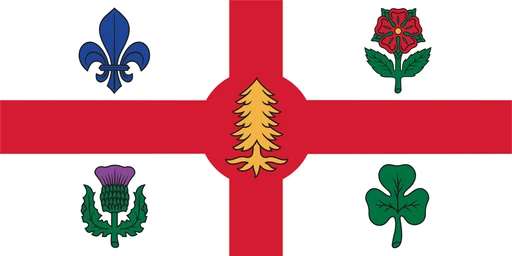
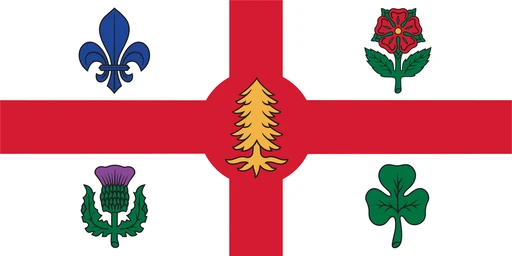
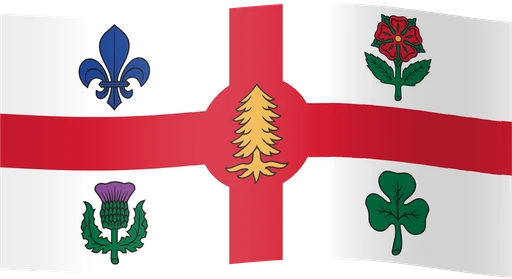
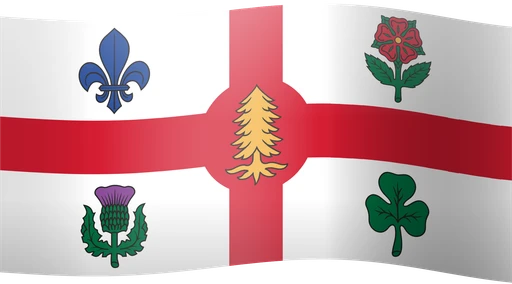
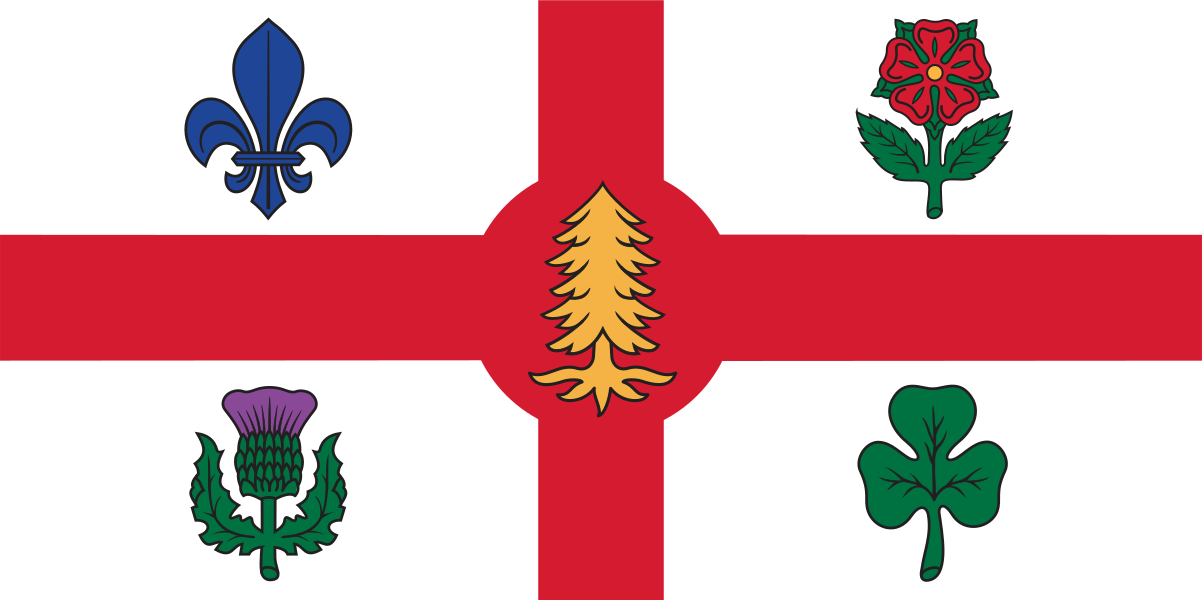
The flag of Montreal is white with a red cross that reaches all four edges. A red disc sits where the arms meet, and on it stands a white pine drawn in gold. Each white quarter holds a plant: a blue fleur-de-lis at the upper hoist, a red rose at the upper fly, a purple thistle at the lower hoist and a green shamrock at the lower fly. The city says the five emblems stand for five founding peoples. The pine is for Indigenous peoples, the fleur-de-lis for the French, the rose for the English, the thistle for the Scots and the shamrock for the Irish. The proportions are 1:2.
Montreal's flag is the shield from its coat of arms stretched to twice its height. A red cross divides a white field into four quarters, and each quarter holds a plant: a fleur-de-lis, a rose, a thistle and a shamrock. Since 2017 a fifth plant, a white pine, has stood on a red disc at the centre. The city reads the five as a list of the peoples who founded it. In 184 years the shield behind it has been redrawn twice.
A beaver where the lily is now
The design began as a coat of arms. Montreal's council adopted it in 1833, when Jacques Viger was the city's first mayor. The council minutes of July 19, 1833, record the details. The shield was white with a red saltire, a diagonal cross. A rose sat in the top quarter for the English. A thistle stood for the Scots and a shamrock for the Irish. In the bottom quarter a beaver lay on a log. The Canadian Heraldic Authority's register says the beaver stood for the French settlers who reached the island in the 17th century.
The motto was "Concordia Salus," which the register translates as "Salvation through harmony." It has survived every revision.
In March 1938 the city redrew the arms. Conrad Archambault, the city's chief archivist, designed the new version. The saltire turned upright and became a cross. The beaver left the shield and moved to the crest above it. A blue fleur-de-lis took its place and its job of standing for the French. A wreath of sugar maple leaves went around the shield.
From shield to flagpole
The flag came a year later. In May 1939 a banner of the revised arms became the flag of Montreal. A contributor to Flags of the World links the timing to the visit of King George VI that spring. Vexillologist Luc Baronian, who wrote the Montreal entry in the 2011 survey Canadian City Flags, lists the flag's designer as unknown.
Baronian describes the flag this way. The field is white, which recalls Viger's original arms. The bars of the cross are one quarter of the flag's height and run to the edges. The fleur-de-lis is blue and sits at the upper hoist. The rose at the upper fly is red with a green stem. The thistle at the lower hoist is purple and green. The shamrock at the lower fly is green. All four are outlined in black. The flag is twice as long as it is tall.
The cross looks like England's Cross of St. George, and a 1981 article in Heraldry in Canada called it that. The city's own text did not. It described the cross as "emblematic of the Christian motives and principles which governed the founders of the city." The register entry for the current arms says the same thing in fewer words. The rose is the flag's English symbol.
The fifth emblem
For 78 years the flag named four peoples, all of them European. On February 12, 2017, during the city's 375th anniversary year, Mayor Denis Coderre announced that the flag would gain a First Nations symbol. La Presse reported two days later that Indigenous people would choose it.
The Assembly of First Nations Quebec-Labrador named an advisory committee. Its members were Mohawk, Anishinaabe and Innu, from both urban communities and reserves, joined by a representative of the Centre d'histoire de Montréal. The Canadian Heraldic Authority assisted the committee throughout its meetings. The committee chose the white pine.
Coderre and Ghislain Picard, Chief of the Assembly, unveiled the new arms and flag on September 13, 2017. The date was the 10th anniversary of the United Nations Declaration on the Rights of Indigenous Peoples. The city says the pine symbolises the Tree of Peace and "represents peace, harmony and concord." It also calls the pine "the only indigenous plant element in the city's coat of arms." Picard thanked the committee for a symbol of "our unity and cultures on this First Nation unceded territory."
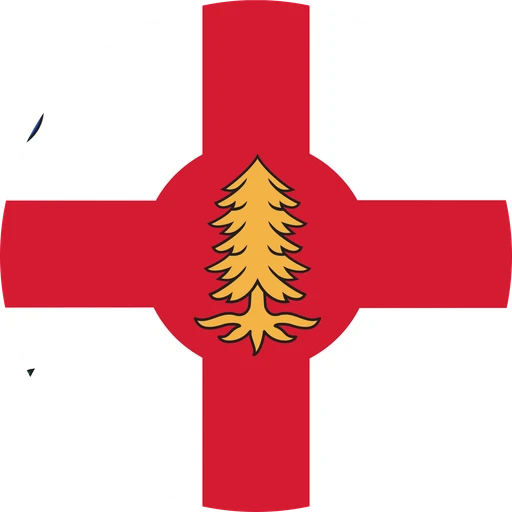
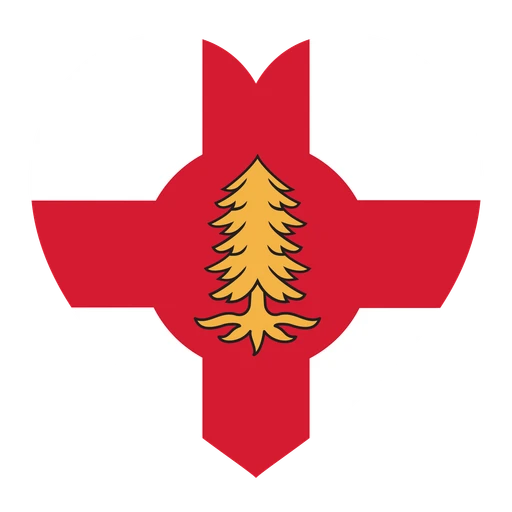
The pine does not take a quarter of its own. It stands on a red disc laid over the crossing of the arms, at the middle of the flag. On the flag it is drawn in gold with a black outline.
The paperwork followed twelve days later. The Canadian Heraldic Authority issued a grant of arms and flag on September 25, 2017, entered in volume VI, page 750 of the Public Register of Arms, Flags and Badges of Canada. On the same day it registered the 1833 and 1938 arms on the two pages before. The register credits the 2017 concept to Claire Boudreau, Chief Herald of Canada, following the committee's proposal, and names Robert Grey as the painter. The Canada Gazette announced the letters patent on March 31, 2018.
Two red and white flags
You will see a second Montreal flag in old photographs. The city adopted a logo in 1981 and updated it in 2003. A flag with that logo in white on red was popular in the 1980s. Baronian notes it was rarely seen afterwards.
The heraldic flag is the one in the Public Register. Its entry there is short. The register describes the flag as a banner of the arms and sends you back to the shield for the symbolism, which is where the design started in 1833.
References
[1] "Montréal's flag and coat of arms," Ville de Montréal. https://montreal.ca/en/articles/montreals-flag-and-coat-arms-38303
[2] "Ville de Montréal: Grant of Arms and Flag, September 25, 2017, Vol. VI, p. 750," Public Register of Arms, Flags and Badges of Canada, Governor General of Canada. https://www.gg.ca/en/heraldry/public-register/project/2960
[3] "Ville de Montréal: Registration of Arms (1938), Vol. VI, p. 749," Public Register of Arms, Flags and Badges of Canada, Governor General of Canada. https://www.gg.ca/en/heraldry/public-register/project/2959
[4] "Ville de Montréal: Registration of Arms (1833), Vol. VI, p. 748," Public Register of Arms, Flags and Badges of Canada, Governor General of Canada. https://www.gg.ca/en/heraldry/public-register/project/2958
[5] "Reconciliation with Indigenous Peoples - Montréal unveils its new coat of arms and its new flag," Ville de Montréal, CNW Telbec, September 13, 2017. https://newswire.ca/news-releases/reconciliation-with-indigenous-peoples---montreal-unveils-its-new-coat-of-arms-and-its-new-flag-644173943.html
[6] "Tree of Peace represents Indigenous founders of Montréal," Windspeaker, September 14, 2017. https://windspeaker.com/news/windspeaker-news/tree-of-peace-represents-indigenous-founders-of-montreal
[7] "Montréal, Quebec (Canada)," Flags of the World. https://crwflags.com/FOTW/FLAGS/ca-qcmtr.html
[8] Luc Baronian, "Montréal," in Canadian City Flags, Raven: A Journal of Vexillology 18, North American Vexillological Association (2011).
[9] "Flag of Montreal," Wikipedia. https://en.wikipedia.org/wiki/Flag_of_Montreal
[10] "Coat of arms of Montreal," Wikipedia. https://en.wikipedia.org/wiki/Coat_of_arms_of_Montreal
Common questions
- What do the symbols on the Montreal flag mean?
- The city names five founding peoples, one per emblem. The white pine at the centre stands for Indigenous peoples. The blue fleur-de-lis stands for the French, the red rose for the English, the thistle for the Scots and the shamrock for the Irish. The Canadian Heraldic Authority's register says the red cross reflects the Christian principles behind the city's founding.
- Why is there a pine tree on the Montreal flag?
- Montreal added the white pine on September 13, 2017, to recognise Indigenous peoples among the city's founders. The city says the tree symbolises the Tree of Peace and "represents peace, harmony and concord." An advisory committee named by the Assembly of First Nations Quebec-Labrador chose it. The committee had Mohawk, Anishinaabe and Innu members, along with a representative of the Centre d'histoire de Montréal.
- When was the Montreal flag adopted?
- The current flag was unveiled on September 13, 2017, and the Canadian Heraldic Authority granted it on September 25, 2017. The version before it, the same design without the pine and red disc, became the city flag in May 1939. Both are banners of the city's coat of arms, which dates back to 1833.
- Who designed the Montreal flag?
- No single designer is credited. The flag copies the shield of the city's arms. Jacques Viger, the first mayor, was behind the 1833 arms. Conrad Archambault, the city's chief archivist, designed the 1938 revision. The Canadian register credits the 2017 version to Claire Boudreau, Chief Herald of Canada, working from a proposal by the First Nations committee. Vexillologist Luc Baronian lists the designer of the 1939 flag itself as unknown.
- Is the red cross on the Montreal flag the St. George's Cross?
- It looks like one, and a 1981 article in Heraldry in Canada called it the Cross of St. George. The city's own text did not. It described the cross as "emblematic of the Christian motives and principles which governed the founders of the city," and the Canadian register repeats that reading. England is represented on the flag by the red rose.
- What did the Montreal flag look like before 2017?
- From May 1939 to September 2017 the flag had the same red cross on white and the same four plants, with nothing at the centre. The 2017 change added a red disc over the crossing and set a white pine on it. Before 1938 the city's arms used a red diagonal cross and a beaver where the fleur-de-lis is now.
Download this flag
Free in 12 styles, from 32px icons up to 2000px, as SVG, PNG, WebP and JPG.