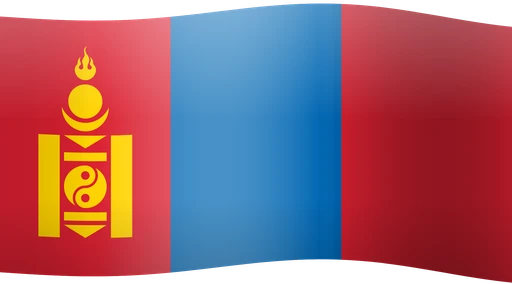
The Flag of Mongolia
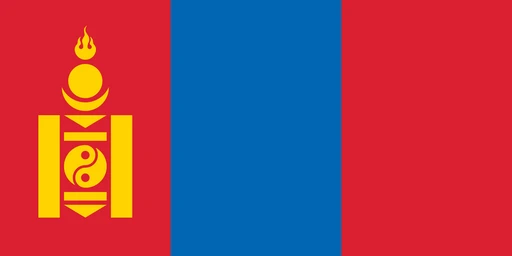
The flag of Mongolia is three vertical stripes: red at the hoist, blue in the center, red at the fly. On the hoist stripe sits the yellow Soyombo, the national emblem, which stands for freedom and independence among other things. Blue is the sky, and red stands for progress and prosperity.
Mongolia's flag rewards a long stare. It is a tricolor of red and blue with a column of sacred symbols on the hoist stripe, and it has survived empire, communist revolution, and democratic transition. That column is the Soyombo, a golden glyph invented by a 17th-century Buddhist monk that packs fire, sun, moon, earth, water, and the yin-yang into a single emblem. It is not a coat of arms or a geometric device. It is a statement about the cosmos and about human society, set on a flag.
The Soyombo, a monk's invention
In 1686, Zanabazar designed the Soyombo as a character in a writing system he had invented to transcribe Sanskrit, Tibetan, and Mongolian. He was Mongolia's foremost spiritual leader, a sculptor, and the first Jebtsundamba Khutuktu, head of Mongolian Buddhism. The Soyombo is unusual among flag symbols in having a direct linguistic origin: it started as a letter.
Look at the Soyombo from top to bottom and you're reading a layered cosmological diagram. Three tongues of flame crown the symbol, representing the prosperity of past, present, and future. Below them, a crescent moon cradles a sun, evoking the sky and Mongolia's cosmic origins. Two horizontal rectangles signify honesty and justice. Two fish, eyes perpetually open, represent wisdom and vigilance (fish, after all, never blink). Two vertical rectangles form the walls of a fortress, symbolizing unity and the collective strength of the Mongolian people. At the center sits a taijitu, the yin-yang-like form representing the complementary forces of male and female, opposition and interdependence.
Taken together, the cumulative meaning is often interpreted as a single declaration: "The freedom and independence of the Mongolian people will last forever."
Zanabazar was both a spiritual and a political figure, and the symbol carried national resonance from the moment it appeared. Because it predates Mongolia's modern statehood by more than two centuries, it gives the flag a continuity few nations can match.
From khans to communists
Mongolia declared independence from the Qing Dynasty in 1911, initially rallying around Buddhist and dynastic imagery tied to the Bogd Khan theocratic monarchy. Those early symbols were religious and dynastic. But the Mongolian Revolution of 1921, backed by Soviet forces, upended everything. The country became the Mongolian People's Republic, and flag design became an ideological battleground.
Early communist-era flags from 1924 onward experimented with red fields and Soviet-style imagery. Various iterations cycled through the 1930s and 1940s, each reflecting shifting political winds in Ulaanbaatar and Moscow. Yet through all of this, the Soyombo survived. It wasn't purged the way Buddhist temples were. The communists found utility in its pre-existing role as a marker of Mongolian identity, reinterpreting it through a secular, nationalistic lens rather than a purely Buddhist one. A pragmatic move, and a lucky one for the symbol's survival.
By 1940, a five-pointed gold star had been added above the Soyombo on the flag, signaling communist alignment with the Soviet bloc. That star remained for over fifty years.
Then came 1990. Mongolia's peaceful Democratic Revolution, one of the lesser-known democratic transitions of the era, swept away one-party rule without bloodshed. The new constitution, adopted in 1992, removed the communist star from the flag. It was a decisive symbolic break with the Soviet period, but the framers kept the red-blue-red tricolor and the Soyombo intact. Exact shade specifications and proportions were formally standardized in Mongolian law following the transition.
The flag's history compresses Mongolia's whole 20th century: colonization, revolution, satellite status, and finally democratic sovereignty.
Red, blue, and gold
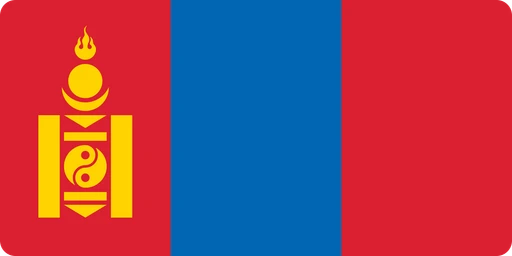
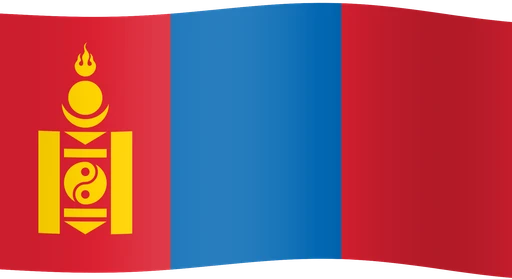
Three vertical bands structure the flag: red on the hoist side, blue in the center, red on the fly, with the golden Soyombo placed on the hoist band. Simple enough in layout. Far more complex in meaning.
The blue band, called Möngkhiin khökh ("Eternal Blue"), represents the sky and is one of Mongolia's most ancient and sacred colors. Its roots run deeper than Buddhism, all the way back to Tengriism, the shamanistic sky-worship tradition that dominated the steppe for millennia. Blue also carries the concept of eternity and the open grasslands, Mongolia's defining geographical reality. It's as much a landscape color as a symbolic one. Stand anywhere in the Mongolian countryside, and that particular blue is above you in every direction.
Red traditionally represents progress and prosperity in Mongolian culture, though it inevitably carries the historical layering of its Soviet-era communist associations. Whether that double meaning is deliberate or accidental depends on who you ask.
Gold for the Soyombo signals royalty, spiritual worth, and the Buddhist tradition Zanabazar helped establish in Mongolian life. The composition, sky blue flanked by earth red, is sometimes described as "the sky held between two flames."
Protocol, variants, and official life
Mongolia's Law on State Symbols governs the national flag with precision, specifying a 1:2 ratio, exact color codes, and proper display protocols. The flag flies permanently at the State Great Khural (parliament), the Government Palace, and presidential buildings in Ulaanbaatar, as well as at Mongolian embassies worldwide.
A state flag variant, used on official government documents and seals, incorporates the full State Emblem of Mongolia. That's a more elaborate composition featuring the Soyombo alongside a horse, the Wheel of Dharma, mountains, and a khadag, the ceremonial blue silk scarf central to Mongolian hospitality and spirituality. The Mongolian Armed Forces use separate military flags with distinct designs, though the Soyombo remains a constant thread across military and institutional heraldry.
Naadam, the national festival held every July 11th (National Day, marking the 1921 revolution), is the flag's biggest annual outing. Wrestling, archery, and horse racing take place beneath enormous ceremonial banners.
Beyond the flag itself, the Soyombo appears independently on currency, official seals, passports, and public architecture. It functions almost like a national logo, distinct from but inseparable from the flag.
Echoes and influences beyond Mongolia
Mongolia's flag is visually distinct from those of its two enormous neighbors, China and Russia, both of which have dramatically different flag traditions. That visual separation is no accident. Wedged between two continental powers, Mongolia asserts a unique cultural identity through every element of its banner.
The Inner Mongolia Autonomous Region of China, home to millions of ethnic Mongolians, uses regional symbols that echo Mongolian motifs but pointedly not the Soyombo, highlighting the political divergence between the two Mongolias. Meanwhile, the Buryat Republic and Kalmyk Republic in Russia, both home to historically Mongolic peoples, incorporate related Buddhist and steppe symbolism in their regional flags. Together, these form a loose family of visual language scattered across Central Asia.
Globally, the Soyombo has become a recognized shorthand for Mongolian identity in sports, business, and cultural organizations. The Mongolian diaspora carries it on jerseys, storefronts, and tattoos.
Vexillologists often cite Mongolia's flag as a case of complex symbolism handled without visual clutter. The vertical composition of the Soyombo against the tricolor works at both large and small scales, which many symbol-heavy flags fail to manage. It gets compared to Bhutan's flag, another Buddhist nation with a complex central device, and to Cambodia's, with Angkor Wat at its center, as examples of banners that put a civilization's identity into a single image.
References
[1] Mongolia's Law on State Symbols (Монгол Улсын Төрийн сүлд, далбааны тухай хууль), official Mongolian government legislative text.
[2] Bawden, C.R., The Modern History of Mongolia (1968, Weidenfeld & Nicolson), foundational English-language history covering the revolutionary and Soviet periods.
[3] Atwood, Christopher P., Encyclopedia of Mongolia and the Mongol Empire (2004, Facts on File), authoritative reference on Mongolian culture, history, and symbols.
[4] Heissig, Walther, The Religions of Mongolia (1980, University of California Press), covering Zanabazar, the Soyombo alphabet, and Mongolian Buddhism.
[5] FOTW (Flags of the World), fotw.info/flags/mn.html, vexillological database with historical flag variants and specification details.
[6] Smith, Whitney, Flag Lore of All Nations (2001, Millbrook Press), accessible vexillological reference with entry on Mongolia.
[7] Mongolian Embassy, Washington D.C., mongolianembassy.us, for current official flag usage protocols.
Common questions
- What is the Soyombo on Mongolia's flag?
- The Soyombo is Mongolia's national emblem, shown in yellow on the red stripe at the hoist. It is a column of symbols including fire, sun, moon, two triangles and two horizontal bars, together standing for freedom and independence. It comes from the Soyombo script, devised in the 17th century.
- What do the colours on the Mongolian flag mean?
- Blue in the centre is the eternal blue sky, a long-standing symbol in Mongolian culture. The red stripes on either side stand for progress and prosperity. Under the socialist period the red carried explicitly communist associations, which the 1992 flag quietly dropped without changing the colours.
- When did Mongolia adopt its current flag?
- On 12 February 1992, after the country's transition to democracy. The basic elements go back to 1940, when a version with the Soyombo but different colour arrangement was adopted. The 1992 change removed the socialist star above the Soyombo and marked the move away from Soviet influence.
- What was removed from Mongolia's flag in 1992?
- A gold socialist star that had sat above the Soyombo since 1945. Its removal was the visible part of the 1992 revision, alongside adjustments to the Soyombo's proportions. The rest of the design, including the three vertical stripes, was kept.
Featured in these articles
Download this flag
Free in 12 styles, from 32px icons up to 2000px, as SVG, PNG, WebP and JPG.