The Flag of the Gambia
Republic of the Gambia
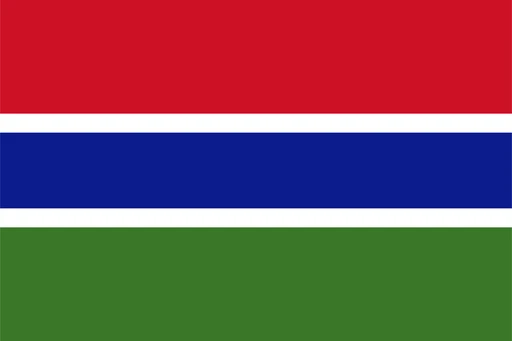
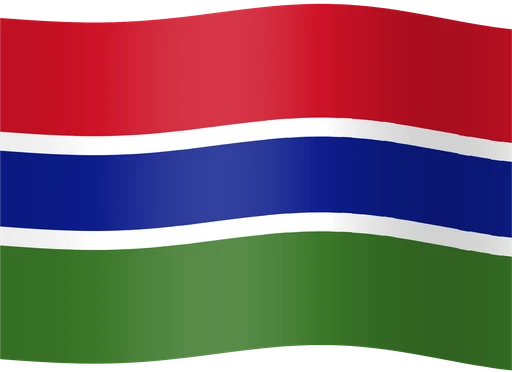
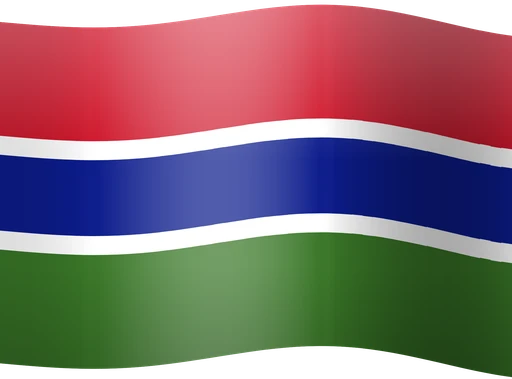
The national flag of the Gambia has three horizontal stripes of red, blue, and green, separated by two thin white stripes. Red is the sun and the savannahs, blue the Gambia River that runs through the country, and green its forests and farmland. The white stripes stand for peace and unity.
Few national flags are as geographically honest as the Gambia's. Three horizontal stripes of red, blue, and green, each separated by thin white bands, form a cross-section of the country itself: sun-scorched savannah above, a great river running through the middle, and forest below. Adopted at independence from Britain in 1965, it has not changed once in six decades.
The geography hidden in the stripes
Look at a map of the Gambia and then at its flag. The country is a narrow sliver of land, rarely more than 50 kilometers wide, carved entirely around the course of the Gambia River as it winds westward to the Atlantic. The river is not just an economic resource or a convenient waterway. It is the country: every border, every town, every trade route exists because of it. So the blue stripe sitting dead center on the flag is closer to cartography than to symbolism.
Above the blue, a broad red stripe represents the sun and the savannah, the dry, hot lands stretching along the river's northern banks. Below it, green stands for the forests and agricultural land to the south. Read top to bottom, the flag is a portrait of the actual landscape.
The narrow white stripes separating each color represent unity and peace, the bonds that hold the riverbank communities together. They also work visually as the riverbanks themselves, the transitional zones where land meets water and where much of Gambian commerce and social life takes place.
The flag's birth at independence
The Gambia gained independence from Great Britain on February 18, 1965, one of the last British colonies in West Africa to lower the Union Jack. On that day the new flag rose for the first time, replacing the colonial Blue Ensign that had been defaced with the Gambian coat of arms.
What is unusual is what happened afterwards, or rather what did not. Many newly independent African nations changed their flags following coups, revolutions, or shifts in political ideology. The Gambia had its own dramatic rupture when Yahya Jammeh seized power in a military coup in July 1994, overthrowing the long-serving President Dawda Jawara. The flag stayed. Through Jammeh's 22-year rule, through his departure in 2017 following electoral defeat and an ECOWAS military intervention, and through the democratic transition that followed, the same three stripes kept flying.
It is worth glancing next door. Senegal surrounds the Gambia on three sides, and the two countries share deep ethnic and cultural ties, yet their flags are strikingly different. Senegal's green, yellow, and red tricolor with a central green star is a classic Pan-African design. The Gambia's palette sets it visually apart despite the geographic intimacy.
Red, blue, green, and white
Precise official color specifications for the Gambian flag, in Pantone or equivalent standards, are not consistently published, which is common for smaller nations. In practice the red tends toward a warm, earthy tone rather than a bright scarlet, the blue is a medium royal blue, and the green is a deep forest shade.
Red speaks to the sun and the savannah, and by extension to the strength and endurance of the Gambian people. Blue is the Gambia River, and its central placement mirrors the river's importance to agriculture, trade, transport, and daily life. Green covers the forests, fields, and natural resources of the interior and the south. White, threading between the others, represents peace, unity, and purity, while doubling as those literal riverbanks.
What makes the palette distinctive in a West African context is the blue. Many neighboring flags draw on the Pan-African scheme of red, gold or yellow, and green, popularized by Ghana's independence flag in 1957, and Guinea, Mali, Senegal, and Cameroon all use variations. The Gambia sidesteps it entirely. No gold, no star, no Pan-African tricolor formula.
Official use, protocol, and national days
The Gambian flag flies at all government buildings, embassies, and official institutions year-round. Its most prominent public display comes on Independence Day, February 18, when streets and public squares across Banjul and the rest of the country fill with red, blue, and green.
The Republic of The Gambia Armed Forces uses the national flag in most contexts, though specific military and naval ensigns have been used at various points, following patterns common among former British colonies. The presidential standard incorporates the national coat of arms. During national mourning the flag is flown at half-mast, following conventions similar to those across the Commonwealth.
International sport has given the flag growing visibility. Gambian footballers competing in European leagues, and the national team's qualification for the Africa Cup of Nations in 2021, their first, brought it to millions of new viewers. At the Olympics, Gambian athletes have carried it since 1984. Among the Gambian diaspora, particularly in the UK, Spain, and the United States, it is a common marker of community identity at cultural events.
A small flag in a large neighborhood
The Gambia is entirely enclosed by Senegal apart from a short Atlantic coastline. Despite deep cultural, ethnic, and linguistic ties between the two countries, their flags share almost nothing visually. Senegal's green, yellow, and red tricolor with its central star belongs firmly to the Pan-African tradition. The Gambia's blue-centered design occupies its own space.
Across West Africa, flags tend to cluster around shared palettes. Guinea and Mali use near-identical red, yellow, and green arrangements. Guinea-Bissau adds a black star on a red vertical band. Sierra Leone opts for green, white, and blue. Mauritania recently added red stripes to its green and gold.
Vexillologists tend to rate the Gambian flag highly on classic design principles: simple, meaningful, distinctive, and reproducible at any scale. A child could draw it from memory. That matters in a country where national identity coexists with strong ethnic affiliations. Mandinka, Fula, Wolof, Jola, and Serahuli communities all maintain distinct cultural identities, and Islam is the predominant faith for roughly 95% of the population. The flag does not try to represent any single group. It represents the river and the land around it.
References
[1] Government of The Gambia, Office of the President (statehouse.gov.gm). Official flag specifications and national symbols documentation.
[2] Flags of the World (FOTW), "The Gambia". Fotw.info/flags/gm.html. Comprehensive vexillological database with historical variants and construction details.
[3] The Flag Institute (UK), flaginstitute.org. Authoritative records on Commonwealth and former-Commonwealth nation flags.
[4] Smith, Whitney. Flags Through the Ages and Across the World (McGraw-Hill, 1975). Classic vexillological reference covering African independence-era flag designs.
[5] Hughes, Arnold. The Gambia, African Historical Dictionaries series (Scarecrow Press). Historical context around independence and flag adoption.
[6] Saine, Abdoulaye. The Paradox of Third-Wave Democratization in Africa: The Gambia Under AFPRC-APRC Rule (Lexington Books, 2009). Political context of flag continuity through the 1994 coup and subsequent transitions.
[7] Wiseman, John A. Political Leaders in Black Africa (Edward Elgar, 1991). Political history surrounding flag continuity.
[8] United Nations Cartographic Section. Official maps confirming the Gambia River's geographic centrality.
Common questions
- What do the colors on the Gambian flag mean?
- Red is the sun and savanna, blue is the Gambia River, and green is forests and farmland. The white lines stand for peace and unity among the country's ethnic groups.
- Who created the Gambian flag?
- The Gambian flag was created by Louis Thomasi, a Gambian civil servant and artist. It has been the national emblem since February 18, 1965, the date of independence from British rule.
- Why does the blue stripe on the Gambian flag represent the river?
- The blue stripe is the Gambia River, which the country depends on for transport, farming, and much of its biodiversity.
- What does the blue stripe in the middle of the Gambia flag represent?
- The blue stripe is the Gambia River, which basically defines the entire country. The Gambia is a thin strip of land that exists because of this river. The flag's layout mirrors the geography: red for the savannah on top, blue for the river in the middle, and green for the forest on the bottom.
Download this flag
Free in 12 styles, from 32px icons up to 2000px, as SVG, PNG, WebP and JPG.