The Flag of Equatorial Guinea
Republic of Equatorial Guinea
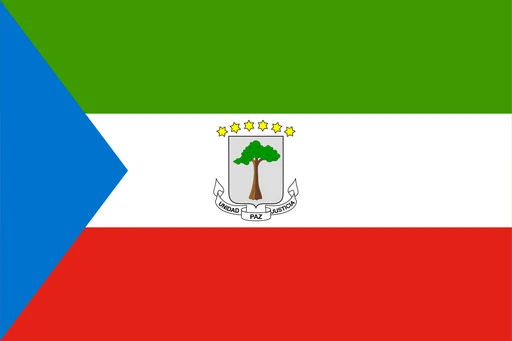
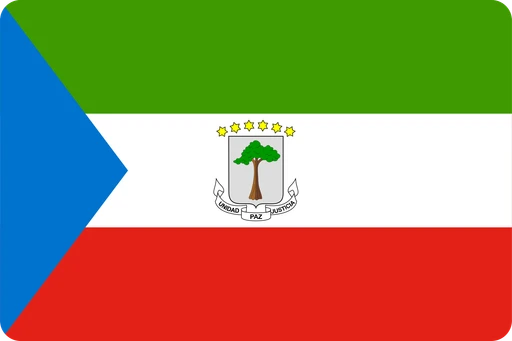
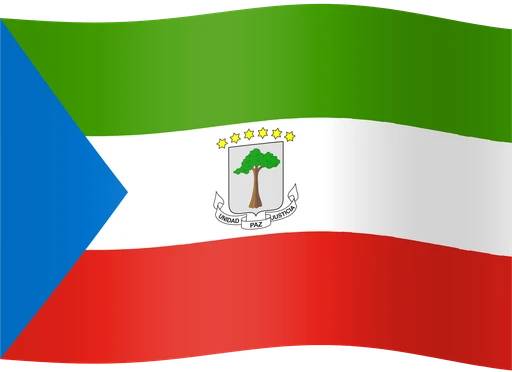
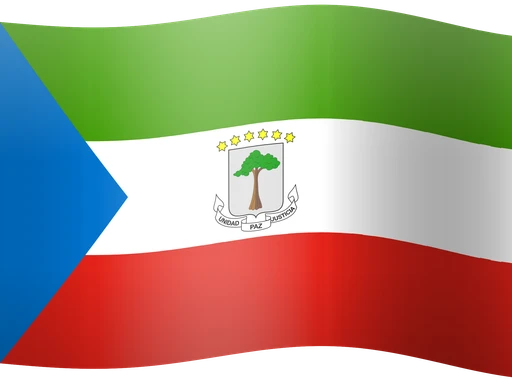
The flag of Equatorial Guinea consists of three horizontal stripes of green, white, and red, with a blue triangle based at the hoist. At the center of the white stripe is the national coat of arms, which features a silk cotton tree, a symbol of the country, along with the motto 'Unidad, Paz, Justicia' (Unity, Peace, Justice) inscribed on a banner. The green symbolizes the natural resources and jungles of the country, the white stands for peace, the red represents the struggle for independence, and the blue triangle signifies the sea, which connects the different parts of the country.
Few national flags tell a story as specific as Equatorial Guinea's. At its center sits a silk-cotton tree, six gold stars arcing above it, a motto scrolled beneath, all set on a tricolor that maps the country's geography in color. It was adopted the same day the nation declared independence from Spain in 1968, and in the decades since it has been altered by a dictator and then restored.
The tree that witnessed a nation's birth
Equatorial Guinea gained independence from Spain on October 12, 1968, and the flag was raised for the first time that very day. The timing was deliberate. A new country needed a new symbol, immediately.
Before independence, the territory was known as Spanish Guinea, one of Spain's few sub-Saharan African colonies. It comprised two geographically disconnected pieces: Río Muni on the mainland, wedged between Cameroon and Gabon, and the island of Bioko (then called Fernando Poo) sitting in the Gulf of Guinea some 160 kilometers off the coast. The flag's design emerged during the independence negotiations of the late 1960s, driven by the need to create something visually distinct from Spain while encoding the new nation's foundational myths.
What happened next is one of the stranger chapters in African vexillology. Under dictator Francisco Macías Nguema, who ruled from 1968 to 1979, the coat of arms was stripped from the flag and replaced with a red rooster, a symbol tied to Macías's personal cult. The national motto was changed to something far less aspirational. It was one of the most dramatic flag alterations in post-colonial African history, turning a national emblem into a dictator's personal branding exercise.
When Macías was overthrown in a 1979 coup led by his nephew Teodoro Obiang Nguema Mbasogo, the original coat of arms and motto were promptly restored. The flag became a marker of political liberation layered on top of its original meaning as a marker of national independence. The 1982 constitution formally enshrined the current design, giving it legal permanence and closing the door on the Macías-era alterations.
Six stars and a ceiba tree
The coat of arms rewards close attention. Set on a silver shield at the center of the white band, a silk-cotton tree (Ceiba pentandra) rises with its canopy spread wide. Above it, six gold five-pointed stars arc in a gentle curve.
That tree isn't generic. It references the specific ceiba under which the 1778 Treaty of El Pardo was signed between Spain and Portugal, the agreement that ceded the territory now known as Equatorial Guinea to Spanish control. There's something quietly subversive about reclaiming a tree rooted in colonial transaction as a national symbol. The very object that witnessed foreign powers carving up African land now anchors the identity of the nation those people built for themselves.
The six stars are equally precise. Each one represents a territorial unit: Río Muni (the mainland), Bioko, Annobón, Corisco, Elobey Grande, and Elobey Chico. The arrangement is closer to a map than a decoration, and it is a reminder that the country exists in fragments scattered across ocean and coast.
Below the shield, a ribbon bears the national motto: UNIDAD, PAZ, JUSTICIA (Unity, Peace, Justice). Those words took on sharper meaning after the Macías years, during which unity meant obedience, peace meant silence, and justice was nonexistent. The motto Macías imposed reportedly included the phrase "There Is No Other God Than Macías Nguema," turning the flag's scroll into a statement of personal deification. Removing that language in 1979 was one of the new government's first acts.
Between them, the tree, the stars, and the motto give the country's history, its geography, and its stated ambitions in a single emblem.
Stripes across sea and land
The flag's background is a horizontal triband of green, white, and red, with a blue equilateral triangle projecting from the hoist side. Each element pulls double duty as both aesthetic choice and geographic statement.
Green covers the top stripe, representing the country's natural wealth: its dense tropical rainforests, its cacao and coffee plantations, the biological abundance of one of Africa's most biodiverse regions. White, the middle band, symbolizes peace, a meaning that carries particular weight in a country that endured extreme internal repression during its first decade of existence. Red, at the bottom, commemorates the blood shed in the struggle for independence from Spanish colonial rule.
Then there's the blue triangle. It's the flag's most geographically expressive element, representing the Atlantic Ocean. This isn't incidental scenery. The sea physically separates Equatorial Guinea's mainland from its islands. The ocean is the space between the nation's own body parts, and the blue triangle acknowledges that water is as central to national identity as any landmass.
The color combination places Equatorial Guinea within the Pan-African palette of green, white, and red, while the ocean blue signals something distinct: a maritime, island-linked character that most of its continental neighbors don't share. The flag's proportions are fixed by national law at a 2:3 ratio.
Official use and variants
The flag with the coat of arms functions as both the national and state flag. Military and naval forces use this arms-bearing version officially, and it appears on maritime ensigns with distinctive additional features. There's no widely documented civil variant without the arms used domestically, which is unusual among nations that maintain separate civil and state flags.
As a member of the African Union, OPEC, and the United Nations, Equatorial Guinea's flag appears in multilateral diplomatic settings with surprising frequency for a country of roughly 1.5 million people. It flies at embassies worldwide, including in Madrid, a posting that carries obvious historical complexity given the colonial relationship.
National Day falls on October 12, the anniversary of independence. That date is also Spain's National Day, tied to Columbus's 1492 landfall in the Americas. The coincidence is loaded, a shared calendar square between colonizer and colonized that neither country has moved to change.
Neighbors and lookalikes
At a glance, Equatorial Guinea's tricolor could be mistaken for several other Central and West African flags. The blue triangle is the distinguishing mark, a feature shared with only a handful of world flags such as Cuba, the Czech Republic, and Sudan.
The ceiba tree on the coat of arms places Equatorial Guinea in a small club of nations whose heraldry features specific trees. Lebanon has its cedar, Belize its mahogany, Fiji its palm. Arboreal heraldry is rarer than you'd expect, and the ceiba's connection to a particular historical event makes it even more distinctive.
Those six stars, each mapping a territorial unit, echo arrangements found in flags like Australia's (representing states) or Micronesia's (representing island groups). Equatorial Guinea's version, dating to 1968, actually predates several of these modern redesigns.
Cameroon and Gabon, the country's immediate neighbors, fly the green-yellow-red palette common across the continent. Without the blue triangle and coat of arms, Equatorial Guinea would dissolve visually into its neighbors' flags. Those two elements are doing the work of telling it apart.
The flag's history, particularly the Macías-era alterations, has made it a case study in how authoritarian regimes weaponize national symbols. Libya's plain green flag under Gaddafi is the most famous example, but Equatorial Guinea's story is arguably more instructive: the original design survived, was defaced, and was restored, all within eleven years. The flag outlasted the dictator who tried to remake it in his own image.
References
[1] Constitución de la República de Guinea Ecuatorial (1982). Official constitutional text specifying flag design, coat of arms, and proportions.
[2] Gobierno de la República de Guinea Ecuatorial. Official government portal. www.guineaecuatorialpress.com
[3] Smith, Whitney. Flags Through the Ages and Across the World. McGraw-Hill, 1975. Foundational vexillology reference covering global flag history and design.
[4] Fegley, Randall. Equatorial Guinea: An African Tragedy. Peter Lang, 1989. Documents the Macías era, including flag alterations and political symbolism.
[5] Flags of the World (FOTW). Detailed vexillological data, historical variants, and usage notes. www.crwflags.com/fotw/flags/gq.html
[6] Liniger-Goumaz, Max. Small Is Not Always Beautiful: The Story of Equatorial Guinea. Hurst & Co., 1988. Historical context for post-independence national symbols.
[7] Flag Institute (UK). Peer-reviewed vexillological records on African flags. www.flaginstitute.org
[8] Treaty of El Pardo (1778). Original treaty text in Portuguese and Spanish archives, providing historical grounding for the ceiba tree symbolism.
Common questions
- Why is there a tree on Equatorial Guinea's flag?
- The silk-cotton tree refers to the ceiba under which the 1778 Treaty of El Pardo was signed, the agreement that handed the territory to Spain. The country took a tree from its colonial past and made it the center of its coat of arms.
- What do the six stars on the Equatorial Guinea flag stand for?
- The six stars symbolize the country's makeup: the mainland and its five major islands.
- What do the 6 stars on the Equatorial Guinea flag represent?
- The six stars each stand for one of the country's territorial units: Río Muni on the mainland, plus the islands of Bioko, Annobón, Corisco, Elobey Grande, and Elobey Chico. It's basically a star map of the nation's geography.
- Why is there a blue triangle on the Equatorial Guinea flag?
- That blue triangle is the Atlantic Ocean, which separates the mainland from the islands. It's an unusual choice for a flag, but it makes sense for a country split between ocean and land. The sea's part of what makes Equatorial Guinea, well, Equatorial Guinea.
- What does the motto on the Equatorial Guinea flag mean?
- The ribbon reads UNIDAD, PAZ, JUSTICIA (Unity, Peace, Justice). Francisco Macías Nguema's dictatorship removed those words and put his own slogan there instead, so restoring them in 1979 was a political act as much as a design decision.
Featured in these articles
Download this flag
Free in 12 styles, from 32px icons up to 2000px, as SVG, PNG, WebP and JPG.