The Flag of the DR Congo
Democratic Republic of the Congo
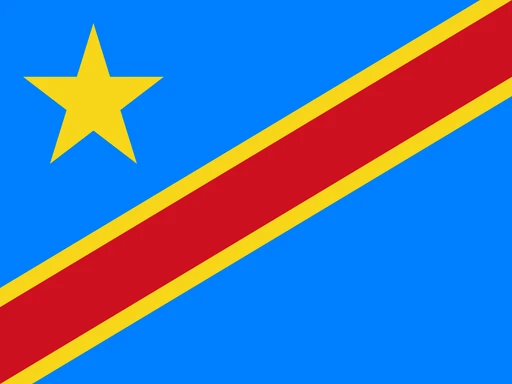
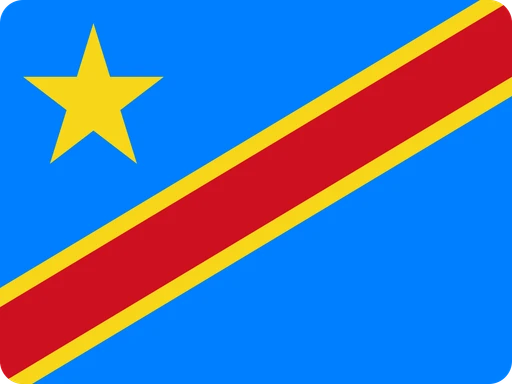
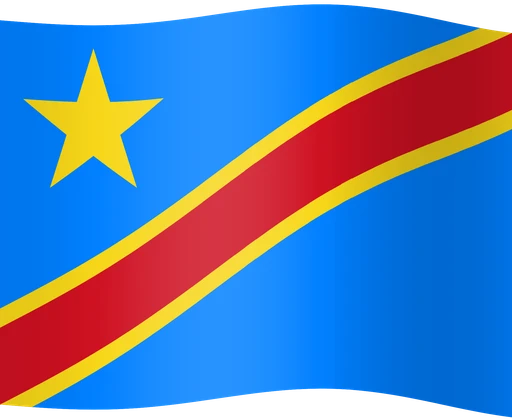
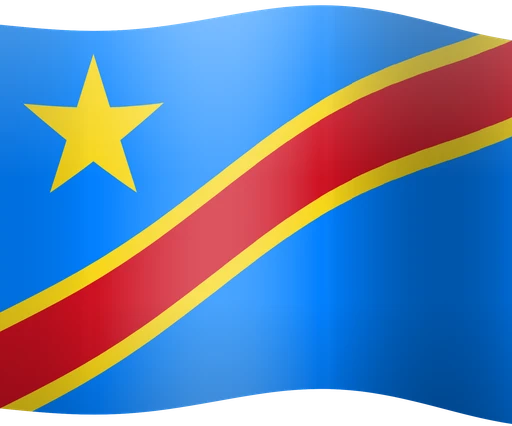
The flag of the Democratic Republic of the Congo is a sky blue field with a large yellow five-pointed star in the canton and a diagonal red stripe edged in narrow yellow stripes, running from the lower hoist side to the upper fly side. Blue stands for peace, yellow for the country's mineral wealth, and red for the blood shed for independence. The star stands for a bright future.
Few national flags have changed as often, or as dramatically, as that of the Democratic Republic of the Congo. Since independence in 1960, the country has cycled through at least six distinct designs, each one arriving on the back of a revolution, a coup, or a new constitution. The current flag, readopted in 2006, has a sky blue field crossed diagonally by a red stripe bordered in yellow, with a single yellow five-pointed star in the upper-left corner. The design is a deliberate resurrection: it is close to identical to the flag flown between 1963 and 1971, before Mobutu Sese Seko remade the country's symbols in his own image. A nation reached back across decades of authoritarian rule to pick up an earlier version of itself.
Six flags in six decades
The story starts under Belgian colonial rule. From 1908 to 1960, the Belgian Congo flew a dark blue flag bearing a single gold star, a design chosen originally by King Leopold II for his so-called Congo Free State and retained when Belgium formally annexed the territory. That lone star would prove remarkably persistent. It survived independence.
When Patrice Lumumba and the independence movement succeeded on June 30, 1960, the new Republic of the Congo adopted a blue flag with a large central gold star and a column of six smaller stars running along the hoist side. Those six stars represented the country's six provinces at the time. It didn't last long.
By 1963, amid political turmoil and Mobutu's growing influence behind the scenes, the flag was revised. The six small stars vanished. In their place came something bolder: a sky-blue field slashed diagonally by a red stripe edged in yellow, with a single star anchored in the upper-left canton. This 1963 design was sharper, more dynamic, less tied to a specific provincial structure that was already shifting. It would fly for only eight years before being suppressed entirely.
In 1971, Mobutu completed his transformation of the country. He renamed it Zaire, renamed its cities, and replaced the flag with something utterly different: a green field bearing a yellow circle with an arm holding a flaming torch, the emblem of his Mouvement Populaire de la Révolution. The old flag was gone. For 26 years, no trace of it flew over official buildings.
When Mobutu fell in 1997, Laurent-Désiré Kabila moved fast. He restored the name "Congo" and adopted a darker blue variant of the original 1960 independence flag, complete with a single large star. But that design, too, proved transitional. Following a constitutional referendum in 2006, the government formally readopted the 1963 design with a slightly lighter shade of blue. The country went back to the symbol it had used before Mobutu told it to forget.
Blood, gold, and sky
The sky blue field represents peace and the hope of stability in a country that has known precious little of either. There's also a quieter resonance: the blue deliberately echoes the United Nations, whose peacekeeping missions have been intertwined with Congolese history since the very first days of independence in 1960. MONUSCO, the UN's largest peacekeeping operation, still operates in the eastern provinces today.
The red diagonal stripe is blunt in its meaning. It stands for the blood of the country's martyrs, those who died fighting for independence from Belgium and the millions lost in the civil wars that followed. In a nation where conflict has claimed more lives than any other since World War II, that red stripe carries a weight that's hard to overstate.
Yellow, or gold, edges the red stripe and fills the star. It points to the DRC's staggering mineral wealth: copper, cobalt, coltan, diamonds, gold. The country sits on an estimated $24 trillion in untapped mineral deposits. That wealth has attracted exploitation for over a century, from Leopold's rubber terror to today's scramble for cobalt used in smartphone batteries. The gold on the flag has never been an unmixed blessing.
The single five-pointed star in the upper hoist stands for national unity and a radiant future. It's a motif inherited from the very first independence flag and carries pan-African echoes, though in the Congolese context it speaks specifically to the hope that a vast, fractured country of over 200 ethnic groups can hold together.
One more thing worth noticing: the diagonal stripe itself. Most African flags use horizontal or vertical bands. The DRC's diagonal gives the flag a sense of motion and makes it easy to pick out at a distance.
The Zaire years, when Mobutu erased the flag
Mobutu's "authenticité" campaign was one of the most thorough rebranding exercises any modern state has attempted. He didn't just change the flag. He renamed the country, the river, the currency, and the cities. Léopoldville became Kinshasa. Stanleyville became Kisangani. Citizens were ordered to abandon their Christian names for African ones. Mobutu himself adopted the name Mobutu Sese Seko Kuku Ngbendu Wa Za Banga.
The Zaire flag, flown from 1971 to 1997, was green with a yellow circle at its center containing a brown arm holding a flaming torch. Green symbolized revolutionary hope and the country's dense equatorial forests. The torch represented the spirit of revolution. In practice, though, this was a party flag elevated to national status. The emblem belonged to the MPR, and since the MPR was the only legal party, the distinction between party and state simply dissolved.
When Mobutu was overthrown, one of the first acts of the new government was to tear down that green flag, and Congolese people understood exactly what it meant. Flags are not abstractions in the DRC. Taking down the Zaire flag was itself experienced as a liberation.
Protocol, variants, and daily life
The flag's specifications are codified in Article 3 of the 2006 Constitution, which prescribes the design in precise legal terms. This matters in a country where competing factions have, at various points, flown competing flags.
Military and government variants exist alongside the national flag. The armed forces, known as the FARDC, fly the national flag beside unit-specific colors. The presidential standard features the national coat of arms on a blue field. Display of the flag is required at all government buildings, border posts, and embassies, and it flies prominently during national holidays, especially Independence Day on June 30.
In everyday life, though, the flag shows up most passionately during football matches. When the Léopards, the national team, play, streets in Kinshasa fill with sky blue, red, and gold. Political rallies and cultural celebrations bring it out in force, too. And among diaspora communities in Belgium, France, Canada, and the United States, the flag functions as a marker of identity, a way of asserting belonging to a country whose relationship with its former colonial power remains complicated and unresolved.
Neighbors and lookalikes
The DRC's flag is sometimes confused with that of its neighbor, the Republic of the Congo (Congo-Brazzaville), which also features a diagonal stripe, this one in yellow cutting across green and red fields. The two countries share a border along the Congo River, and their flags' shared diagonal motif only adds to the mix-ups.
Beyond the immediate neighborhood, the DRC's color palette connects it to the broader pan-African tradition rooted in the Ethiopian tricolor. Red, yellow, and green (or gold) appear on flags across the continent, adopted during the wave of decolonization in the 1950s and 1960s. Tanzania's flag offers a rare design cousin: it too features a bold diagonal stripe, black edged in gold, cutting across green and blue. Few other national flags worldwide use this layout.
The single-star motif links the DRC to Ghana, Somalia, Liberia, and others. But the DRC's star traces its lineage specifically to Leopold II's Congo Free State flag and the independence movement that repurposed it, making it a distinctly Congolese symbol rather than a borrowed pan-African one.
References
[1] Constitution of the Democratic Republic of the Congo (2006), Article 3. Official legal description of the national flag's design and specifications.
[2] Smith, Whitney. Flags Through the Ages and Across the World. McGraw-Hill, 1975. Comprehensive vexillological reference covering historical Congolese flag variants.
[3] Nzongola-Ntalaja, Georges. The Congo from Leopold to Kabila: A People's History. Zed Books, 2002. Essential historical context for the political upheavals that drove each flag change.
[4] Flags of the World (FOTW). crwflags.com/fotw/flags/cd.html. Peer-reviewed vexillology database with detailed DRC flag entries and historical variants.
[5] Young, Crawford, and Thomas Turner. The Rise and Decline of the Zairian State. University of Wisconsin Press, 1985. Context for Mobutu-era symbolism and the authenticité campaign.
Common questions
- What do the colors on the DR Congo flag mean?
- The sky blue represents peace and nods to the UN, whose peacekeeping missions have been part of the country's story since 1960. The red diagonal stripe honors the blood of martyrs who died fighting for independence and in civil wars. Yellow (gold) points to the DRC's massive mineral wealth, think cobalt, copper, diamonds, and gold.
- What's the difference between the DR Congo and Republic of Congo flags?
- People mix these up all the time, and it's easy to see why. Both have diagonal stripes. But the DRC's flag is sky blue with a red stripe bordered in yellow and a yellow star. The Republic of the Congo (Congo-Brazzaville) has a yellow diagonal cutting across green and red fields. The two countries sit right next to each other, separated by the Congo River.
Download this flag
Free in 12 styles, from 32px icons up to 2000px, as SVG, PNG, WebP and JPG.