The Flag of Colombia
Republic of Colombia
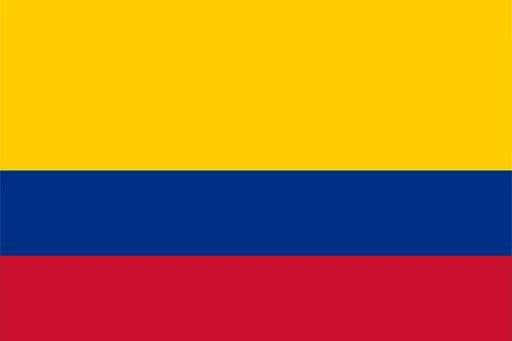
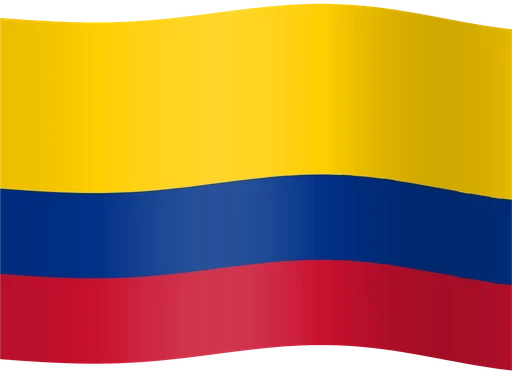
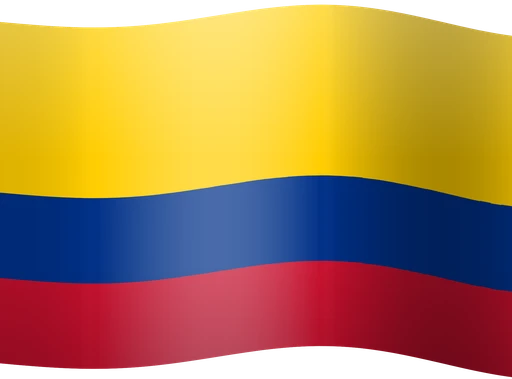
Colombia's flag has three horizontal stripes: yellow on top, blue in the middle, red at the bottom. The yellow takes up the whole upper half, and the blue and red each occupy a quarter, which is what sets it apart from most tricolors.
Colombia's flag is one of the oldest in South America, a horizontal tricolor of yellow, blue, and red going back to the revolutions of the early nineteenth century. The distinctive part is its asymmetry: the yellow band takes the full upper half, and the blue and red split the lower half between them. Its origins are inseparable from Francisco de Miranda, the Venezuelan revolutionary whose choice of three colors produced not just Colombia's banner but a whole family of South American flags. Colombia adopted the current form on November 26, 1861, and it has survived civil wars, constitutional rewrites, and the fracturing of Gran Colombia unchanged.
Miranda's dream: the revolutionary origins of the tricolor
Francisco de Miranda never governed a nation, never won a decisive battle, and died in a Spanish prison cell in 1816. Yet his single most lasting contribution to the world is something billions of people have seen: a combination of three colors on cloth.
Miranda, born in Caracas in 1750, spent decades crisscrossing Europe and the Americas, gathering support for South American independence. Somewhere along the way, possibly as early as 1801, he conceived a horizontal tricolor of yellow, blue, and red. The exact inspiration remains debated. One well-known account ties the colors to a conversation with Johann Wolfgang von Goethe in Weimar, where the German poet supposedly spoke about the primacy of yellow, blue, and red in the theory of light. Another tradition links them to the banner of the Lautaro Lodge, a secretive revolutionary fraternity operating across Europe and South America. Miranda himself left behind 24 volumes of personal archives, but no single definitive explanation.
What's certain is that he first flew a version of the tricolor on March 12, 1806, during his failed invasion of Venezuela at the port of La Vela de Coro. The flag outlived the expedition. By 1819 it had become the banner of Gran Colombia, the enormous republic Simón Bolívar stitched together from modern-day Colombia, Venezuela, Ecuador, and Panama. When that union fractured in 1831, every successor state kept some version of Miranda's colors. One man's palette became the visual identity of four nations.
The unequal halves: design, proportions, and what the colors mean
Most tricolors divide their space evenly. Colombia's doesn't, and that's the first thing you notice.
The flag's proportions are 2:3. The top half is entirely golden yellow, while the lower half splits into two equal bands of blue and red, each taking up one quarter of the flag's total height. This 2:1:1 ratio isn't accidental. It visually prioritizes yellow, which carries the heaviest symbolic weight. Traditional interpretation holds that the yellow represents the gold and natural wealth of the land, the blue evokes the two oceans and the rivers crossing the country, and the red recalls the blood shed by those who fought for independence.
There's also a popular Colombian mnemonic that reframes the palette: yellow for sovereignty, blue for loyalty and vigilance, red for the valor and generosity of the people. Both readings coexist comfortably. Colombians tend to know both and use whichever suits the moment.
Colombian law defines the flag's shades, though the Pantone and RGB specifications are looser than in some other countries, so you'll see slight variation from one manufacturer to the next. What you won't see on the civil flag is a coat of arms, a star, or any emblem at all. It works entirely on the arrangement and weight of color, a top-heavy wash of gold over the cooler, darker bands below.
From Gran Colombia to modern republic: a flag that outlasted empires
After Gran Colombia dissolved in 1831, the territory that is now Colombia went through a dizzying series of political reinventions. New Granada, the Grenadine Confederation, the United States of Colombia: each new constitutional identity brought flag modifications. Stripes were reordered. Proportions shifted. Stars and crests came and went.
The current design was formally locked in by law on November 26, 1861, during the presidency of Tomás Cipriano de Mosquera. That makes it one of the longest-continuously-used national flags in the Americas. Panama's secession in 1903, backed by the United States, carved away a huge piece of Colombian territory, but it didn't touch the flag. Unlike the fracturing of Gran Colombia decades earlier, this separation left the tricolor intact.
What's striking is the flag's stability through periods of extraordinary upheaval. The Thousand Days' War (1899-1902), La Violencia (1948-1958), decades of armed conflict with guerrilla groups: through all of it, the flag remained unchanged. In a country where constitutions, borders, and governments shifted repeatedly, the tricolor became one of the few fixed points of national identity.
A family resemblance: Colombia, Venezuela, and Ecuador
Line up the flags of Colombia, Venezuela, and Ecuador, and the kinship is unmistakable. All three fly yellow-blue-red horizontal tricolors descended from Miranda's original design. They form one of the most recognizable flag families in the world.
The differences, though, are telling. Venezuela uses equal horizontal stripes and adds an arc of eight stars on the blue band. Ecuador also uses equal stripes and places its national coat of arms in the center. Only Colombia retains the dominant yellow half, giving its flag a visual weight the others lack. At international sporting events, the three flags have been confused often enough to become a running joke among fans of all three countries.
Together the three banners are what's left of the Gran Colombian experiment and Bolívar's unrealized plan for a unified South America. Romania and Chad use a similar blue-yellow-red palette in vertical stripes, but there's no historical connection to the Miranda tradition. Coincidence, not kinship.
Protocol, variants, and the flag in Colombian life
Colombian law takes the flag seriously. Decree 1967 of 1991, along with subsequent regulations, mandates its display on public buildings and during national holidays, especially July 20 (Independence Day) and August 7 (the anniversary of the Battle of Boyacá, the engagement that effectively sealed independence from Spain in 1819).
The state and war flag adds the national coat of arms, centered on the blue stripe. That emblem features a condor perched atop a shield containing, among other elements, a pomegranate (a nod to New Granada) and a depiction of the Isthmus of Panama, a geographic feature Colombia lost over a century ago but still memorializes on its official seal. The naval ensign carries the same coat of arms and flies on Colombian Navy and merchant vessels.
At the local level, departmental and municipal flags across Colombia frequently echo the national tricolor's palette, reinforcing the same symbolic vocabulary in regional contexts. Desecration or disrespect of the flag is legally prohibited, though enforcement is more cultural than punitive. You're unlikely to face jail time, but you'll certainly face disapproval.
Cultural weight: more than cloth
The tricolor shows up everywhere in Colombian life, far beyond government buildings. During FIFA World Cup campaigns, the yellow-blue-red palette floods streets, faces, and social media feeds. When Colombian cyclists dominate stages at the Tour de France, fans drape the flag across Alpine switchbacks. At the Carnival de Barranquilla, one of the largest carnivals in the world, the colors are inescapable.
Colombian musicians, from cumbia orchestras to reggaeton stars, routinely weave the tricolor into album covers, stage sets, and music videos. For the Colombian diaspora, one of the largest in the Americas, with major communities in the United States, Spain, and across Latin America, the flag functions as a portable marker of identity and continuity. You'll spot it hanging in bakery windows in Jackson Heights, Queens, as easily as in the plazas of Bogotá.
Its simplicity helps: three colors, no emblem, and an unusual proportion that sticks in the mind. Vexillologists rate it highly for clarity and recognizability, and a child can draw it from memory.
References
[1] Presidencia de la República de Colombia, "Símbolos Patrios," official government page on national symbols. https://www.presidencia.gov.co
[2] Smith, Whitney. Flags Through the Ages and Across the World. New York: McGraw-Hill, 1975.
[3] Znamierowski, Alfred. The World Encyclopedia of Flags. London: Lorenz Books, 2001.
[4] Miranda, Francisco de. Archivo del General Miranda (24 volumes), particularly correspondence regarding the tricolor design. Caracas: various publishers, 1929-1950.
[5] Decreto 1967 de 1991, República de Colombia. Legal codification of flag protocol and usage.
[6] Bushnell, David. The Making of Modern Colombia: A Nation in Spite of Itself. Berkeley: University of California Press, 1993.
[7] Archivo General de la Nación (Colombia). Historical documents on flag legislation and decrees.
[8] North American Vexillological Association (NAVA) and Fédération internationale des associations vexillologiques (FIAV). Comparative flag analysis resources.
Common questions
- What do the colors of the Colombian flag stand for?
- Yellow stands for the country's gold and natural wealth, blue for the sky and the oceans, and red for the blood shed during the fight for independence.
- Why does the Colombian flag resemble the flags of Ecuador and Venezuela?
- All three descend from the flag of Gran Colombia, the union that once included Colombia, Venezuela, Ecuador, and Panama.
- What do the colors on the Colombian flag mean?
- Yellow represents the country's gold and natural wealth. Blue stands for the two oceans (Atlantic and Pacific) and Colombia's rivers. Red honors the blood spilled during the fight for independence. There's also an older interpretation where yellow means sovereignty, blue means loyalty and vigilance, and red means valor and generosity.
- Why is the yellow stripe on Colombia's flag so much bigger than the other two?
- The yellow band takes up the entire top half, while blue and red each get a quarter. That 2:1:1 split is intentional. Yellow carries the most symbolic weight, representing the nation's gold and natural riches. It's a design choice that makes Colombia's flag instantly recognizable compared to most tricolors, which divide their space evenly.
- Why do Colombia, Venezuela, and Ecuador all have such similar flags?
- They all trace back to a yellow-blue-red tricolor designed by Francisco de Miranda, a Venezuelan revolutionary, around 1801. When Gran Colombia broke apart in 1831, each new country kept its own version of Miranda's colors. Colombia held onto the oversized yellow band, while Venezuela and Ecuador went with equal stripes and added their own emblems.
- Who designed the Colombian flag?
- The colors come from Francisco de Miranda, a Venezuelan revolutionary who first flew a yellow-blue-red tricolor in 1806 during an attempted invasion of Venezuela. Simón Bolívar later adopted it for Gran Colombia. Colombia's current version, with its distinctive 2:1:1 proportions, was officially established on November 26, 1861.
- Why does Colombia's coat of arms still show the Isthmus of Panama?
- Colombia's state flag includes a coat of arms that depicts the Isthmus of Panama, even though Panama split off in 1903. It's basically a historical nod to territory that once belonged to Colombia. The country chose to keep that geographic legacy in its official symbolism rather than update it after the separation.
Featured in these articles
Download this flag
Free in 12 styles, from 32px icons up to 2000px, as SVG, PNG, WebP and JPG.