The Flag of Cameroon
Republic of Cameroon
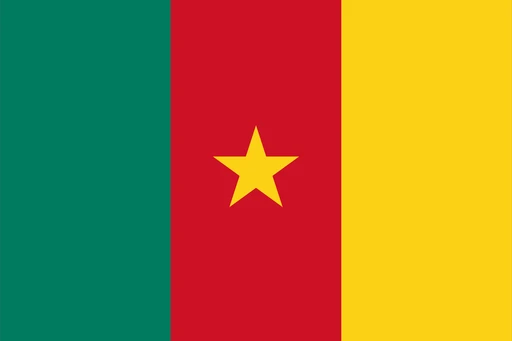
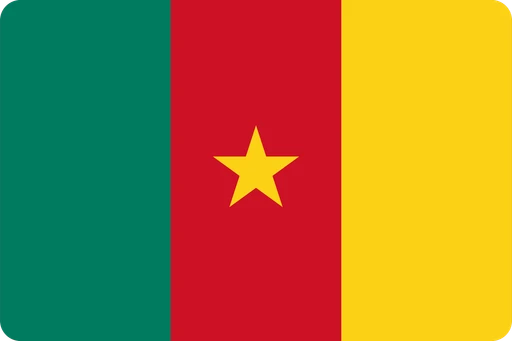
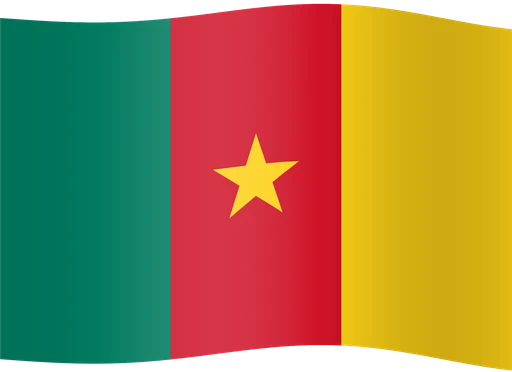
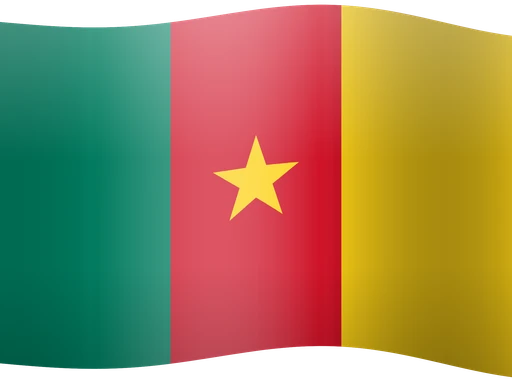
The flag of Cameroon has three vertical stripes of equal size, green, red and yellow from the hoist side to the fly side, with a yellow five-pointed star centered on the red. Green stands for the vegetation of the south, red for unity and independence, and yellow for the savannas of the north. The star is known as the 'star of unity'.
Cameroon's flag has three vertical bands of green, red, and yellow with a gold star at the center, and its changes over a single generation track the country's shift from two colonial territories under separate European powers, to a federation, to a unitary republic. The colors are the pan-African ones. The star is the part whose meaning moved as the country was remade around it.
Two stars, then one
Between 1961 and 1975, Cameroon's flag carried two gold stars on the green stripe, one for each half of a newly federated nation: French-speaking East Cameroon and English-speaking West Cameroon. They were added after the 1961 plebiscite, when the southern portion of British Cameroons voted to join the already independent Republic of Cameroun.
That arrangement did not last. President Ahmadou Ahidjo, who had been consolidating power since independence, pushed through a new constitution in 1972 that abolished the federation and declared a unitary state. The flag was redesigned three years later to match, with the two stars replaced by a single gold star moved from the green band to the center of the red one.
What makes the change unusual is what did not cause it. No revolution, no coup, no regime change. A constitutional restructuring that erased the federal distinction between Anglophone and Francophone regions was enough to rewrite the national banner.
The missing second star has not been forgotten. When the Anglophone crisis escalated in 2016 and 2017, as protests over the marginalization of English-speaking Cameroonians turned into armed conflict, some activists pointed back to the 1975 redesign as an early act of erasure. For Anglophone separatists, dropping that star said plainly how the unitary state saw them: not as a partner in a federation but as a region to be absorbed. The single star reads differently depending on which side of the linguistic divide you stand on.
The pan-African palette
Green, red, and yellow belong to the pan-African tradition that spread across the continent in the late 1950s and 1960s, popularized by Ghana's 1957 independence flag and traceable further back to the green, yellow, and red of Ethiopia's. Cameroon took the palette and attached local meanings to it.
The green band at the hoist is the forest of the south and its farmland. Yellow at the fly is the dry savanna of the north and the sun over it. Red in the middle is national unity and the blood shed in the struggle for independence. Putting the star of unity on the red band was a compositional decision as much as a political one: the center holds the forests and the savannas together.
The vertical tricolor format follows the French Tricolore, a quiet trace of France's rule over the eastern half of the country. The 2:3 proportions are the French standard too, rather than the wider ratios common elsewhere.
There is a practical problem with all this. Mali, Guinea, and Senegal use almost the same colors. Without the gold star you would struggle to tell them apart at a distance.
From Kamerun to Cameroun
Germany established the protectorate of Kamerun in 1884, planting its flag over a territory that stretched from the Atlantic coast deep into central Africa. That arrangement ended with World War I. After Germany's defeat, the territory was carved up between Britain and France under League of Nations mandates. France took the larger eastern portion; Britain administered two narrow strips along the western border, governing them as part of neighboring Nigeria.
French Cameroun gained independence on January 1, 1960, and adopted its first flag: a clean green-red-yellow vertical tricolor with no star at all. It was simple, almost generic. The stars came a year later, when the southern part of British Cameroons voted in a UN-supervised plebiscite to join the Republic of Cameroun rather than remain part of Nigeria. (The northern part voted the other way and was absorbed into Nigeria.) Two stars were added to the green band to mark the new federation.
Starless tricolor, then a two-star federation banner, then the single-star unitary design: the sequence follows the country's postcolonial history step by step, through partition, partial reunification, and the arguments over national identity that are still going on.
Protocol and daily life
Cameroon's constitution doesn't leave the flag to chance. Article 1 of the 1996 constitution specifies the design explicitly: three equal vertical bands of green, red, and yellow, with a gold star centered on the red band. It flies over every government building, military installation, and diplomatic mission.
May 20, National Day, is the primary occasion for mass public display. The date marks the 1972 referendum that created the unitary state, which means the holiday itself is tied to the same political moment that eventually produced the current flag. Parades, school ceremonies, and public gatherings are awash in green, red, and yellow. The presidential standard incorporates the national colors with additional elements specific to the office.
Desecrating or misusing the flag is a punishable offense under Cameroonian law, and that provision has taken on new weight during the Anglophone crisis. Some separatists in the English-speaking Northwest and Southwest regions have adopted the blue and white flag of the self-declared "Republic of Ambazonia" in place of the national tricolor. Displaying the Ambazonian flag can lead to arrest, and flying the Cameroonian flag in separatist-held areas can provoke hostility. Two flags, in a conflict that has displaced hundreds of thousands of people.
Lookalikes
Mali's flag is a green-yellow-red vertical tricolor, nearly identical to Cameroon's but with the yellow and red bands swapped and no star. The two are frequently confused, even by international broadcasters who should know better. Guinea uses the same three colors in reverse order: red, yellow, green. Senegal's version adds a green star to a green-yellow-red tricolor, creating yet another close cousin.
Within this family, the gold star on the red band is the fastest way to pick out Cameroon. The pan-African tricolors are one of the most commonly confused clusters in world flags, a problem that turns up at international sporting events and diplomatic summits with some regularity.
The resemblance is neither coincidence nor copying. The designers were all drawing on pan-Africanism and anti-colonial solidarity, and they wanted independence to have a shared visual language.
References
[1] Constitution of the Republic of Cameroon, 1996, Article 1, Title I. Official government text specifying the national flag's design and legal status.
[2] Whitney Smith, Flags Through the Ages and Across the World (1975), McGraw-Hill. A comprehensive vexillological reference covering flag history and symbolism worldwide.
[3] Flags of the World (FOTW) database entry on Cameroon. Peer-reviewed vexillological resource maintained by the Flag Research Center. https://www.crwflags.com/fotw/flags/cm.html
[4] Victor T. Le Vine, The Cameroons: From Mandate to Independence (1964), University of California Press. Essential historical account of Cameroon's colonial period and path to statehood.
[5] Piet Naudé, "Pan-African Colours and Symbols in National Flags," Journal of Vexillology, various issues. Analysis of the pan-African color tradition in flag design.
[6] United Nations Trusteeship Council records on British and French Cameroons mandates. Primary source documentation of the plebiscite and mandate history.
[7] International Crisis Group, reports on the Anglophone Crisis in Cameroon (2017 to present). Contemporary political analysis of the crisis and its symbolic dimensions.
Common questions
- What do the colors on the Cameroon flag mean?
- The green represents the dense forests in the south and the country's agricultural wealth. Yellow is for the dry savannas up north and the sun. Red, the middle band, represents national unity and the blood shed during the fight for independence. Together, the three colors also tie Cameroon to the pan-African tradition you'll see on flags across the continent.
- What does the star on the Cameroon flag represent?
- The gold star on the red band represents national unity. From 1961 to 1975, the flag actually had two stars, one for each half of the federation: French-speaking East Cameroon and English-speaking West Cameroon. When the country became a unitary state in 1975, those two stars were swapped out for a single one.
Featured in these articles
Download this flag
Free in 12 styles, from 32px icons up to 2000px, as SVG, PNG, WebP and JPG.