The Flag of Burundi
Republic of Burundi
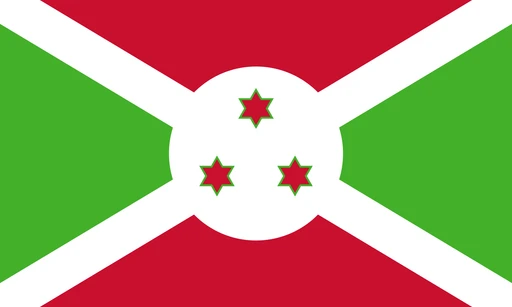
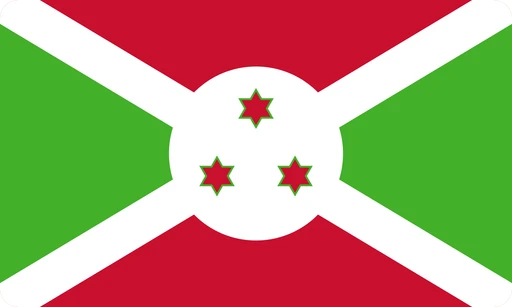
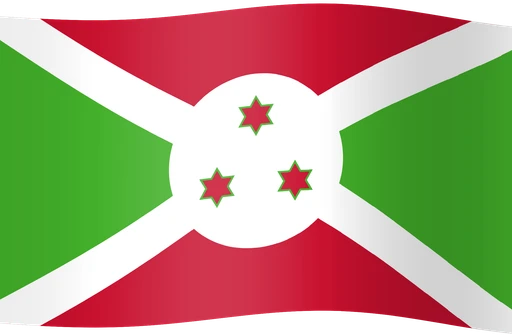
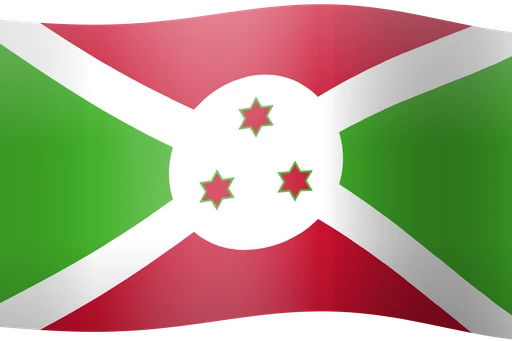
The flag of Burundi has a white saltire dividing the field into alternating red and green areas. At the center of the cross is a white disk with three solid red six-pointed stars outlined in green, arranged in a triangle. The stars stand for national unity, and the colors for the independence struggle, peace, and hope.
Burundi's flag is one of the few in the world built around a saltire, a diagonal cross, and the only one in Africa. Adopted on June 28, 1967, five years after independence from Belgium, it replaced an earlier flag carrying the royal drum and sorghum plant of the overthrown monarchy. A white saltire divides fields of red and green, and a white central disc holds three red six-pointed stars outlined in green: one star each for the words of the national motto, "Unité, Travail, Progrès" (Unity, Work, Progress).
From kingdom to republic
When Burundi gained independence from Belgium on July 1, 1962, it did so as a constitutional monarchy under King Mwambutsa IV. The first national flag reflected that arrangement. It used the same saltire layout we see today, but at the center sat a karyenda, the sacred royal drum, flanked by a sorghum plant. These were the symbols of the Ganwa monarchy that had governed under Belgian trusteeship, and they made clear who held power.
That arrangement didn't last long. The mid-1960s were brutal years. A failed Hutu-led coup in 1965 triggered ethnic reprisals. In July 1966 Prince Charles Ndizeye deposed his own father, Mwambutsa IV, and took the throne as King Ntare V, introducing his own short-lived flag variant during a few months in power. By November, Captain Michel Micombero had removed Ntare V in a military coup and proclaimed the Republic of Burundi.
The royal symbols came off the flag in 1967. Out went the drum and the sorghum, in came three six-pointed stars on a white disc. The geometry survived intact: same saltire, same colors. What changed was the claim it made. The flag was no longer about a dynasty but, in aspiration at least, about all Burundians.
The saltire and the stars
The flag's proportions are 3:5. A white saltire extends from corner to corner, carving the field into four triangles: red above and below, green at the hoist and fly sides. Where the diagonals meet sits a white circular disc, and inside that disc, three red six-pointed stars arranged in a triangular pattern, one above and two below, each outlined in green.
Those stars carry two meanings at once. They stand for the three major ethnic groups, Hutu, Tutsi, and Twa, and for the three words of the national motto, Unité, Travail, Progrès.
They are not Stars of David. They are heraldic mullets, a common element in flag design, chosen for geometric balance rather than religious meaning. The question comes up often enough to be worth answering.
The colors do not map quite so neatly. Red is blood, both the blood shed for independence and the blood spilled in the ethnic conflicts that followed. Green is hope and Burundi's identity as an agricultural country, its hillsides terraced with coffee and tea. White, in the saltire and the disc, is peace.
The saltire is what makes the flag hard to mistake. The diagonal cross is rare among national flags. Scotland, Jamaica, and a handful of others use it, and no other flag in Africa does.
Unity, work, progress
The national motto "Unité, Travail, Progrès" predates the current flag, but the two have been tied together since the three stars became its visual shorthand.
Representing three ethnic groups with three equal stars was not an accident. By the mid-1960s, tensions between Hutu and Tutsi had already erupted into killing, and three identical stars made a political claim: these groups are equal and they are one nation. Whether the country lived up to that is a separate question.
The Twa are easy to overlook here. They are Burundi's smallest ethnic group, roughly 1% of the population, and they got a star of their own well before that kind of inclusion became a global conversation. In practice the Twa have stayed marginalized, with limited political inclusion despite sitting at the center of the flag.
The stars have been invoked during peace processes since. In the negotiations that produced the Arusha Peace and Reconciliation Agreement of 2000, they were cited as a reminder of the inclusive republic the flag had promised.
Protocol and daily life
The flag flies at all government buildings, military installations, and diplomatic missions. Flag protocol is governed by presidential decree, and the rules are taken seriously.
A vertical hanging variant exists for ceremonial purposes, with the green triangle oriented to the viewer's left. The presidential standard incorporates the national flag's central motif, the three stars, set against a distinct background. During Independence Day celebrations on July 1, Unity Day on February 5, and periods of national mourning, the flag takes on heightened visibility, lowered to half-staff when the nation grieves.
In everyday life, you'll find the flag on school uniforms, painted on the sides of public minibuses, and waved enthusiastically at football matches. Burundi's national team, Les Hirondelles (The Swallows), qualified for the Africa Cup of Nations for the first time in 2019, and suddenly the flag was on screens across the continent. For many viewers, it was their first real look at that distinctive diagonal cross.
Comparisons with other flags
Burundi's flag gets confused at a distance with those of neighboring countries, but the saltire settles it, since no other African flag uses a diagonal cross.
The red, white, and green palette links it visually to several other flags, Madagascar among them, and again the geometry is the giveaway. The three-star motif is also unique among current national flags. Stars for ethnic or political unity are common across Africa, from Ethiopia's pentagram to South Sudan's guiding star, but no other country uses three six-pointed stars in this arrangement.
The most instructive comparison is with Rwanda, Burundi's closest cultural and historical neighbor. Both countries emerged from Belgian colonial rule, both endured catastrophic ethnic violence, and both grappled with how their flags reflected those divisions. Rwanda chose rupture: after the 1994 genocide, it adopted an entirely new flag in 2001, deliberately erasing all visual connections to the old regime. Burundi chose continuity, keeping its post-1967 design through a civil war that lasted from 1993 to 2005. Same region, same broad history, opposite approaches to national symbolism.
Sixty years, one design
The same flag has flown through a monarchy, multiple coups, a twelve-year civil war, and a contested constitutional referendum in 2018.
During the political crisis of 2015, when President Pierre Nkurunziza's bid for a third term triggered mass protests and a failed coup, both sides used it. Protesters in Bujumbura wrapped themselves in it, government supporters waved it at counter-rallies, and diaspora communities carried it at solidarity marches in Brussels and Nairobi.
Whether the flag's promises have been kept is argued over periodically. The ethnic unity the three stars claim is still fragile, and progress is slow in one of the world's poorest countries. The design has outlasted the political moment that produced it either way, which is more than the 1962 flag managed.
References
[1] Constitution of the Republic of Burundi (2005), Article 6. Official description of national symbols including the flag.
[2] Whitney Smith, Flags Through the Ages and Across the World (1975), McGraw-Hill. Comprehensive vexillological reference covering Burundi's flag history.
[3] Flags of the World (FOTW), Burundi page. crwflags.com/fotw/flags/bi.html. Peer-reviewed vexillological database with detailed technical specifications.
[4] René Lemarchand, Burundi: Ethnic Conflict and Genocide (1996), Cambridge University Press. Essential historical context for the political events behind Burundi's flag changes.
[5] Arusha Peace and Reconciliation Agreement for Burundi (2000). Contextual document for the ethnic unity symbolism encoded in the flag.
[6] CIA World Factbook, Burundi entry. Current flag description and national data. cia.gov/the-world-factbook/countries/burundi/
Common questions
- What do the three stars on the Burundi flag represent?
- The three red, six-pointed stars represent Burundi's three main ethnic groups: the Hutu, Tutsi, and Twa. They also match the three words of the national motto, Unité, Travail, Progrès (Unity, Work, Progress). You'll find them arranged in a triangle inside a white disc at the center of the flag.
- Why does Burundi's flag have a diagonal cross?
- Burundi is one of very few countries, and the only one in Africa, to use a saltire (diagonal cross) on its national flag. The white saltire splits the flag into red and green triangles and represents peace. It's been part of the design since independence in 1962 and has survived every political change since.
- Are the stars on Burundi's flag Stars of David?
- Nope. They're six-pointed, but they're heraldic mullets, a pretty standard element in flag design picked for geometric balance. There's no religious meaning to them at all. People ask this a lot, but the resemblance to the Star of David is just a coincidence.
- What do the colors on the Burundi flag mean?
- Red represents the blood shed during the independence struggle and later conflicts. Green symbolizes hope and the country's deep agricultural roots. White, which you see in the saltire and the central disc, represents peace.
- Why did Burundi change its flag after independence?
- The original 1962 flag had a royal drum (karyenda) and a sorghum plant on it, both symbols of the monarchy. After a military coup ended the kingdom in 1966, those royal symbols were dropped. In 1967, they were replaced with the three stars representing ethnic unity and the national motto, turning it from a monarchical flag into a republican one.
Featured in these articles
Download this flag
Free in 12 styles, from 32px icons up to 2000px, as SVG, PNG, WebP and JPG.