The Flag of Burkina Faso
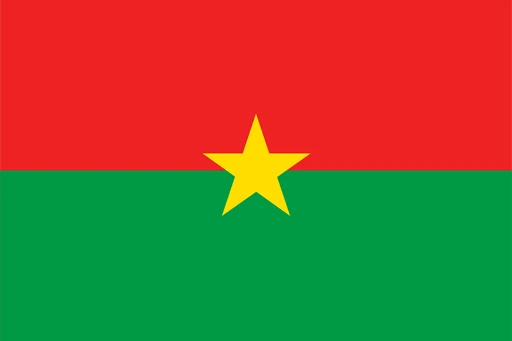
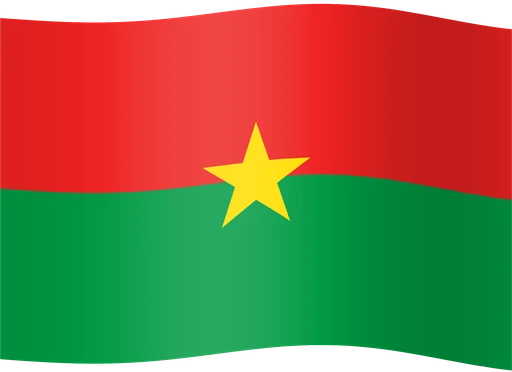
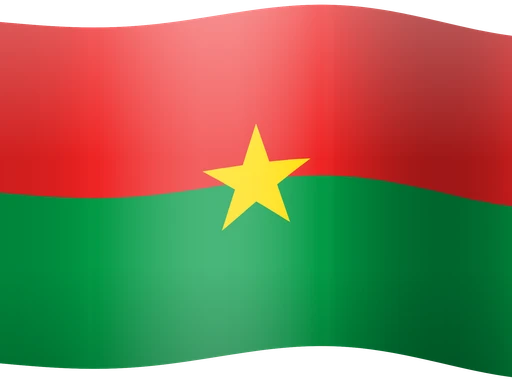
The flag of Burkina Faso has two horizontal bands, red over green, with a yellow five-pointed star in the center. Red stands for the revolution, green for the country's natural wealth, and the yellow star for the guiding light of the revolution.
Burkina Faso's flag marks something more than independence from a colonial power. It marks a break with the country's own post-colonial past. Adopted on August 4, 1984, a year to the day after Captain Thomas Sankara seized power in a popular uprising, the red and green bicolor with a central yellow star replaced the black, white, and red striped flag that had flown since independence from France in 1960. The name "Burkina Faso," meaning "Land of Upright People," was coined at the same moment out of words from the country's two most widely spoken languages. The flag is bound up with the pan-African politics of the revolution and with Sankara's four years in power.
The flag that renamed a nation
Upper Volta gained independence from France on August 5, 1960, and adopted a horizontal tricolor of black, white, and red. The colors carried no pan-African meaning. To many people they looked like leftovers from the colonial filing cabinet, an identity drawn in Paris rather than anything the people living there had asked for.
That ended on August 4, 1983, when Captain Thomas Sankara, a 33-year-old military officer, led a popular coup. He called it the "Democratic and Popular Revolution" and meant it literally: land reform, mass literacy campaigns, vaccination drives, and women's rights initiatives followed in quick succession. Sankara governed with a sincerity that made him popular at home and well known across the continent.
A year after taking power, on August 4, 1984, he announced the renaming of the country and the adoption of a new flag, coat of arms, and national anthem all at once. Upper Volta became Burkina Faso. The name was itself an argument about unity. "Burkina" comes from Mooré, the language of the Mossi people, and means "upright" or "honest." "Faso" is Dyula, a widely spoken Manding language, meaning "fatherland" or "homeland." The demonym "Burkinabè" takes its suffix from Fula. Three languages in one name, and none of it accidental.
The new flag carried the revolution's pan-African and anti-imperialist politics. Its green, gold, and red are the colors long associated with African liberation movements, which trace back to the Ethiopian flag, the banner of the one African nation that successfully resisted European colonization.
Sankara was assassinated on October 15, 1987, at 37, in a coup led by his former comrade Blaise Compaoré. The new regime kept the flag, the name, and most of the national symbols. They were already too embedded in popular identity to throw out. The revolution lasted four years, and its flag has now lasted four decades.
Two bands and a star
Two equal horizontal bands, red on top, green below, with a five-pointed yellow star centered where they meet. The official proportions are 2:3, though you will see variations in practice, especially on hand-sewn flags sold in markets.
Red is for the blood shed in the revolution and the continuing struggle for liberation. Sankara's government said so directly, rather than using the vaguer language of "sacrifice" that other countries attach to red. Green is for agricultural wealth, a loaded subject in a landlocked Sahelian country where farming supports most of the population and rain decides whether a year is good or catastrophic. The yellow star does two jobs: the guiding light of the revolution, and the country's mineral wealth, especially gold, which has since become the leading export.
The design is spare next to many African flags. No coat of arms, no seal, no heraldry, just two colors and a star. That fits Sankara, who sold the government's fleet of Mercedes sedans and replaced them with the cheapest car available, the Renault 5.
The flag of Upper Volta
The original flag of Upper Volta, flown from 1960 to 1984, featured three horizontal stripes: black on top, white in the middle, red on the bottom. The colors represented the three branches of the Volta River, the Black Volta, the White Volta, and the Red Volta, which defined the colony's geography and gave it its French name.
It was a functional flag, but it carried no pan-African color symbolism, which made it an outlier among the West African nations that became independent in the same wave. Mali, Guinea, Senegal, and Ghana all chose green, gold, and red in some configuration.
Critics, Sankara among them, argued that the old flag described a colonial map rather than a people. French explorers named the rivers. French officials drew the colony. Why should an independent country define itself by someone else's geography?
The 1984 replacement was therefore an act of decolonization: national symbols should come from the people rather than from the naming conventions of the former metropole. The Upper Volta flag is almost never displayed publicly in Burkina Faso now. It survives in history books and vexillological databases rather than on flagpoles.
Protocol and daily life
The flag flies at government buildings, military installations, and diplomatic missions abroad, under national protocol regulations. A vertical hanging variant exists for ceremonial display, with the red band on the left (hoist side) when viewed from the front. The presidential standard uses the national flag design with additional elements for the office of the head of state.
Two dates bring it out in force: August 4, Revolution Day (also Republic Day), and December 11, Independence Day, which still marks the 1960 date. Both mean parades, speeches, and red, green, and gold through the streets of Ouagadougou.
Day to day, the flag turns up on clothing, market goods, and in Burkinabè music and art, often alongside images of Thomas Sankara, who remains a cultural figure well beyond Burkina Faso and among leftist movements elsewhere. Diaspora communities fly it too, particularly in Côte d'Ivoire, home to millions of Burkinabè migrants, and in France and Italy.
Flags it gets confused with
Ghana's flag causes the most confusion, since it also uses red, gold, and green with a central star. But Ghana's is a horizontal tricolor with a black star. Side by side the two are easy to separate. At a distance or in a photograph, less so.
The red-over-green bicolor with a yellow star also resembles flags from Guinea-Bissau, Cameroon, and other countries and movements shaped by pan-Africanism. Portugal's flag happens to share the red-green layout, though the symbolism has nothing to do with any of this. It makes for a good trivia question.
Among Sahelian and West African neighbors like Mali, Niger, Senegal, and Côte d'Ivoire, Burkina Faso's flag is unusual in having an explicit revolutionary origin story. Most national flags come out of committees or pre-independence movements. This one was announced on a specific day by a specific leader as part of a specific political project.
The design also reproduces well at any scale, from a postage stamp to a stadium banner, which vexillologists tend to appreciate regardless of what they think of the politics.
References
[1] Constitution of Burkina Faso (1991, revised), Article 34. Official description of national symbols including the flag.
[2] Harsch, Ernest. Thomas Sankara: An African Revolutionary. Ohio University Press, 2014. Detailed account of the 1983-1987 revolution and the renaming and reflagging of the country.
[3] Prairie, Michel. Thomas Sankara Speaks: The Burkina Faso Revolution 1983-87. Pathfinder Press, 2007. Primary source collection including Sankara's August 4, 1984 speech announcing the new name and flag.
[4] Smith, Whitney. Flags Through the Ages and Across the World. McGraw-Hill, 1975. Comprehensive vexillological reference covering Upper Volta's original flag.
[5] Flags of the World (FOTW), Burkina Faso page. The world's largest online vexillological database. crwflags.com/fotw/flags/bf.html
[6] Englebert, Pierre. Burkina Faso: Unsteady Statehood in West Africa. Westview Press, 1996. Political history covering the symbolic politics of national identity.
Common questions
- Why did Burkina Faso change its flag?
- The flag changed on August 4, 1984, exactly one year after Thomas Sankara's revolution. The old Upper Volta flag (black, white, and red stripes tied to colonial-era river names) felt like a leftover from French colonial rule. Sankara swapped it for the red and green bicolor with a yellow star as part of a total national reset. The country was also renamed from Upper Volta to Burkina Faso at the same time.
- What do the colors on the Burkina Faso flag represent?
- Red is for the blood of the revolution and the fight for liberation. Green represents agricultural wealth and natural abundance. The yellow star is the guiding light of the revolution and a nod to the country's mineral wealth, especially gold. The color combo deliberately mirrors the pan-African palette that traces back to Ethiopia's flag, tying Burkina Faso to broader African independence movements.
- What does 'Burkina Faso' mean, and why was that name chosen?
- It means "Land of Upright People." Thomas Sankara coined it in 1984 as an act of linguistic unity. "Burkina" comes from Mooré (meaning "upright"), "Faso" from Dyula (meaning "fatherland"), and the demonym "Burkinabè" uses a suffix from Fula. Three languages, one name. It replaced "Upper Volta," which was just a label French colonizers gave based on local geography.
- Why does Burkina Faso's flag look so similar to Ghana's?
- Both flags use the pan-African colors of red, gold, and green with a central star, all rooted in the Ethiopian tricolor tradition that symbolizes African independence. But they're actually pretty different up close. Ghana's is a horizontal tricolor with a black star, while Burkina Faso's is a two-tone red and green split with a yellow star. Side by side they're easy to tell apart, though from a distance they can get mixed up.
Featured in these articles
Download this flag
Free in 12 styles, from 32px icons up to 2000px, as SVG, PNG, WebP and JPG.