The Flag of the British Indian Ocean Territory
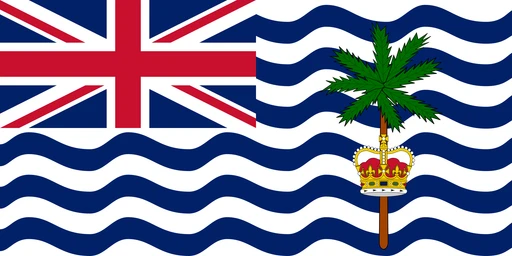
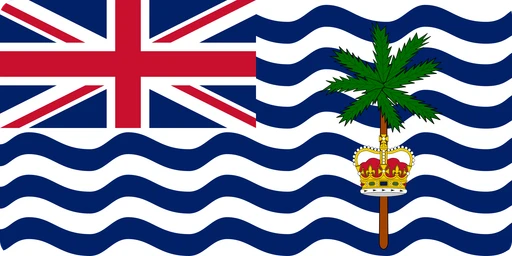
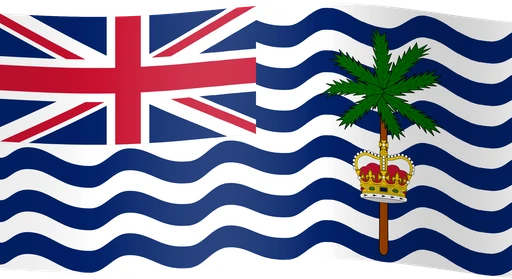
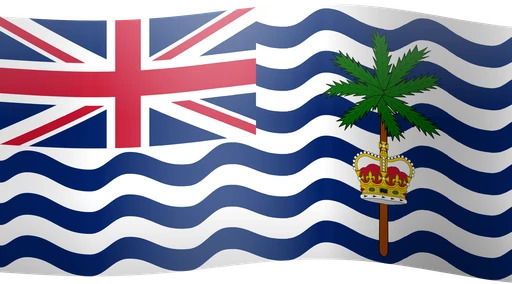
The flag of the British Indian Ocean Territory (BIOT) has a navy blue field with the Union Jack in the canton, the standard mark of British sovereignty. In the fly, a palm tree and a crown sit on a white circle. The palm tree stands for the vegetation of the islands and the crown for the British monarchy. The design identifies the territory as a British overseas territory in the Indian Ocean.
The flag of the British Indian Ocean Territory (BIOT) is one of the odder ensigns Britain has issued to an overseas territory, and one of the most politically loaded. Adopted in 1990, it shows a palm tree, a crown, and a sea turtle over wavy blue and white stripes, all in the fly half of a Blue Ensign. The tropical imagery sits on top of an ugly history: between the late 1960s and early 1970s, Britain removed the Chagossian people from the islands to clear the way for a U.S. military base on Diego Garcia. The territory the flag stands for now has no permanent civilian population. It is governed from London and claimed by Mauritius, and the people who were displaced from it fly a flag of their own.
A flag without a people
The British Indian Ocean Territory was created in 1965, carved out of Mauritius and the Seychelles three years before Mauritian independence. The purpose was blunt: keep strategic military real estate in the middle of the Indian Ocean. Between 1968 and 1973, the entire Chagossian population, roughly 1,500 to 2,000 people known as the Îlois, was forcibly relocated to Mauritius and the Seychelles. Their removal cleared the way for a U.S. military installation on Diego Garcia that remains operational today.
For its first 25 years, BIOT had no flag of its own. Official use relied on the standard Blue Ensign or the Union Jack. A dedicated territorial flag was not adopted until November 8, 1990, which makes it a late arrival among British overseas territory ensigns. It came during a period when several territories were granted or updated their own flags.
By 1990 the islands had been empty of their indigenous population for nearly two decades. Critics have pointed out the uncomfortable irony of giving a visual identity to a territory whose human identity had been deliberately erased. The palm trees, ocean waves, and wildlife on the flag belonged to a place that no longer belonged to its people.
Palm, crown, and turtle
At first glance the BIOT flag looks almost cheerful. It follows the standard British Blue Ensign format, with a dark blue field and the Union Jack in the canton. The fly half is where it gets unusual. Instead of a coat of arms on a plain background, the whole right side is filled with alternating wavy blue and white stripes for the Indian Ocean. That rippling background gives the flag a sense of motion you rarely see in administrative ensigns, which tend toward stiff heraldic compositions.
Rising from the waves is a coconut palm, leaning slightly to the right, the kind of tree you would find on the coral atolls of the Chagos Archipelago. On top of the palm sits St Edward's Crown, the royal crown, marking British sovereignty. Given the territorial dispute with Mauritius, that crown is a pointed assertion rather than a decoration.
At the base of the palm is a giant Aldabra tortoise (sometimes described as a sea turtle), a nod to the wildlife of the archipelago, which includes species found nowhere else. The colors follow the same logic: deep blue for the ocean, white for surf and sand, green for the vegetation, gold-brown for the tree and the tortoise. Next to its Blue Ensign cousins the flag reads less like a government document than a postcard, which is strange for a territory with no postal service and nobody to send letters.
The sovereignty dispute
Mauritius has never accepted the separation of the Chagos Archipelago. It considers BIOT an illegal occupation of its sovereign territory, and international opinion has increasingly shifted in its favor. In 2019, the International Court of Justice issued an advisory opinion supporting Mauritius's claim, and the UN General Assembly voted overwhelmingly in favor of British withdrawal under Resolution 73/295.
Then, in 2024, the UK announced negotiations to transfer sovereignty of the Chagos Islands to Mauritius while retaining a long-term lease on Diego Garcia. If finalized, the deal raises an obvious question: what happens to the BIOT flag?
In practice the flag is already something of a ghost. It is rarely flown in the territory itself. The military base on Diego Garcia mostly displays U.S. and UK military flags, and the BIOT ensign turns up chiefly on government documents, official communications, and the BIOT Administration's website.
The Chagossian diaspora has its own unofficial flag, a green, blue, and yellow tricolor with a central emblem, created by community organizations including the Chagos Refugees Group and Chagossian Voices. It is a counter-symbol, tied to the right of return. Two flags exist for the same islands: one issued by an administration, the other made by the people that administration removed.
BIOT among the Blue Ensigns
The BIOT flag belongs to the large family of Blue Ensign flags used across British overseas territories, Crown dependencies, and some Commonwealth nations. Its closest relatives are the flags of the Cayman Islands, the Turks and Caicos Islands, and the Falkland Islands, which all put a territorial badge in the fly half. The wavy-stripe background is what sets BIOT apart. Most other Blue Ensign flags leave a plain blue field behind the emblem.
It is also one of very few national or territorial flags anywhere that puts a turtle or tortoise front and center.
The flag has appeared on stamps and coins issued by the BIOT Administration, which are collected internationally. A territory with no permanent residents earning revenue and cultural presence through philately is a peculiar arrangement. If sovereignty transfers to Mauritius, the BIOT flag could turn out to be one of the shortest-lived territorial flags in modern history, in use for about 34 years.
What happens to the flag if the territory goes
The 2024 UK-Mauritius sovereignty agreement, if finalized, would almost certainly retire the BIOT flag. It could be replaced by the Mauritian flag, by a new emblem for the Chagos Archipelago, or by something not yet designed. There are precedents. Hong Kong's colonial flag was lowered for the last time in 1997. The flag of the British Western Pacific Territories was retired when its last constituent territory gained independence.
For the Chagossian community, scattered across Mauritius, the Seychelles, and the UK, which flag flies over the islands is bound up with recognition and the right to return. Many are still fighting to go home.
References
[1] British Indian Ocean Territory Administration official website. https://bfrsa.org.uk/
[2] Vine, David. Island of Shame: The Secret History of the U.S. Military Base on Diego Garcia. Princeton University Press, 2009.
[3] International Court of Justice, Advisory Opinion on the Legal Consequences of the Separation of the Chagos Archipelago from Mauritius in 1965 (25 February 2019). https://www.icj-cij.org/
[4] Smith, Whitney. Flags Through the Ages and Across the World. McGraw-Hill, 1975.
[5] Flag Institute (UK), British Overseas Territory Flags reference sheets. https://www.flaginstitute.org/
[6] Sand, Peter H. United States and Britain in Diego Garcia: The Future of a Controversial Base. Palgrave Macmillan, 2009.
[7] UN General Assembly Resolution 73/295 (2019) on the Chagos Archipelago.
[8] Chagos Refugees Group and Chagossian Voices community organizations, documentation of the Chagossian diaspora flag and its symbolism.
Common questions
- What do the blue and white waves on the BIOT flag mean?
- The wavy blue and white stripes stand for the Indian Ocean, which surrounds the islands of the British Indian Ocean Territory.
- Why does the BIOT flag feature a palm tree?
- The palm tree stands for the plant life of the islands, which are tropical coral atolls.
- What is the significance of the crown above the palm tree on the BIOT flag?
- It is the royal crown, and it marks the territory as one governed under the British monarch.
- Why is the Union Jack part of the BIOT flag?
- The Union Jack signifies the United Kingdom's authority over the British Indian Ocean Territory.
- Why is the British Indian Ocean Territory flag controversial?
- The flag represents a territory whose entire indigenous population, the Chagossians, was forcibly removed between 1968 and 1973 to make way for a U.S. military base on Diego Garcia. For many, it's uncomfortable to give a visual identity to a place whose human identity was deliberately erased. On top of that, Mauritius considers the territory an illegal occupation of its sovereign land.
Download this flag
Free in 12 styles, from 32px icons up to 2000px, as SVG, PNG, WebP and JPG.