Red, Gold, and the Flag That Belongs to Everyone: How Communist Vietnam and Royal Spain Ended Up Wearing the Same Colors
Julio Song · · 8 min read
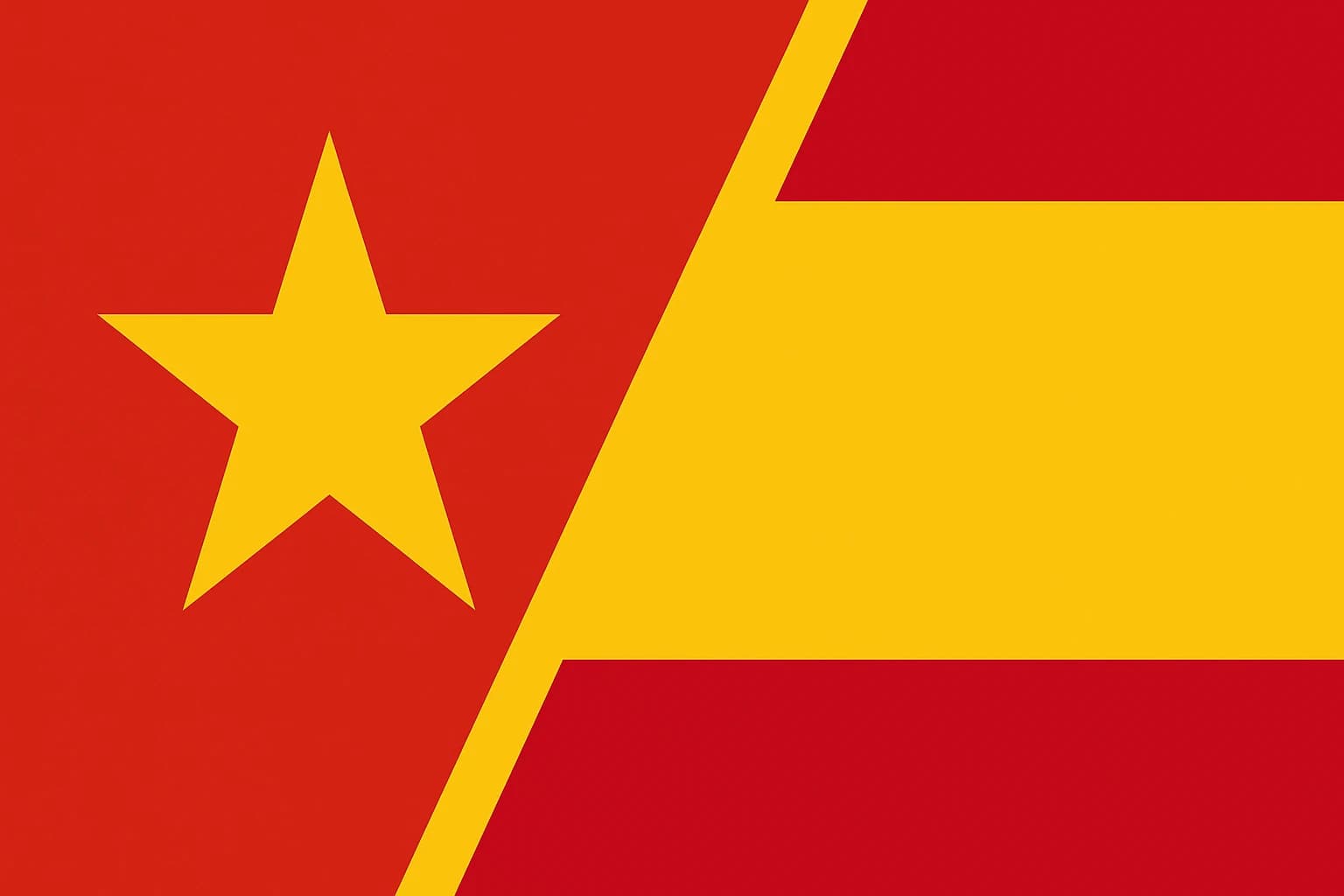
Place the flags of Vietnam and Spain side by side and ask someone who knows nothing about either country which belongs to a communist republic and which to a constitutional monarchy. The red and gold palette gives nothing away. Both wear it with conviction, for reasons separated by centuries and by opposite politics.
That is the puzzle. How does one colour pairing end up meaning revolutionary socialism, medieval heraldry, pan-African liberation and civic unity all at once? Following the combination across four countries and five centuries is a decent way to find out, and it makes red and gold the most ideologically overloaded pairing in flag history.
Vietnam and Spain, side by side
Vietnam's flag is a plain red field with a centred five-pointed gold star. It was first raised in 1940 and formalized in 1955.
Spain's flag is a horizontal triband of red-yellow-red, bearing the royal coat of arms. The red-and-yellow combination traces to an 18th-century Bourbon naval ensign and has been codified across multiple modern constitutions.
One statistic frames the whole question: red and yellow or gold together appear on roughly 20 to 25 percent of the world's national flags, which makes it one of the most common pairings anywhere. Vietnam and Spain are two of the purest expressions of those two colours alone.
So is the convergence random, or does red and gold have a visual logic that keeps attracting designers independently?
The answer starts in medieval heraldry, with the rule of tincture: place metal on colour, or colour on metal. Gold, or yellow, is one of only two heraldic metals. Red is one of the most visually forceful colours. Together they give maximum contrast, which is what makes a flag readable at distance. That is the practical explanation and it is a good one.
It does not explain the rest, though. Each culture chose the pairing for reasons that almost invert each other, which is where it gets interesting.
Vietnam's red and gold were engineered
Vietnam's flag has an author. Nguyễn Hữu Tiến, a Marxist organizer, designed it around 1940 for the Indochinese Communist Party, and it was first raised publicly during the Nam Kỳ Uprising of November 1940, more than a decade before independence.
The symbolism was specified rather than felt. The red field is the blood of revolutionary struggle and the socialist cause. The gold star is the light of the party guiding the nation. Each of the star's five points stands for a group: workers, peasants, soldiers, intellectuals and youth. That is an ideological taxonomy printed on fabric, not general patriotism.
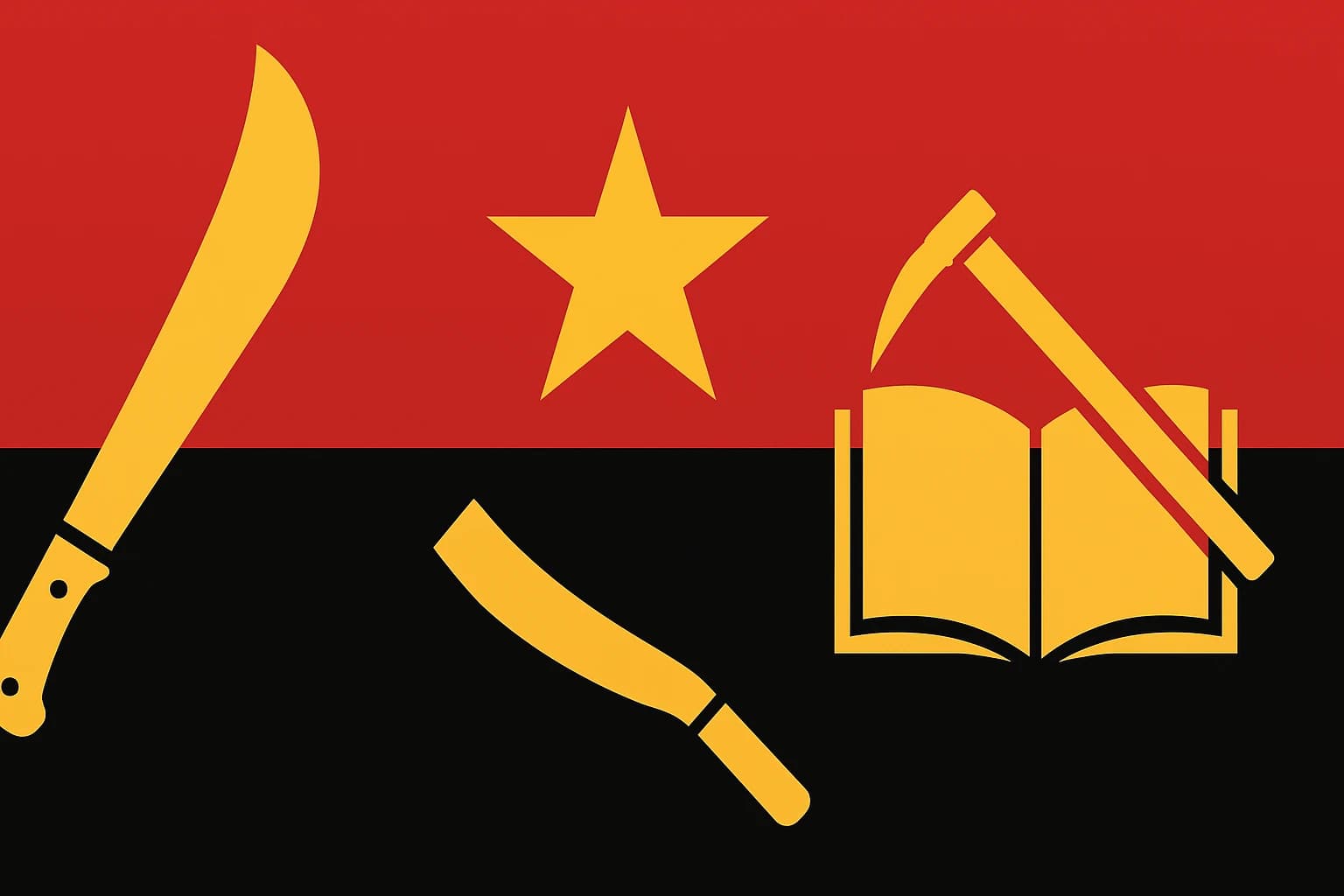
The palette belongs to a larger system. The USSR's flag, a red field with a gold hammer and sickle adopted in 1923, made red and gold the international language of communist states. China adopted it in 1949 and Vietnam followed. Those choices were conscious, signalling ideological solidarity as much as national identity.
There is a sharper detail inside Vietnamese vexillology. The flag Vietnam replaced was the yellow flag with three red stripes of the State of Vietnam, later South Vietnam, which inverted the colour hierarchy: gold field, red marks. Even which colour dominated the field was a loaded question.
None of Vietnam's red and gold is inherited or accidental. It was picked from a menu of available symbols to communicate a political identity to an international audience that already knew how to read it.
Spain's red and gold predates the modern world
Spain's colours start centuries before ideology was a concept. They trace to the Crown of Aragon, whose royal banner had four red stripes on gold, dating to the 12th century and the legend of Count Wilfred the Hairy. When that crown merged with the Crown of Castile through the marriage of Isabella and Ferdinand in 1469, the entity we recognize as Spain began to take shape and the colours came with it.
How did dynastic heraldry become a national flag? In 1785, King Charles III decreed a new naval flag: red-yellow-red horizontal bands. The reason was pure practicality. Spanish ships needed to stand apart from other Bourbon navies, most of which flew white-heavy ensigns that looked identical at sea. Charles chose red and gold as a direct reference to the Crown of Aragon's heraldic legacy.
The constitutional history since then has been turbulent: the 1812 Cádiz Constitution, the upheavals of the 19th century, the Second Republic's purple, red and yellow tricolour from 1931 to 1939, Franco's reversion to red and gold, and finally the 1978 constitutional flag flying today. The combination survived all of it because its meaning predated every regime that tried to claim it.
The coat of arms is where the arguments actually happen. The castle for Castile, the lion for León, the chains for Navarre, the pomegranate for Granada: these shift across regimes and signal who holds authority. The red and gold field behind them does not move.
So Spain's red and gold stands for monarchy, Catholicism, empire and an aristocratic heraldic tradition running back 800 years, which is roughly the precise opposite of what the same two colours mean over Hanoi.
Ghana's black star, a third meaning entirely
Red and gold is not a two-way contest between communism and monarchy.
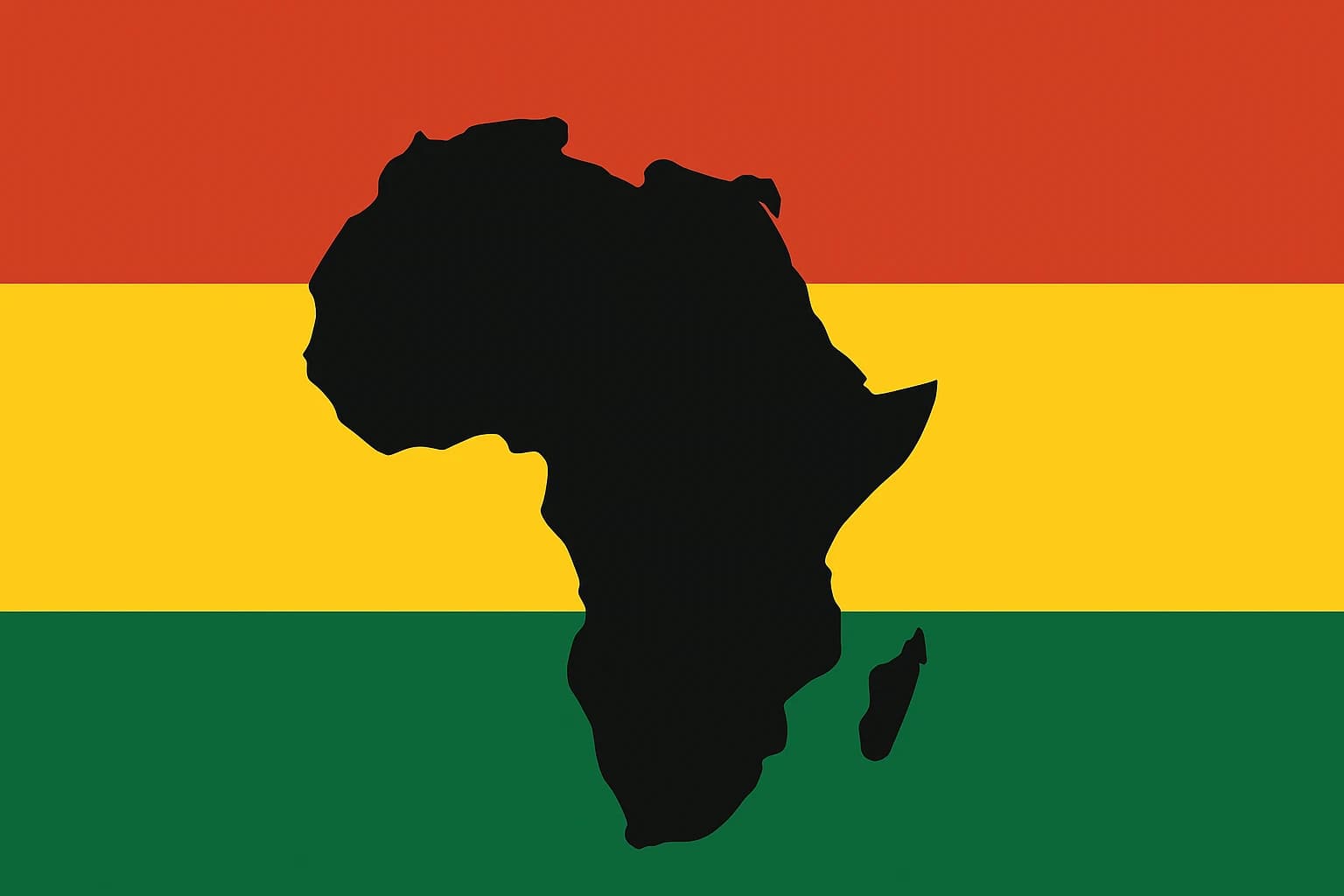
Ghana's flag, adopted at independence in 1957, features red, gold, and green horizontal bands with a black star at center. Kwame Nkrumah's design choices were meticulous. Red represents the blood of those who died for independence. Gold represents the mineral wealth of Africa. Ghana was then the world's leading cocoa exporter and a major gold producer. The country's name itself evokes the ancient Ghana Empire. Green stands for forests and natural wealth. And the black star? Borrowed directly from Marcus Garvey's Black Star Line shipping company, linking the flag to the pan-African diaspora movement.
Set that against Vietnam. Both flags put a star at the centre of a red field, but Ghana's is black for pan-African solidarity and Vietnam's is gold for party leadership. The grammar is the same and the vocabulary is opposite, and neither owes anything to the other.
Ghana's design rippled across the continent. A wave of red, gold and green pan-African flags followed as other nations gained independence. Ethiopia's tricolour supplied the colour scheme and Ghana added the star, producing a regional signalling system that owed nothing to European heraldry or Soviet iconography.
Which is the point. Red and gold did not need Vietnam or Spain to acquire meaning in Africa. It arrived at its own reading through its own history.
The Central African Republic's red stripe
The most structurally unusual flag in this comparison belongs to the Central African Republic.
The Central African Republic's flag, adopted in 1958, has four horizontal bands of blue, white, green, and yellow, all crossed vertically by a single red stripe, with a gold star in the upper-left canton. The red stripe doesn't dominate the design. It cuts through all four other colors.
That crossing is the whole design. The CAR's founders made the red vertical stripe stand for the blood that unites all citizens across regional and ethnic divisions, a unifying cut across difference in a country whose borders were drawn by French colonial administrators with little regard for who lived inside them.
So in the CAR red is not revolutionary as in Vietnam, not royal as in Spain, and not pan-African as in Ghana. It is civic, a colour of constitutional togetherness that overrides every other colour it crosses.
Four contexts, four meanings, one colour. Which suggests flags do not carry meanings so much as invite readings, and the invitation depends entirely on who is reading.
Colours do not mean things, cultures do
The global prevalence of red and gold is not evidence that the pairing has a universal meaning. It is evidence that the pairing has universal legibility. Maximum contrast, rooted in the rule of tincture, makes it easy to see and hard to misread at flag scale. What gets loaded into that contrast is supplied by whoever is flying it.
Whitney Smith, who coined the word vexillology in 1957 and spent decades cataloguing exactly this kind of divergence, understood the distinction. Flags are readable because of their visual properties and meaningful because of their cultural context, and those are separate things.
Take the assumption most of us carry around, that red means danger or gold means wealth. In European heraldry red (gules) signifies military strength and courage, not danger. In Chinese tradition red is luck and celebration. In Soviet iconography red is revolution. The colour is constant; the reading is not.
That matters practically, because flag redesigns keep coming up. Debates over Confederate symbolism in US state flags persist. Post-Brexit arguments about UK national identity circle back to the flag. Australian and New Zealand republic conversations do the same. In all of them, it helps to know that colours are assigned by culture rather than fixed by nature.
Spain and Vietnam did not make the same flag. They made two completely different flags that happen to look alike, and adding Ghana's black star and the CAR's crossing stripe turns that coincidence into a crowded intersection.
Julio Song
Writer
Julio is a staff writer at FlagDB. He studied Mathematics at the University of Madrid and has a passion for vexillology.
More from Julio Song →