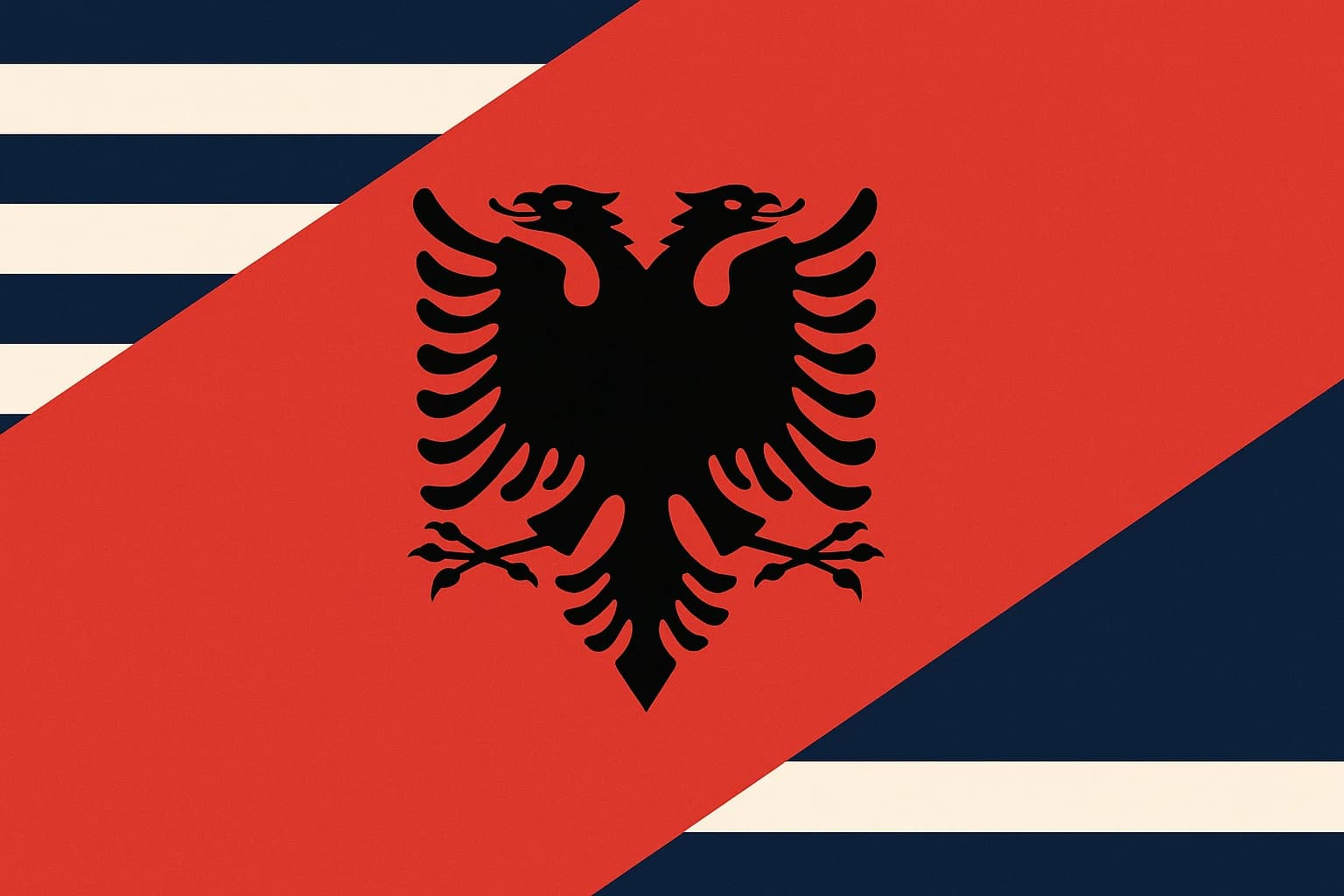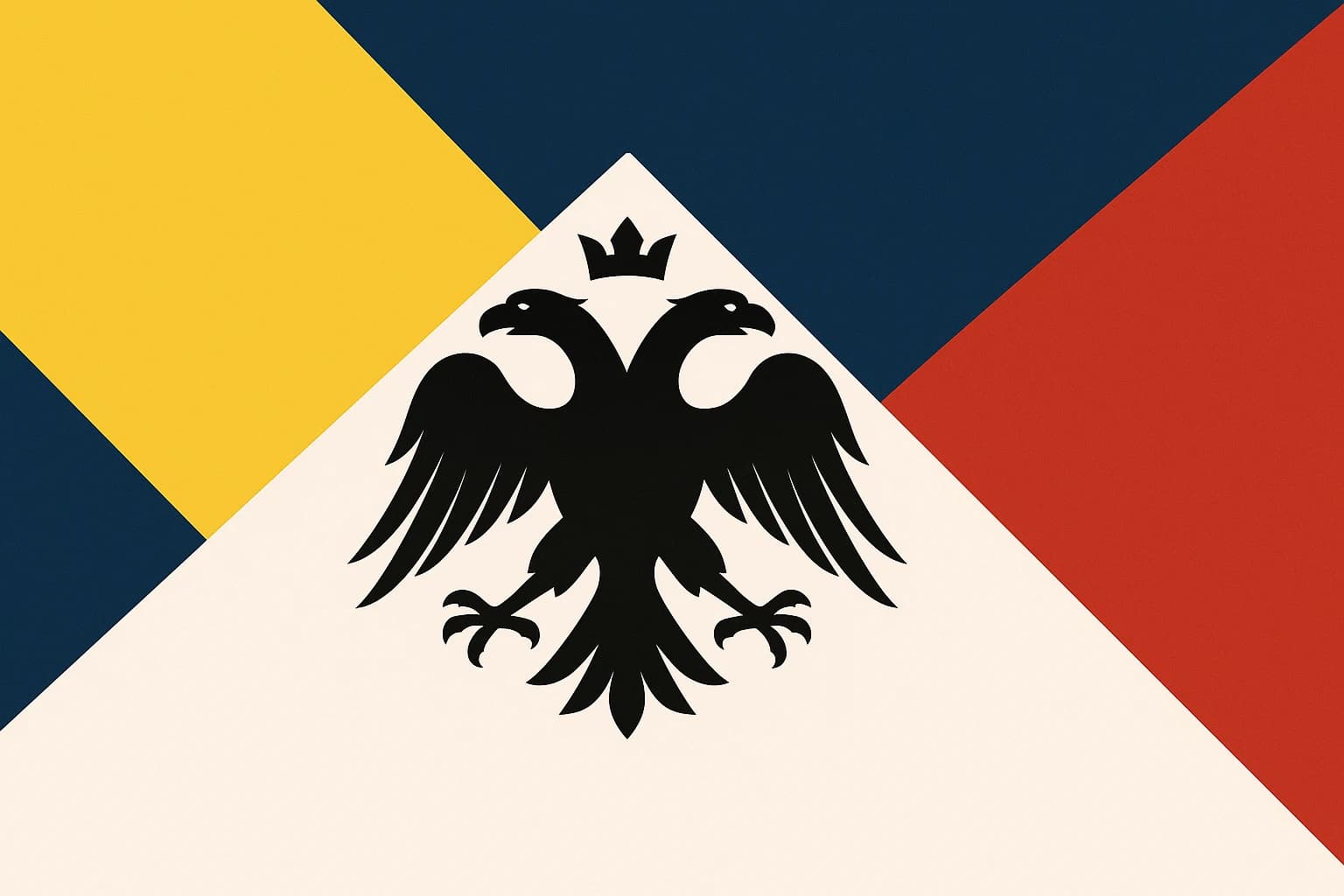
Spend an afternoon travelling around Europe and you can collect the same bird four times over. In Podgorica it flies above a government ministry on Montenegro's flag. An hour's flight south it stares down from an Albanian parliament building. In Belgrade it sits on a Serbian Orthodox church dome. In Vienna it is carved into the façade of a Habsburg-era café, faded but unmistakable. Four countries, four histories, one bird with two heads.
How does the same heraldic creature end up on the flag of a post-communist Balkan republic, the coat of arms of a NATO member, and the crumbling signage of a dissolved empire? Not by inheritance. The double-headed eagle has been taken, reinterpreted and washed clean of its previous political meaning, over and over, for more than three thousand years. The trail runs from Hittite Anatolia to the modern United Nations.
Before Byzantium the eagle already had two heads
Most people assume the double-headed eagle is a European symbol. It is not. The earliest known example comes from the Hittite Empire, carved into the ceremonial gates at Alacahöyük in central Anatolia, dating to roughly 1400-1200 BCE. That's more than two millennia before Byzantium existed. The bird appeared as a divine guardian, flanking religious gateways, watching over both the earthly and the sacred.
Then it vanishes from the record for centuries, only to resurface in a place that complicates every neat narrative about the eagle being "Christian" or "European." The Seljuk Sultanate of Rum, a Muslim Turkish dynasty ruling Anatolia in the 12th and 13th centuries, used the double-headed eagle on coins, palace tiles, and stonework across their capital at Konya. This was hundreds of years before the Romanov tsars would claim the symbol as an emblem of Orthodox Christendom.
What ties these early uses together is the bilateral symmetry. Two heads facing opposite directions communicated dominion in two directions and watchfulness over two realms, and none of that required a particular theology to decode. The meaning was legible before it was political.
That matters, because no single civilization invented the double-headed eagle. Any civilization that came along later could adopt it without appearing to steal from anyone in particular.
Byzantium codifies the eagle and ties it to empire
The Palaiologos dynasty is where the symbol becomes formal. When they restored Byzantine rule in 1261, reclaiming Constantinople from the Latin crusaders, they needed a symbol that argued for their legitimacy. They chose the double-headed eagle: gold on a black or sometimes deep red field, wings spread, both heads crowned.
For the first time the bird was systematically tied to a specific sovereign state, and the Palaiologoi did not treat it as decoration. In Byzantine court theology the two heads meant dominion over both East and West, the emperor as ruler of the secular world and protector of the sacred at once. It was a cosmological claim, carved into stone and stitched into fabric.
The visual template the Byzantines established, the spread wings, the twin crowns, the frontal heraldic posture, would be copied almost line-for-line by later empires. You see the family resemblance immediately when you compare Byzantine seals to Russian imperial standards or Habsburg coats of arms.
Byzantium also bequeathed something more dangerous than an image: an idea. The concept of Constantinople as the "Second Rome" (and later, Moscow as the "Third Rome") meant that adopting the eagle was not a fashion choice. It was a claim to Roman imperial succession. Whoever wore the eagle implicitly declared themselves heir to Rome itself.
Then, in 1453, Mehmed II conquered Constantinople and the empire vanished. The symbol started travelling outward immediately, carried by Byzantine exiles, Orthodox clergy, and ambitious monarchs watching from the edges of the old empire.
Ivan III's calculated adoption
That moment came in 1472, when Ivan III of Moscow married Sophia Palaiologina, niece of the last Byzantine emperor Constantine XI. The marriage was not romantic. It was a branding operation.
Ivan needed external legitimacy. He was consolidating power over rival Russian principalities, and a claim to Byzantine succession gave him something no military victory could: the appearance of ancient authority. The double-headed eagle was on his state seal by 1497, which is not a coincidence of timing.
Later Romanov tsars deepened the association. Peter the Great formalized the eagle in the imperial standard. By the 19th century the Russian coat of arms had the eagle festooned with shields for conquered territories from Poland to Siberia, turning a Byzantine religious emblem into a map of conquest with each shield pinned to the bird's chest like a trophy. The dynasty that built all of this was shot in a basement in Yekaterinburg in 1918.
Russia had taken the symbol from a civilization the Ottomans destroyed and used it to project an unbroken imperial lineage that never existed. The Romanovs were not Palaiologoi and Moscow was not Constantinople, but the eagle made the claim feel plausible.
The eagle of a nation that never had an empire
Albania's relationship with the double-headed eagle is unlike any other, because there the imperial symbol came to mean the opposite of imperial.
In the 15th century, Gjergj Kastrioti Skanderbeg, an Albanian nobleman and former Ottoman military commander, raised a red flag bearing a black double-headed eagle and led a Christian resistance against the Ottoman Empire. Skanderbeg had converted to Islam under Ottoman service, then reconverted to Christianity to lead his revolt. His use of the Byzantine eagle was a statement of civilizational allegiance rather than a dynastic claim, since he had a rebellion rather than an empire.
When Skanderbeg died in 1468, Albania had no independent state. It wouldn't have one for another 444 years. But the eagle survived, kept alive not by governments or armies, but by the Albanian diaspora. The Arbëreshë communities in southern Italy, descendants of Albanian refugees, preserved Skanderbeg's iconography through centuries of Ottoman rule. Orthodox and Catholic clergy carried the image forward in liturgical art and folk memory.
Then, in 1912, Ismail Qemali declared Albanian independence in Vlorë and raised the same black eagle on red. A 20th-century nation-state took an explicitly imperial heraldic form as its founding symbol and used it to declare survival.
Albania is where the eagle's meaning inverts completely. In Byzantium it meant empire; in Albania it meant resistance to empire. Four hundred years of stateless preservation did what no deliberate redesign could have, reversing the symbol's entire political charge.
The Habsburg variation: the eagle over bureaucracy
While Russia claimed the Byzantine lineage heading east, the Habsburgs claimed it heading west. As Holy Roman Emperors from the 15th century onward, the House of Habsburg adopted the double-headed eagle and made it something distinctly their own.
The Habsburg version was visually busier than its Byzantine ancestor. Each head received its own crown, plus a larger imperial crown hovering above both. The eagle clutched a sword and scepter. And on its chest, it bore the arms of a dozen constituent kingdoms, a heraldic spreadsheet of the empire's staggering complexity.
Two philosophies, one symbol. The Byzantine eagle was cosmological and claimed a divine mandate. The Habsburg eagle was administrative and claimed that all these different peoples belonged inside a single framework. It was a logo for a multinational bureaucracy rather than a divine mission.
When Austria-Hungary collapsed after the First World War in 1918, the new Austrian Republic stripped the eagle from official use. It did not disappear so much as transfer, like an heirloom out of a dissolved estate, into the coats of arms of successor states.
Austria's coat of arms today has a single-headed eagle. One head was deliberately removed, which leaves a permanent visible record of a political decision: keep the bird, shed the empire.
Montenegro and Serbia in the age of self-determination
Montenegro adopted its current flag in 2004, with a golden double-headed eagle on a red field, and declared independence from its union with Serbia in 2006.
Why would a 21st-century democracy, in the act of breaking away from a federated state, choose one of the oldest imperial symbols in European heraldry as its new national identity?
The answer lies in the Nemanjić dynasty. Medieval Serbian rulers used the double-headed eagle from the 13th century onward, drawing on Byzantine influence through the Orthodox Church and royal intermarriages. Montenegro's use of the eagle taps into this local medieval precedent, bypassing the Russian and Habsburg versions entirely. It says: our history predates the federation we're leaving.
Serbia's coat of arms has the double-headed eagle too. Two independent nations that once shared a state now claim the same symbol through different but overlapping lineages, and they are not arguing about who owns the eagle so much as telling different stories about what it means.
That is what the symbol does for modern states. It supplies ancient legitimacy on demand, working less as imperial nostalgia than as a credential borrowed from history to show that a young country has old roots.
How the eagle survived
Every adoption of the double-headed eagle, from the Hittites to modern Montenegro, involves the same move: claiming continuity with a prestigious past whether or not that continuity is real.
Call it heraldic laundering. Each new user erased the previous user's specific ideology and kept the vague prestige. Russia erased the Hittite and Seljuk associations. Albania erased the Russian imperial meaning. Montenegro erased neither and synthesized both. Every handoff cleaned the symbol for its next owner.
Which suggests something about how symbols work in general. They do not carry fixed meanings; they carry accumulated authority. A symbol that has appeared on enough flags, coins and gates across enough centuries becomes self-legitimizing. The double-headed eagle means authority because it has always meant authority, whoever happened to hold it.
In 2026, at least nine sovereign nations and territories use the double-headed eagle in their official state symbols. Each would give you a different account of what it stands for. The Byzantine emperors who codified it are gone, the Romanovs who borrowed its prestige are gone, and the Habsburg Empire broke into a dozen nation-states, but the bird is still on the wall of a Viennese café and still above a Montenegrin ministry, heads pointing in opposite directions.